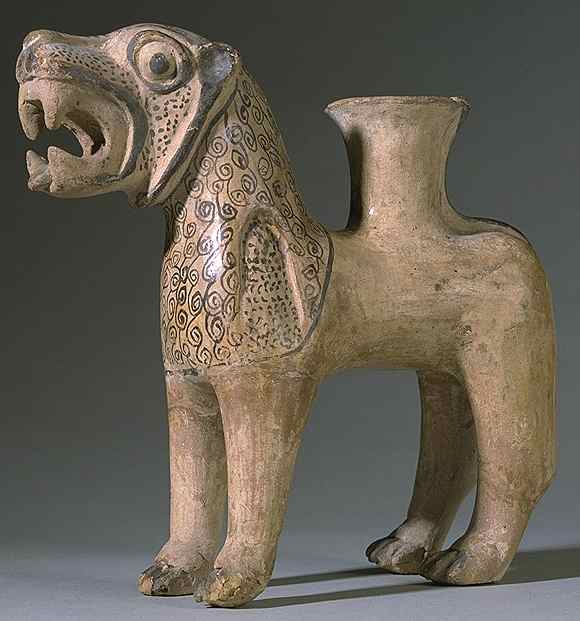
(Click above For Larger Image)
- Alpha to Omega
At approximately 5600 BC we know that in the
the center of the region of Anatolia there was already civilization in
the form of town dwelling farmers and shepherds. These people not only
were known to have ongoing agriculture, pottery and arts, trade with outlying
areas and metal manufacturing, they were keeping sheep, goats, and dogs
which moved to outlying areas for improved grazing and brought in for trading
and slaughter. Over the passage of time these same patterns were established
in other areas as trade and the need for more and better agricultural land
was realized.
As distinct races and groups in the area emerged
and new governments formed the spread of these people became significant.
We know that names of people and towns derived from the Luvians, from the
southwestern regions of Anatolia, not only spread throughout Anatolia,
then Greece but as far away as Italy and the Balkans. This lay a foundation
of relations by the exodus from Anatolia and the exchange and development
of new ideas and methods from Anatolia as the better known Civilizations
such as the Hittites and Hellenes developed.
About 2000 BC we saw the onset of the LGD
in addition to the hunting dogs. Art from the Hyricians in this era shows
large dogs which resemble the LGDs and and approximately at this time we
have written reference of dogs living with the flocks. It is my theory
that by selective breeding and/or rare non-lethal mutation the giant breeds
were formed and put into service to protect the flocks from large predators.
With the further emergence of civilizations it is natural that further
migrations and familial exchanges would spread progressive ideas and practices
along the established path that the Luvians had begun. It is
believed that dogs were already in use to some extent with the flocks,
but with dependence of people on their flocks and with large predators
in abundance, the giants would have been welcomed by all.
The use of the livestock guardians was established
across Asia and parts of southern Europe by 1500 BC. Prior to this time
migrations were relatively peaceful. However war was inevitable and
political segregation was to follow. The onset of great wars would segregate
the shepherds to a great extent and although trade thrived which further
spread the LGDs into Europe, the segregation of people would have allowed
the emergence of diverse philosophies of what represented the most desired
characteristics of LGDs within a given geographical area. By the birth
of Christ the LGDs were moving northward in Europe.
After this point in time the trading and military
movement became the greater influence of the exchange of dogs. This continued
to be true until modern times. However the basic gene pool for all LGDs
was set and refinement was to follow in European LGDs. The Asian dogs took
a much slower course in evolution.
Space will not allow exploration of the formation
of numerous LGD breeds so with the foundation laid for the spread of livestock
guardians, I will direct your attention back to the LGDs to
later become known as the Anatolian Shepherd Dog. We have little documentation
specific to the LGD but it is accepted that formal pedigrees were not a
part of LGD breeding programs until modern times even though the people
of Anatolia and all of the Islam nations knew of and used pedigrees in
sophisticated breeding programs of domestic animals. However the shepherds
made do without such records and based breeding more in line with natural
selection. Those dogs best suited to the job and the environment were bred.
The best survived. This process continued until modern times with little
documented history to guide us as to the specifics. We can surmise by observation
that along with the requisites of a guardian, i.e. size, speed, endurance,
and a conservative metabolism, that even while selective breeding such
as in Greece for white guardians, in Anatolia the environment was varied
enough to make survival in diverse climates and terrain of greater importance
than coat colors. Genetic dominants do exist but enough variation has been
needed that coat lengths must have been allowed to differ and color selection
irrelevant.
The most notable exception to the slow progression
based on utility was inadvertently caused by
fluctuations of the government of Attaturk as it built an independent
nation. In the 1920's as Turkey emerged, the nation made an exchange of
populations with Greece, Crete and Cypress. As background, large populations
of people of each heritage were inconveniently living in the wrong places
when the new government emerged. Many Greek people were reunited
with the Nation of Greece and of course the Turks went to Turkey.
These Turks included shepherds and they brought back their flocks
and of our special interest, their dogs. By this time the white guardian
dogs were well entrenched as the favored LGDs of Greece. As you might imagine
the Turks who had live with the influence of the Greek shepherds would
have used the white dogs of the region.
This movement of people to Turkey is what
probably gave rise to to a limited gene pool of white dogs in Turkey. Thus
we have a population of what might have been what some now call the Akbash.
Of course these people would have been slow to give up the practice of
breeding white dogs but their gene pool would have been easily overwhelmed
by the native dogs. This could well have been categorized as a separate
breed though founded in Greece. As a note of interest, I have confirmed
that the word "kangal" is a Greek word meaning "coil". This may actually
have given rise to the designation of the Greek dogs with the coiled tail.
Thus the kangal dog designation may have, much to the embarrassment of
the historical revisionists, have actually been the Greek dogs with the
coiled tails. Of course of much greater embarrassment would be that those
kangal dogs were most probably white.
The migration these dogs of Greek origin became
diluted with the gene pool of the native Turkish dogs of which there is
no evidence of purposeful color separation. In fairness regional tendencies
did exist due to limited interaction of gene pools but homogenous gene
pools do not exist. Genetic dominance with modifiers remains the rule.
Thus the white dogs we now know as Akbash might once have been genetically
separated from the Turkish dogs but are now integrated with the greater
gene pool. The Turkish population of white dogs is almost gone. Those remaining
show marked similarity to the non-white dogs. The coil dog designation
has been appropriated by those seeking to create a new breed. And the new
name of Akbash came into being as a joking exchange between an American
an a British citizen while discussing the dogs they had come to admire
in Turkey.
This is a very succinct representation of
over 3000 years of history of our dogs. Very little would change from the
dawn of civilization up until the present. A dog that would work faithfully
and effectively was the demand made upon it by man. Nature was more exacting
upon the evolution of this dog and created what is currently a supreme
creature. However little did nature prepare this previously indestructible
dog to face its greatest challenge in its fight for survival ... You and
me.
In modern times with the people's greater
access to transportation and lesser perceived need for dogs that actually
work, our dogs have come into danger. More has happened in the past twenty
years to challenge our cherished companions than in the previous 3000 years.
All in all that leads us to ponder the fate of our beloved Turkish dogs
with the new millennium upon us. These dogs that we so admire have had
thousands of years to not only be the foundation of the entire population
of giant breeds and LGDs but have evolved in their own right as one of
the most outstanding canines on this planet. With these events so fresh
in our memory I will forego the sermon I envision as needed to preserve
our dogs, but with this small representation of history showing that change
is best achieved slowly (if at all), I remind each of you that if events
proceed unchecked, our beloved dogs, regardless of what we care to call
them will be destroyed. As history shows us over and over, humans can destroy
what we cherish much quicker than we or nature can create it.
Some comment is in order subsequent to questions of readers.
Indeed kangal is the Greek word for coil. There are many words from
other lands in use in Turkey.
I have noticed that Peter Wells covers the Kangal family name on his
web page at Anatolian
Shepherd Dogs: Breed Notes, by Peter Wells . All of his articles are
well worth your attention.
Comments from British and a few American sailors confirm the migration
of many shepherds and their
flocks from other areas into Turkey. However the comments came as more
of a complaint than as folklore. The sailors had to load small flocks of
sheep on small ships that were not much larger than American PT Boats.
During transport the not only were the sheep restless but on initial trips
the dogs were actually moving freely among the sheep and of course challenging
the sailors. These sailors quickly learned thattying up the dogs was the
healthiest course of action. The biggest complaint was obviously regardingcleaning
up the mess after the flocks were offloaded.
Of course it would make more sense for the sheep to be sold and replacements
bought where the shepherds settled. However my guess is that since this
was planned and executed under government control, that government employees
are the same worldwide. Thus the obvious eluded them.
This an edited version of this article first appeared in Gatekeeper, the magazine of United Anatolian Guardians. Please visit this group at Anatolian Shepherd Dogs - United Anatolian Guardians .
Copyright 1999 By K.Hamlett. All rights are reserved. Reproduction in
whole or in part by any means is expressly prohibited unless written permission
is obtained from the author.