The
following material is an adaptation of mecha designed by SpyHawk for use in the realm of
MACROSS 7, a sequel to the original Japanese MACROSS
TV series (which became Robotech here in the U.S.). Please feel free to use,
copy, and distribute it as you see fit. All I ask is that you give proper credit
to me and do not claim that it is your own work. Comments and suggestions are
welcome.
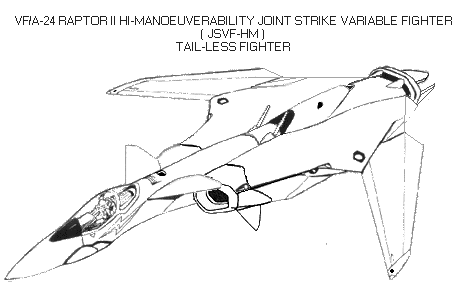
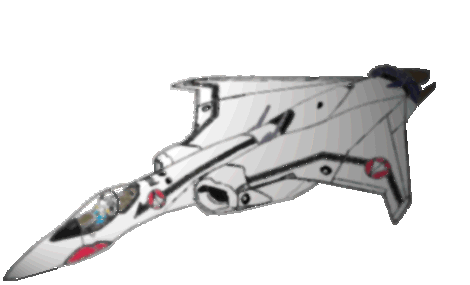
VF/A-24 "RAPTOR II"
HI-MANOEUVERABILITY JOINT STRIKE VARIABLE FIGHTER
( JSVF-HM )
RPG Stats, and customized art by SpyHawk ([email protected])
Layout style and background adapted from Dave Deitrich ([email protected])
BACKGROUND
When the Super Nova project concluded, and the YF-19 was
declared winner, no one ever dreamed the project would end up being so
expensive. With numerous cost over runs and delays ( wich cost even more ), the
project faced severe limitations on procurement and deployement. Just a few
years after the "Blazer/Excallibur" went into IOC the need was seen
for a low cost alternative. As many branches of the New Unity Armed Forces were
faced with increasing accident rates due the age and wear of their existing
Valkyries, a new "Joint Services" program was initiated to provide a
fighter more inline with the philosophy that produced the VF-11 than that wich
produced the VF-19. At first anyway. But as with many great designs the
"Joint Attack Valkyrie Advancement-Light Normalized," or
"JAVALiN" as it became known, was transformed into a new and awsome
platform. Hense the "Hi-Manoeuverability Joint Strike Variable
Fighter," or JSVF-HM was borne.
Dubbed the "Raptor II," after the winner of the first real advanced
fighter project, the ATF program of the United States. This fighter was a marval
of modern program management techniques and AI aided and simulated developement.
After only two squadrons were fully equiped with the fighter, a new and greatly
enhanced ( and even lighter and CHEAPER!! ) variant was developed. This new
tail-less design was created based on UAV data collected over the years and
evaluated, which proved that with the aid of three-dimentional thrust vectoring,
a FULLY tailess aircraft was possible. If it was well ballanced.
For this project, the old competitors Shinsei Industries and General Galaxy
teamed up against newer competitors, and created a lightweight fighter that
combined many elements of the lessons learned from the Super Nova project.
Including the 3-d vectored thrust and the main weapons systems of the VF-22, and
many advanced aerodynamic and reactional techniques developed on the M7's Kai
Valkyrie, and with contributions by Bofors, in their first forray into fighter
design ( although a minor partner ).
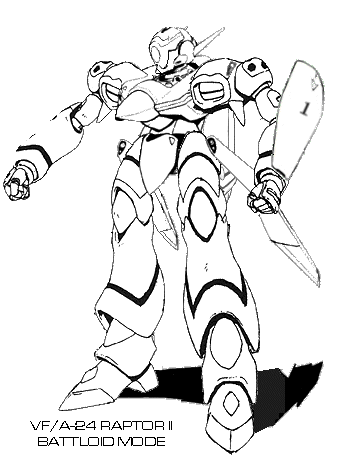
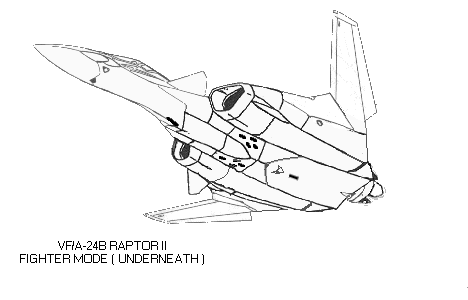
TRANSFORMATION NOTES: In fighter mode the arms and legs are stored in
a maner almost identical to that of the old VF-1's. The feet angle out and fold
flat against the main engine necelle. The feet can open up to function as an
air-brake when operating in an atmosphere, or to expose the secondary leg
thrusters for use in space ( in an atmosphere the drag would cancel out the
extra thrust ). The nose/main fusalage from the head forward transform
identically as they do in the VF-19. The missile launchers on the shoulders are
exposed ( more or less ) in front of the rest of the arms, which are concealed
by the shield and extended leg panels ( wich lock into the shield ) , this is
designed to reduce the radar returns of the Valkyrie should the Active Stealth
System fail. The main engine necelle remains in place, and is the corner stone
of the process ( since it is the single component of greatest mass ). The
necelle has an air intake that is exposed ( but louvered to allow either
water/air-tightness or unrestricted flow ) at top in battloid mode, and normally
concealed in fighter mode, fed via the cooling/mainflow intakes that disengage
from the engine in battloid mode to form the "pectoral regoin" of the
battoid. In that mode they still function as cooling intakes however. The broad
shouldered stance allows the optional FAST Pack units ( see below under weapons:
Universal FAST Pack Adapter ) to rotate around backwards ( port unit then
starboard unit in rapid succession--otherwise they would collide into each other
as they are canted out at 45 degrees )and under to face the missile launchers or
sound boosters forward, under the intakes.
RPG STATS
- Vehicle Type:
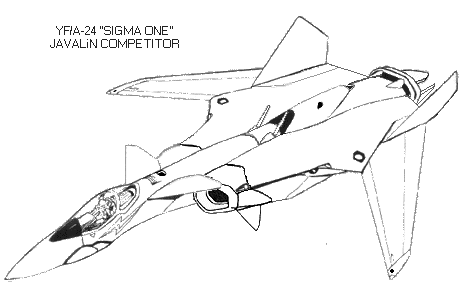
- YF-24 (Prototype, Project White Dwarf, full tail )
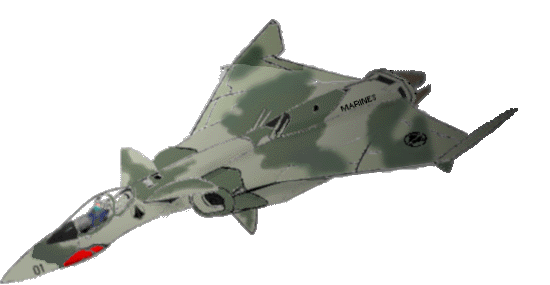
- VF/A-24A Raptor II ( UNAF/N variant--tail-less FSW/canard layaout )
- VF/A-24MJ/S Raptor II ( UNSM variant--tail-less delta, two -J- or four
-S- head lasers )
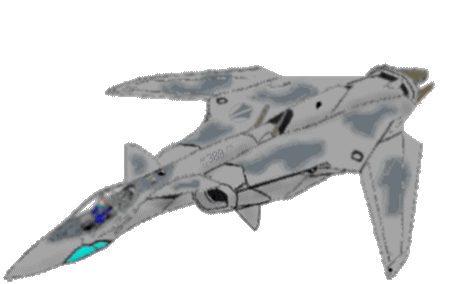
- VF/A-24SF/S Raptor II ( UN Spacy/UNSAF variant--tail-less semidelta/FSW
hybrid layout fighter, no canards but has added verniers, two -J- or four -S-
head lasers )
- VF-24-X-1 Raptor II ( tail-less delta fighter, SES equiped and sound
booster capable *under developement* )
- Class: Advanced Variable Fighter
Manufacturer: Shinsei
Industries/General Galaxy
Crew: One pilot wearing customized
Tactical Life Support System.
MDC BY LOCATION:
|
Head Pulse Lasers (2-4) |
15 |
each |
| (1) |
Head |
100 |
|
Hands (2) |
50 |
each |
|
Arms (2) |
125 |
each |
|
Shoulders (2) |
100 |
each |
|
Thrusters (2) |
165 |
each |
| (2) |
Main Body |
325 |
|
Main Wings (2) |
150 |
each |
|
Tails/Canards (2/2) |
75 |
each |
|
Stealth Gun Pod |
120 |
| (3) |
Pinpoint Barrier Shield |
100 |
|
Light Anti-Projectile Shield |
125 |
|
Reinforced Pilot Compartment/Escape Pod |
150 |
| (4) |
External Fold Generator (1, optional) |
100 |
each |
NOTES:
- Destroying the head of the VF/A-24 will knock out the mecha's main sensor
systems, including all of the optics systems (infrared, nightvision, thermal).
Backup sensor systems will provide standard vision for the pilot in soldier
mode. Radar and communications will be unaffected.
- Depleting the MDC of the main body will destroy the mecha. The pilot and
cockpit section/escape pod will be automatically ejected from the doomed mecha
before it explodes by the VF/A-24's main computer.
- The pinpoint barrier shield regenerates at a rate of 50 MDC per round.
Even if completely destroyed the shield will regenerate to full strength
within 2 melee rounds. The shield is usually generated on the right or left
arm of the Raptor II.
- The External Fold Generator will become non-functional after taking only
25 points of damage. However, the unit can still be repaired. If the generator
takes a full 100 points of damage, it is destroyed beyond any hope of repair.
SPEEDS:
- RUNNING, SOLDIER CONFIGURATION:
- 110 mph (192 kmph)
- LEAPING, SOLDIER CONFIGURATION:
- 50 ft (15 m) high or 70 ft (21 m) long without thrusters.
- FLYING, GERWALK/SOLDIER CONFIGURATION:
- Mach One (670 mph/1072 kmph) maximum speed limit in an Earth-like
atmosphere. Can also hover in place indefinitely.
- FLYING, FIGHTER CONFIGURATION:
- *Highly classified*, "slightly less
than the VF-22." Cruising speed is usually Mach 5. The VF/A-24 can vary
the configuration of its wings and control surfaces to provide greater speed
or control as the situation requires. The Raptor II is capable of achieving
orbit over an Earth-class planet without additional rocket assistance. Maximum
rate of ascent is "around 62,000 meters/minute." G limits are
"greater than +60.0 to -45.0 Earth gravities."
- MAX ENGINE THRUST:
- 68,500 kg in an atmosphere, 78,950 kg in space. The maximum thrust is
automatically limited in an atmosphere due to coolant problems with the
optional air intake systems for the engines..
STATISTICAL DATA:
- HEIGHT:
- Classified, "shorter than an AVF."
- WIDTH:
- Classified, "less than an AVF.".
- LENGTH:
- Classified, "less than an AVF."
- WEIGHT:
- Classified, "less than an AVF,"
maximum weight in space with optional fold booster is 48,305 kg (weights
beyond that exceed theoretical safe limit for fold booster).
- PHYSICAL STRENGTH:
- Equal to a P.S. of 60
- CARGO:
- Small compartment behind pilot's seat for personal belongings.
- POWER PLANT:
- One 72,500 kg Shinnakasu Industry/Pratt & Whitney/Rolls Royce FF-2550F
thermonuclear turbine engines, designed for dual atmosphere/space use with
optional concealed trapezoidal air intakes for use in an Earth-type
atmosphere. One 3-dimensional independentent convergent/divergent exhaust are
equipped on the FF-2550F for greater maneuverability and V/STOL performance.
In addition, many Pratt & Whitney HMM-6J high-maneuverability vernier
thrusters are mounted on the wingtips, vertical stabilizers, nose, and other
key locations for added performance. Additional thruster options include an
external fold generator developed for use with Project Super
Nova.
WEAPON SYSTEMS:
- ANTI-AIRCRAFT HEAD LASERS: The Raptor II mounts two( standard and J
models ) to four ( S models )anti-aircraft lasers on its head, very similar to
those originally found on the older VF-1 Valkyrie design. These lasers are
designed for use in air combat skirmishes but are mostly used for defensive
purposes. Due to the placement of the head in fighter and gerwalk modes the
lasers can only be fired rearward. In addition to their use as weapons, the
lasers can also generate a continuous beam useful for cutting.
- PRIMARY PURPOSE: Defense
- SECONDARY PURPOSE: Anti-aircraft
- RANGE: 4000 feet (1200 m)
- DAMAGE: 1D6 M.D. per laser; 2D6 M.D. dual fire.
- RATE OF FIRE: The lasers can be fired in rapid pulses up to 4
blasts per round. In addition, the lasers can all be fired as one continuous
beam for double damage. This takes up all the Raptor II's attacks for the
melee round and cannot be used against moving targets.
- PAYLOAD: Effectively Unlimited.
- MAULER REB-23 LASER GUNS: Two semi-fixed laser guns are mounted in
the wings of the VF/A-24, near the base of the wing where it connects to the
main body. These lasers can be fired in any mode (the beams exit the
hip-mounted wing units in soldier mode) but can only be aimed along the front
arc of the mecha (max angle is about 45 degrees in any direction from the
nose).
- PRIMARY PURPOSE: Anti-mecha
- SECONDARY PURPOSE: Air-to-ground strafing runs
- RANGE: 4000 feet (1200 m)
- DAMAGE: 1D4x10 M.D. per laser.
- RATE OF FIRE: The laser can be fired in rapid pulses up to 4
blasts per round. A rapid fire blast counts as a burst of up to 4 shots.
- PAYLOAD: Effectively Unlimited.
- BIFORS BML-02S ALL-ENVIRONMENT RAPID-FIRE MICRO-MISSILE CLUSTERS:
The VF/A-24 is armed with eight internal BML-02S missile launchers that were
designed for the General Galaxy VF-22. The launchers are mounted in the
forward ventral sections of the craft. Any type of UN Spacy mini-missiles
can be used by the launchers, including the high-maneuverability
mini-missiles recently developed by the UN Spacy. Armor-piercing MMs are
standard issue, however. Although the Raptor II has eight missile launchers
they all feed from the same missile bay. Therefore the total number of
missiles carried is available should any launcher ( or shoulder ) be disabled.
- PRIMARY PURPOSE: Assault
- MISSILE TYPES: Any type of UN Spacy Mini
Missile, including the new High
Maneuverability Mini Missiles (HMMMs).
- RANGE: Varies with missile type, typically 1 miles (1.6 km).
- DAMAGE: Varies with missile type, typically 1D4x10 M.D.
- RATE OF FIRE: Volleys of 1-8 missiles. The rate of fire of the
BML-02S launcher is equal to the pilot's combined number of attacks; and the
pilot can fire all of his missiles in a single round if he has six or more
attacks.
- PAYLOAD: 4 missiles per launcher; 32 missiles total.
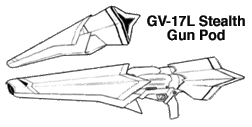
- HOWARD/GENERAL DYNAMICS GV-17L GUN PODS: For a main external
weapon, the VF/A-24 contains the new stealth gatling gun pod produced by
Howard Industries and General Galaxy. These gun pods are the same as the ones
used for the VF-22 and are mounted in a specially designed storage bay located
on the underside centerline of the craft in fighter mode, similar to the
gatling gun used by the VF-17 Nightmare. In Gerwalk or Soldier modes the gun
pod can be ejected from it's bays and used by one or both of the VF-22's
hands. The gun pod can fire in any mode; it fires out of a special concealed
port when stored in Fighter mode.
Like the original GU-11 gun pod used by the VF-1 Valkyries, the GV-17L gun
pod does NOT use clips of ammo, but instead have a large internal supply of
ammo stored in the barrel of the pod. This allows the GV-17L to contain a
larger supply of ammo and bypasses the need to reload while in the field. Once
exhausted, the gun pod can only be reloaded by trained technicians at a supply
base.
- PRIMARY PURPOSE: Assault
- SECONDARY PURPOSE: Anti-mecha
- RANGE: 4000 feet (1200 m)
- DAMAGE: Does 4D6 M.D. for a short burst, 1D6x10 M.D. for a long
burst, or 2D6x10 M.D. for a full melee burst.
- RATE OF FIRE: Equal to the number of combined attacks of the
pilot.
- PAYLOAD: 800 rounds, equal to 80 short bursts, 40 long bursts, or
20 full melee bursts. Once depleted, the gun must be reloaded by a service
technician at a UN Spacy base or starship.
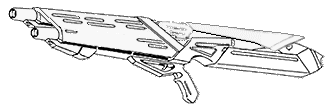
- OPTIONAL
XGU-117 COAXIAL GUNPOD
- UNIVERSAL FAST PACK ADAPTER: A 2-pack MER style adapter has been
developed for the VF/A-24. This special adapter was designed to allow the
fitting of the various booster/missile launcher packs and sound boosters
already in use by VF-11's and VF-19's. The adapter mounts on the top of the
main engine necelle, and has the hardpoints angled out at 45 degrees, so that
the packs designed for larger mecha will fit.
A companion adapter for the
legs can be fiited. It too is angled at 45 degrees forward. This is to allow
the leg units to be used without interfering with the transformation process.
This contoured unit has adjustable mounting lugs that must be set for the leg
unit to be mated with.
NOTE: Use of the VF-11 FAST Packs, that were not designed to
interface with the Active Stealth System, will result in the lowering of the
Active Stealth System's initiative bonus by 2. IE: +1 init, +1 strike, instead
of +3 init, +1 strike.
- WING HARD POINTS: The VF/A-24 has four( six on MJ and MS models )
fixed hard points (two per wing) which can be used to hold a variety of
different ordinance payloads, including long ,medium, or short range missiles,
or even the new medium-range high-maneuverability (MRHM) missiles. One
long range, one MRHM, 3 medium range, or 5 short range missiles can be mounted
per hardpoint. A variety of other hardpoint stores can also be fitted, like
ECM pods, Chaff/Flare pods, Sensor pods, or a large variety of bomb loads.
Usually long range, medium range, or MRHM missiles are used.
NOTE: Due to the location of the hard points, ALL missiles must be
fired or ejected before the VF/A-24 can convert into battloid mode. For this
reason the missiles mounted on the hard points are usually fired within the
first few passes of an attack.
- HOWARD PBS-03F PIN-POINT BARRIER SYSTEM: The VF/A-24 is equipped
with a new mecha-scale pinpoint barrier system for defense. The system can
generate a single pinpoint barrier that can be moved anywhere on the mecha and
used as a shield against incoming attacks. The barrier provides 100 MDC of
protection, and regenerates at a rate of 50 MDC per round when damaged. Even
if destroyed by combined attacks, the shield will regenerate itself within 2
rounds. In order to use the shield, the pilot must make a successful parry
roll to intercept an incoming attack. Due to the tremendous power requirements
of the system, the head and wing lasers on the VF/A-24 cannot be used while
the barrier is in operation.
- Primary Purpose: Defense
- Protection: 100 MDC total
- Regeneration Rate: 50 MDC per round.
- Size: The barrier can be up to 10 ft (3 m) in diameter.
- Duration: Unlimited.
- HAND TO HAND COMBAT: If necessary, the VF/A-24 can engage in melee
combat rather than use a weapon. The valkyrie is extremely agile and can
execute most typical hand to hand combat moves, such as punches, jump kicks,
leap attacks, rolling with impacts, etc.
DAMAGE:
- Restrained Punch: 1D6 M.D.
- Full Strength Punch: 3D6 M.D.
- "Booster" Punch: 4D6 M.D. (counts as two attacks)
- Tear or Pry with Hands: 2D4 M.D.
- Kick: 2D4 M.D.
- Leap Kick: 3D6 M.D.
- Body Flip/Throw: 1D6 M.D.
- Body Block/Tackle: 2D6 M.D.
- Stomp: 2D6 M.D. (only effective against small objects)
STANDARD EQUIPMENT FOR THE VF/A-24:
- ACTIVE AERODYNAMIC CONTROL SYSTEM: The Active Aerodynamic
Control System is partly responsible for the mecha's high fighter mode dodge
bonus. The new feature, pioneered by the Project Super Nova, constantly
monitors the Valkyrie's position inside it's flight envelope, and makes
changes to the sweep, and to some extent the shape, of the control surfaces as
deemed necessary by the highly advanced flight control computer.
- VF-19M STYLE OPTICS: The Raptor II utlilzes the optics system
developed for the Marine Blazer. It has a large "fly-eye" digital
composite camera array ( DCCA ) in the head that produces extremely high
resolution stereoscopic images for 3d rendering in the vertual cockpit or
later for analysis and BDA. The many cameras integrate their images with a
special computer subprocessor made by Matrox-Honeywell.
- VIRTUAL ENVIRONMENT COCKPIT: The VF/A-24 is equipped with the
innovative new cockpit layout pioneered by the YF-19 that provides monitors
below and around the pilot in addition to the HUD cockpit dome. In flight,
these monitors display what is below and behind the aircraft, giving the pilot
a tremendous field of view that is unparalled by any other aircraft (with the
possible exception of the YF-21's brain-direct
imaging system). This wide view in addition to the combat computer's cockpit
overlays give the VF/A-24 a +1 to dodge and initiative rolls in addition to
any other bonuses.
- ACTIVE STEALTH SYSTEM: The VF/A-24 is equipped with a revolutionary
stealth system that when activated renders the craft almost invisible to
standard sensors such as radar. Unlike passive stealth systems like those used
by the VF-17 Nightmare or the old USAF F-117, the VF/A-24's stealth system is
an ACTIVE stealth that actually bends radar waves around the mecha rather than
reflecting them. When activated, this system gives the VF/A-24 a +3 on
initiative and a +1 to strike at all times.
NOTE: Since the VF/A-24's stealth capability is a system and not a feature
of the design, it can be damaged or destroyed. Once the mecha has lost half of
its main body MDC, there is a 50% chance that the stealth system will fail
every time the main body of the craft is hit. Once the stealth system has
failed, it will not work again until repaired at a UN Spacy base.
- AUTO-PILOT: The VF/A-24 is equipped with a computerized auto-pilot,
allowing the pilot to relax or even sleep during long voyages. The auto- pilot
can be programmed with a single destination or a complex flight plan involving
multiple speeds, directions, and destinations. The onboard computer will alert
the pilot when the fighter is near its destination, and can also be set to
automatically signal when sensors detect objects near the mecha. The
auto-pilot was designed with long intra-system space journeys in mind.
- COMBAT COMPUTER: The VF/A-24 is equipped with a combat computer
that can store and analyze data during combat with hostile forces. Data
collected by the combat computer can be viewed by the pilot either on standard
HUD displays included in the cockpit viewports or on cockpit video monitors,
allowing the computer to display large amounts of data to the pilot and even
highlight enemies and missile attacks with overlaid graphics. The combat
computer tracks and identifies specific enemy targets, and has a database of
over 10,000 images stored in memory. The computer can identify and track up to
250 targets simultaneously.
- ESCAPE POD: The entire reinforced cockpit of the VF/A-24 is a
detachable escape pod that can be jettisoned when the mecha is destroyed. The
ejected cockpit does not contain thrusters, but does contain a powerful
locator beacon and an integrated life support system that can support the
pilot for up to 24 hours after ejection. The pod is also equipped with
parachutes in case of ejection in an atmosphere. The combat computer is
programmed to automatically eject the escape pod if the mecha is destroyed
(main body MDC reduced to 0), but this can be overridden if the pilot is
feeling suicidal for some reason.
- EXTERNAL AUDIO PICKUP: Range: 300 ft (91.5 m). A sound
amplification system that can pick up normal conversation up to 300 feet away.
- HEAT AND RADIATION SHIELDS: Special shielding prevents the
penetration of life threatening head and radiation. A radiation detection and
alarm system are linked with the shields and will sound an alarm if there is a
rupture in the shields and what the levels of radiation are.
- HOMING SIGNAL: The escape pod of the VF/A-24 is equipped with a
homing device that enables rescue teams to locate a disabled craft or ejected
life pod. The range of the signal is 400 miles (640 km). Most valkyries and UN
Spacy ships can key on and track/locate specific signals, and the onboard
computers will automatically notify their pilots if such a signal is detected.
- LASER TARGETING SYSTEM: Range: 100 miles (160 km). Used for
increased accuracy in the striking of enemy targets and is partly responsible
for the mecha's strike bonus.
- LOUDSPEAKER: A loudspeaker system is built into the craft, which
can be used to amplify the pilot's voice up to 90 decibels.
- OPTICS: INFRARED: Range: 2000 feet (610 m). This optical system
projects a beam of infrared light that is invisible to the normal eye, but
detectable by the mecha's sensors. The system allows the pilot to detect
hidden/concealed objects by their IR reflectiveness. The beam will be visible
to anyone with IR sensitive optics, however.
- OPTICS: NIGHTVISION: Range: 2000 feet (610 m). A passive light
image intensifier that emits no light of its own, but relies on ambient light
which is electronically amplified to produce a visible picture.
- OPTICS: THERMAL IMAGER: Range: 2000 feet (610 m). A passive optical
heat sensor that detects infrared radiation projected by warm objects and
converts that data into a false-color visible image. The system enables the
pilot to see in the dark, in shadows, and through smoke, and also adds a +10%
bonus to pilots using a tracking skill.
- PILOT FLIGHT SUIT AND HMD HELMET: The VF/A-24 comes with a
custom-designed flight suit for the pilot instead of the standard UN
Spacy-issue design used by most Valkyries. This flight suit consists of an
upper and lower g-suit that promotes circulation even during high-g turns,
thus decreasing the possibility of pilot's blacking out in combat. The flight
suit also comes with a specialized HMD helmet which can display computer
graphics and overlays over what the pilot sees, providing additional
information. The one disadvantage of the flight suit is that it is customized
for the VF-22 and VF/A-24 and is NOT usable in other aircraft.
- RADAR: 200 mile (321 km) range.
- RADIO/VIDEO COMMUNICATION: Long range, directional communications
system with satellite relay capabilities. Range: 600 miles (960 km) or can be
boosted indefinitely via satellite relay.
- SELF-DESTRUCT: To prevent capture of a Valkyrie fighter by the
enemy, the pilot can activate the VF/A-24's self-destruct system, which will
cause the fighter to explode after a delay of up to 60 minutes (time is set by
the pilot). The explosive damage is contained within a 20 foot (6 m) area and
inflicts 1D6x10 M.D. to everything within the radius of the explosion. All
internal systems are obliterated. The escape pod will be automatically ejected
prior to the explosion unless the pilot overrides the ejection sequence.
- STANDARD SURVIVAL KIT: All valkyries come equipped with a portable
survival kit. Inside the small reinforced box is a medium-sized flashlight,
two hand flares, one rocket flare, a compass, infrared distancing binoculars,
a small mirror, a pocket knife, dehydrated and concentrated food (can be
stretched into a five day supply for one person) and basic first aid items
(aspirin, bandages, disinfectants, etc.)
- TACTICAL LIFE SUPPORT SYSTEM: The VF/A-24's cockpit is pressurized,
and also provides additional air feeds to the pilot's flight suit that
provides him with pressurized breathing.
COMBAT BONUSES FOR VF/A-24 RAPTOR II FIGHTER TRAINING:
NOTE: One of the primary criteria for the JSVF program was
comonality for all versions, and to utilize as much pre-existing technology as
possible in order to minimize developement costs and transition time for crews
and support personel moving up to the new VF. Because of this, any pilot
trained in the VF-19, or VF-22 can fly the Raptor II with full bonuses.
Likewise, any pilot trained on the VF/A-24 can fly the VF-19 or VF-22 (
however a VF-22 pilot cannot jump into a VF-19 and expect to be an instant
expert ).Pilots flying the VF/A-24 Raptor II without training for the VF/A-24,
VF-19, or VF-22 only get bonuses from Basic Valkyrie Combat
Training.
BASIC VALKYRIE COMBAT TRAINING
- Basic training for non-pilot military personnel.
- 2 attacks per melee (plus those of the pilot).
- Add one additional action/attack at levels three, nine, and fifteen.
- +2 on initiative--including bonuses for the Virtual
Cockpit ( +5 when using Active Stealth System
without VF-11 FAST Packs, +3 when doing so ) .
- +1 to strike( +2 when using Active Stealth ).
- +1 to parry
- +2 to dodge in battloid mode, +4 in gerwalk, +6 in jet mode--including bonuses from the Virtual Cockpit
- +1 to roll with a punch or fall with an impact, reducing damage by half.
- No leap dodge.
- No leap kick.
- Critical strike same as pilot's hand-to-hand.
- Body block/tackle/ram - 1D6 M.D. plus a 50% chance of knocking an opponent
down, causing him to loose initiative and one attack that melee round.
ADVANCED VF/A-24 VALKYRIE COMBAT TRAINING
- Advanced training for U.N. military pilots specializing in the VF/A-24
Raptor II.
- 4 attacks per melee (plus those of the pilot).
- Add one additional action/attack at levels two, five, seven, and ten.
- +3 on initiative--including Virtual Cockpit
bonus (+6 when using Active Stealth System without
VF-11 FAST Packs, +4 when doing so )
- +3 to strike( +4 when using Active Stealth )
- +4 to parry
- +5 to dodge in battloid mode, +7 in gerwalk, +9 in jet mode--including Virtual Cockpit bonus.
The S variant gets an additional +1 to dodge when in space but a
-1 when in an atmosphere. The A variant gets an additional +1 to dodge when in
an atmosphere, but a -1 when in space.
- +3 to roll with a punch or fall with an impact, reducing damage by half.
- +3 to leap dodge. A leap dodge is an automatic dodge which causes no loss
of attacks per melee. The new generation valkyries are so maneuverable that
the pilot can dodge an attack while moving to counterattack an enemy.
- Critical strike same as pilot's hand-to-hand.
- Body block/tackle/ram - 2D4 M.D. plus a 50% chance of knocking an opponent
down, causing him to loose initiative and one attack that melee round.
REFERENCES USED IN THIS DESIGN
This page is maintained by SpyHawk using HTML Notepad.