A counselling session -a gratis academic exercise, which, on the basis of its success, may be of help to the concerned or the interested
~ TRANSCRIPT FOLLOWS TEXT ~
COUNSELLING 'SID' (not his real name) -Introduction & Session: 1
Sid ('client' as he will be referred to hereinafter), is black, in his 30s, had been mentally ill over bereavement -paranoid; volunteers labour at a mental health organisation. He shares a council-flat with a supportive white female partner who works part-time when can; from white ex-partner he has a young son , with weak muscles, who his parents haven't seen and he could not see but now does weekly; his parents live far, financially help but are unwell retiring overseas -he has felt dad's died; he is jealous of the attention his sister gets -parents having lost faith in him and interest in what he does; seeing his nemesis in his ex-partner's brother (who would be civil toward him but beat her for seeing him) he had felt hated because of his colour, had heard thoughts and felt hatred and anger of others at him, blamed others and hated his race and himself, feeling suppressed anger physically in his stomach, reacting to feeling considered beneath others by copying for motivating approval ~which made no difference to his inability to stick with and complete what be he starts ~to keep jobs or complete courses -to prove himself, to live better than, as he does as a trainee-counsellor at a college, on disability allowance.
Skills-wise, notice use of such kinds of questions as.. seldom, for yes/no, closed: "That is the partner you had your son with?".. exceptionally, about thoughts/opinions, process: "What made you think she could take on his personality?".. often, for responses as pleased, open: (Client: Causes conflict within me) "What form does it take?".. mostly affective: "How does it make you feel?"
Sometimes, note, given feed-back and paraphrasing: "You do not want to give up, but something is holding you back, you are saying".. or summarised: "What I am hearing you, Sid, saying, is that you are still concerned, and (...), and (...)"... and requesting clarification when necessary: "I said 'scary' you said 'no', yet you're saying 'scary -what does 'scary' mean to you in that context?"
Empathising, see, also by 'reflecting/mirroring': (Sid: Went to see my parents -it was nice to see them) "It was nice to see them.".. and, while focusing: "Sid, I can see your fear, I understand; and, I was wondering if we can focus on what you said before - 'but I'm not going to give up!'; your feelings about that, would you like to talk to me about that, for a while?".. sometimes gaining insight into some underlying causes: "You're also sounding like you'd've felt securer if could've continued the dream, the day-dream." (Client: Yes, yes.).. or: "That feeling of failure, is that the main worry -is that why.. you're trying to find.. excuses..?" (Client: I think it is).
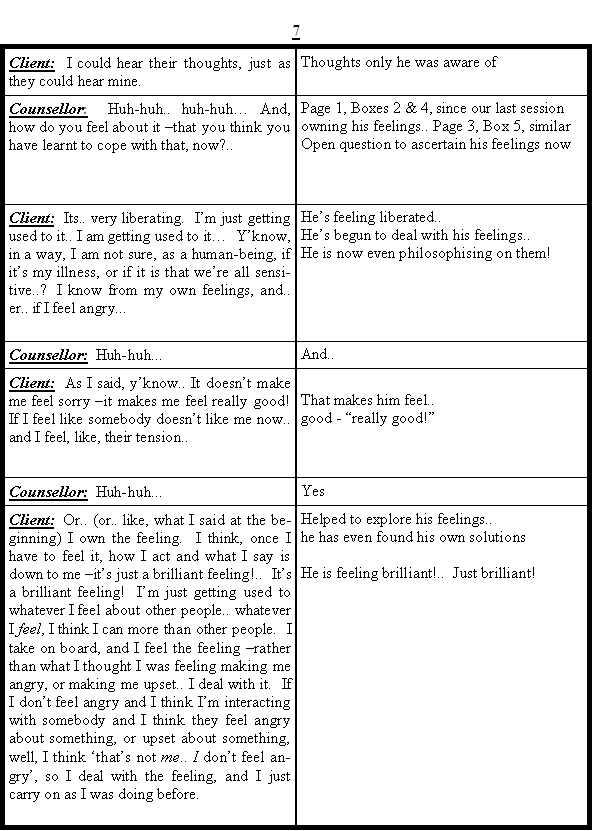
Theory-wise, was tried to be born in mind the core-conditions of acceptance-congruence-empathy, non-directively giving Sid space, while seeking to empower also by a smile and relaxed, open, posture, keeping to boundaries, assuring of interest also by nods -'huh-huh's, concern; note how was with feelings not of others mentioned but concentrating on Sid's present feelings, and focusing on issues brought by himself, seeking to help explore and deal with his feelings to come to his own realisations to find his own solutions. Sid client was apprehensive even of his ex-partner, and believed his partner talked down to him "because of ignorance of races" ~he did not need the Ames based cognitive-behavioural, nor the behavioural approach, he had no problem with rationality, and the cure of his mental-illness had dealt with his behaviour; nor did he need the Freudian psycho-dynamic insight into his problem -he knew that: his self-concept. It was thought the humanistic 'focus on the constructive side of his nature with the assets he brought to counselling' would be applicable in helping regain his pre-mental-illness self-concept; having given thought to Gestalt's confronting and Transactional's learnt-perception approaches, and considered Egan's 'assess-plan-implement-evaluate' on a desired scenario with a view to Maslow's 'creative-attitude', it was felt Roger's caring-understood-valued-trusting person-centered approach would be appropriate, perhaps with a dash of Egan's problem-solving, for Sid who also saw the glass half empty rather than half full.
Development: Sid "didn't think much of" his counsellor. An introduction, agreement re. confidentiality, tapes, times, boundaries, supervision, did away with nervousness. Cured of paranoia in the social behaviour sense, hadn't been catered for his deteriorated self-concept for functioning as previously; he wanted that -not to feel thought less of, a failure, anger to suppress, but self-drive to be a doer. In our relationship we'd move from this session -the first paragraph, to work on it.
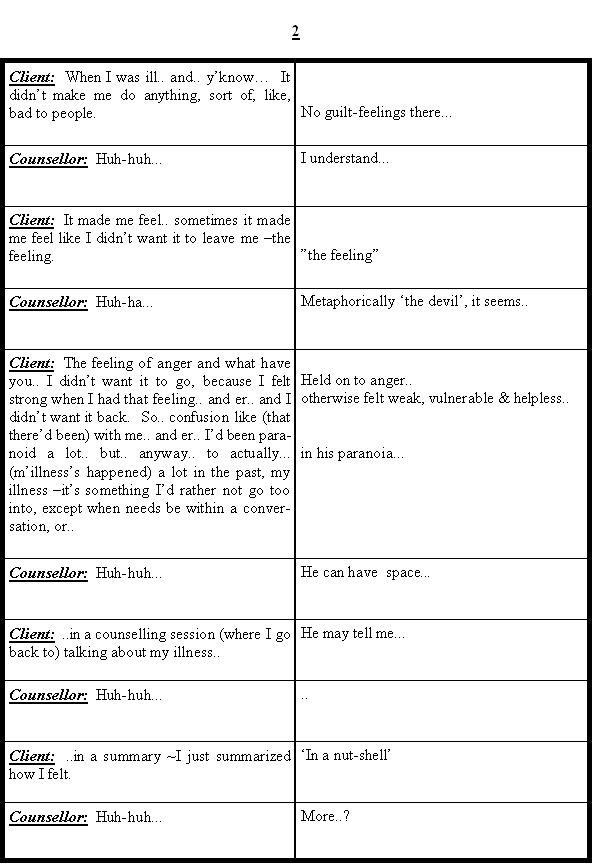
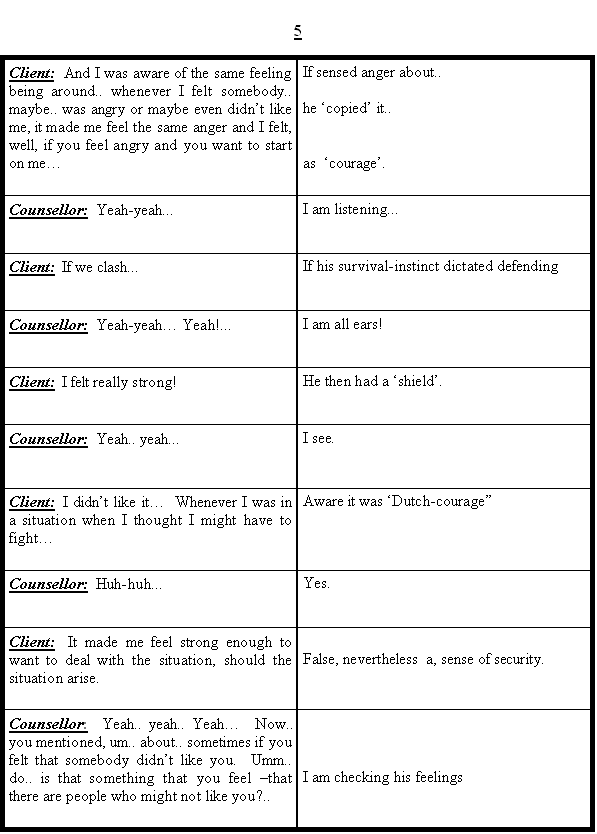
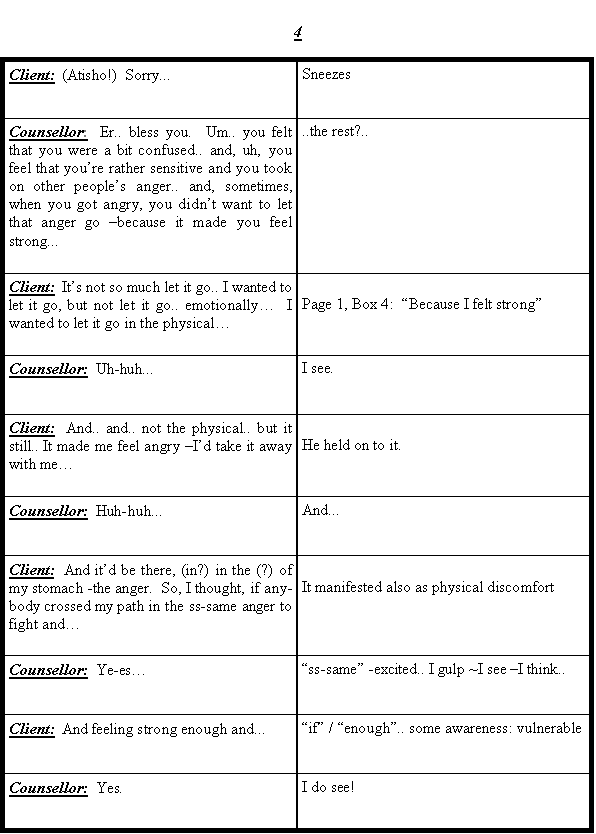
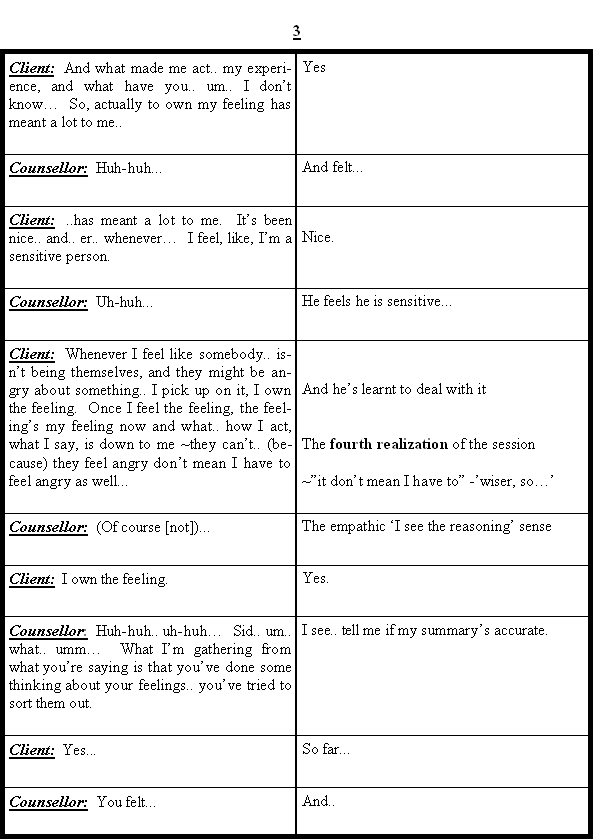
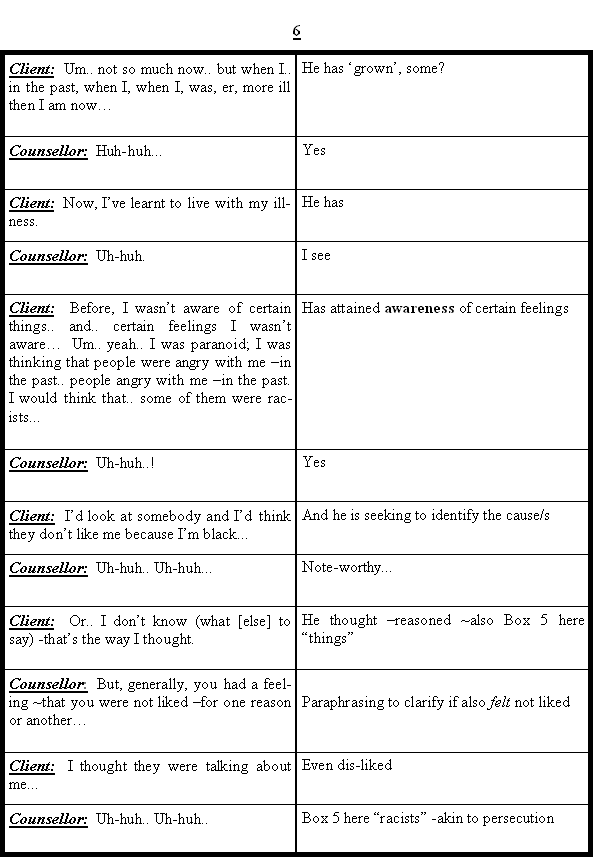
Follows a transcription...
COUNSELLING 'SID' -the rest & session 5 (last)
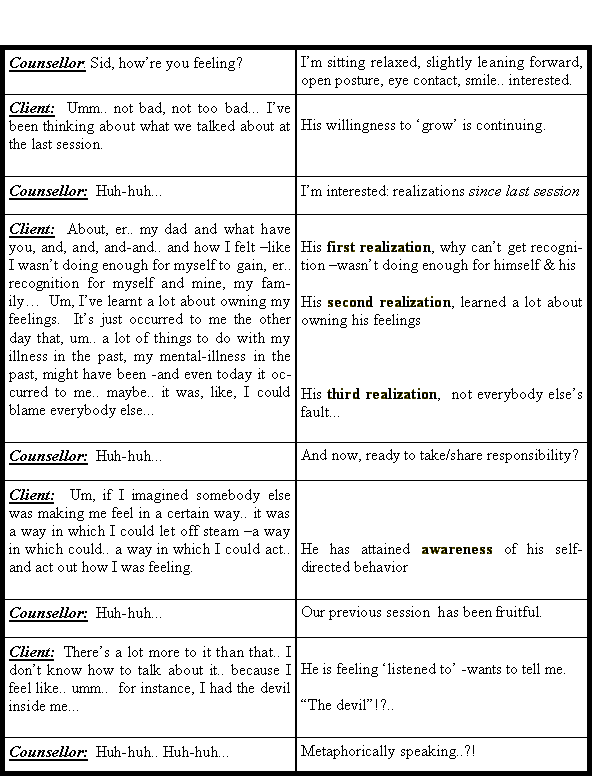
"Profound" changes had begun to take place in Sid; he was visibly and auidibly and joyously emotionally quite excited, almost lost for words. Our penultimate session began as follows:-
I as Counsellor: Can have a longer session today -what would you like to talk about this time?
Client: I'm not, er.. I don't know where to start, really... It's been like a funny few, like a funny month for me, really.. a few profound things have been happening to me, especially since you've been, er.. especially since counselling, since you've been counselling... Um, owning my feelings.. was a big one for me.. which is something I was talking until I get to grips some of, er.. I'm just.. I was getting used to owning my feelings, realising, also realising about.. shall I shut the window...?"
Introduction attended at the first, at our second session, I began to gain some insight into Sid's problems, and, to some extent, their underlying causes:-
Did his breakdown over bearevement, sensensitivity, have to do with his feeling that his dad, the major provider, not ill mom, he felt died ~"Every now and then, I'll phone them up and ask them to send me down some money; when they (retire overseas) they can't" -did that feeling symbolise the degree of his insecurity and anxiety financially, too?..
It had sounded envy, at the first session: "I mean, my sister, (...) I was a bit jealous" ~but at the second, it was: "She's so positive.. (...) I want to be like that." -was it aspiration?
Our third session: "..like I had the devil inside me'.. "I'd be (sinful in mind)".. "it's like I had a nemesis; I felt like he was evil and I was good".. "I felt like him, I imagined feeling like him."
Fourth session: "Hurtful things"... (I as Counsellor: What sort of hurtful things?).. "I'm black"... (I: What is it that hurts you about being black?)... "..I am beneath them -that's what they think."
Theory-wise, although also-humanistic Gestalt emphasises 'economic-stability', any insights too were the person-centered way -uninterpreted. Sid's negativeness appeared unintuitive -not perceptory, but, his 'nemesis' in the past, a reasoned conscious concept, from a locus of evaluation, about his self ~apprehension his son's mother'd adapt her 'racist' brother's view and other significant-others' loss of faith in him: dad "expects me to fail..." -as in 'I knew you'd fail!'
Skills-wise, at the fifth session Sid's "I start things and not finish -it, it's always been that way" became summarisable "..it is fear of yet again failing because of past experience..?" (Client: "Yes") ~and, in response to Sid's "When you're talking to me, you were saying 'determination to finish', I felt.. I felt shtrong!" empahthically mirrorable by me as "You felt.. sh.. strong!" -and paraphrasable "You'll be looking after No.1 -you"... In ending I and the client were aware of each other's thinking, evaluated, reviewed our work together in the light of the original aims, future plans: Client: "I'm determined!" I: "And you feel you can do that?" Client: "Yes!" I: "And there is no reason why you can't?" Client: "There isn't!" I: "You feel you can do that." Client: "Yes!" I : "Your determination is stronger than your fear?" Client: "Definitely!.. Definitely, definitely!"
Development:: "Definitely.. is.. this is.. soo.. so.. when you were talking to me I could fe-el.. like, your strength.. like it was making me feel strong! I feel better now, I feel different, things are a bit clearer to me. I've realised, I have no excuse ~I know I can do it, I know -that's that!" ("And you know best how to go about it...") "Yes!" ("Sid, best of luck to you)... "Thank you..."
Phoned: his parents visited him, sister too 'read' his books; ex-partner will take son to his parents, may keep son overnight; partner did his typing; and, a first ever: he has 'done', completed, his course finishing work! Wanted to buy me a drink ~politely declined -well done!
May be of interest also - click… TEACHER OF TEACHERS
The 'client', to protect his identity, has been called 'Sid'
Parts in brackets (in this transcript -session 3) are unclear on the tape