
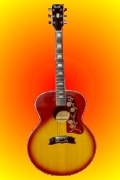
Orville Gibson was in his fifties by the time Leo Fender was born, having established his mandolin and guitar company in Kalamazoo, Michigan, some seven years earlier. As far as the early years are concerned, the company Gibson built is especially famous for its early mandolins and archtop guitars, both of which are highly prized by collectors. Later years have seen the introduction of many, many other models. Some of those models are the J-200 and the ES-175, the Flying V™ and the Explorer,™ the SG and, of course, the . . .
For countless guitarists, the Les Paul® is their version of the Holy Grail. The shape of the Les Paul® is instantly recognizable among guitarists. The asymmetrical body, with one cutaway on the lower side of the neck, enables guitarists to play notes on the upper reaches of the neck (a staple of many screaming lead guitar solos). Gibson® also makes a double cutaway version of the Les Paul,® but the single cutaway is the shape everyone associates with a guitar of this name.
Les Paul was more than the person whose name Gibson® put on these guitars. He was an accomplished and popular guitarist, as well as an inventor. Around 1940, he created The Log, which was essentially a guitar neck attached to a block of wood, and with two sides taken from another guitar. Les Paul devised a pickup system that he attached to The Log. Thus was born his version of an electric guitar. The Gibson® company was not impressed . . . at least, not until Leo Fender started gaining the upper hand in the electric guitar market by mass producing his line of guitars. The rest is history. I once played a 1957 Les Paul® GoldTop, but I've never owned a Les Paul® with any color of top. I can dream, though, can't I?
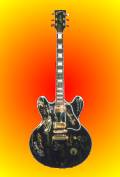
B.B. King is one of the most famous blues guitarists of all time. And his guitar bears one of the most unusual names in the world of guitars: Lucille.™ In reality, King has had a number of guitars over the years, and he has referred to them all as Lucille. Gibson didn't assign his original Lucille that name, of course; he just began calling "her" Lucille.
King has preferred to play Gibsons for decades. In 1982, the long, informal association of B.B. King with Gibson finally resulted in a formal relationship. As a result, Gibson introduced the Lucille™ model. The Lucille™ model is actually a variation of the famous Gibson ES-335. The semi-hollow body and the neck are laminated maple, and the fingerboard is ebony. The guitar comes with two humbucking pickups and numerous tone, volume, and other controls. One of Lucille's™ more unusual characteristics (for a semi-hollow body guitar) is the lack of soundholes. The example shown in the picture here happens to have a number of autographs on it. Among those who signed the guitar are B.B. King (of course!), Buddy Guy, Lonnie Brooks, and Sam Moore.
Where do you want to go now?
Please take me back to the beginning of this Web site.
I want to read your comments on Fender® guitars.
What's this about Terada guitars?
Read some tips for guitar buyers.
Read some comments on how to grade guitars.
Visit the Web site of Fender Musical Instruments.
Visit the Web site of Gibson Musical Instruments.