The Birth of A Nation
In 1775, people living in the British colonies in America protested at the way they were ruled by the government in London, England. One year later, on July 4, 1776, they declared their independence, promising to fight the British rather than accept their laws any more. The struggle for independence from Britain was not achieved until 1782, but July 4, 1776 is the day recognized as Independence Day, as the signing of the Declaration of Independence by the Continental Congress was begun on this date in Philadelphia, Pensylvania. All 56 signers would not affix their signatures until August 4, 1776.
At the time, the US consisted of 13 colonies under the rule of England's King George III. There was growing unrest in the colonies concerning the taxes that had to be paid to England. This was commonly referred to as "Taxation without Representation" as the colonists did not have any representation in the English Parliament and had no say in what went on. As the unrest grew in the colonies, King George sent extra troops to help control any rebellion. In 1774 the 13 colonies sent delegates to Philadelphia, Pennsylvania to form the First Continental Congress. The delegates were unhappy with England, but were not yet ready to declare war.
In April 1775 as the King's troops advanced on Concord, Massachusetts, Paul Revere would sound the alarm that "The British are coming, the British are coming" as he rode his horse through the late night streets. The battle of Concord and it's "shot heard round the world" would mark the unofficial beginning of the colonies war for Independence.
The following May the colonies again sent delegates to the Second Continental Congress. For almost a year the congress tried to work out it's differences with England, again without formally declaring war.
By June 1776 their efforts had become hopeless and a committee was formed to compose a formal declaration of independence. Headed by Thomas Jefferson, the committee included John Adams, Benjamin Franklin, Philip Livingston, and Roger Sherman. Thomas Jefferson was chosen to write the first draft which was presented to the congress on June 28. After various changes, a vote was taken late in the afternoon of July 4th. Of the 13 colonies, 9 voted in favor of the Declaration, 2 - Pennsylvania and South Carolina voted against, and Delaware was undecided, while New York abstained.
To make it official John Hancock, President of the Continental Congress, signed the Declaration of Independence. It is said that John Hancock signed his name "with a great flourish" so "King George can read that without spectacles!".
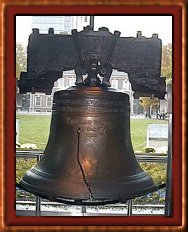
The following day copies of the Declaration were distributed. The first newspaper to print the Declaration was the Pennsylvania Evening Post on July 6, 1776. On July 8th the Declaration had it's first public reading in Philadelphia's Independence Square. Twice that day the Declaration was read to cheering crowds and pealing church bells. Even the bell in Independence Hall was rung. The "Province Bell" would later be renamed "Liberty Bell" after it's inscription -
Proclaim Liberty Throughout All the Land Unto All the Inhabitants Thereof.
The Statue of Liberty, which stands on Liberty Island in New York Harbour, was a gift from the French people in 1886. It is often regarded as the symbol of the independence of the USA.
The first Independence Day celebration took place on July 4, 1777. By the early 1800s the traditions of parades, picnics, and fireworks were established as the way to celebrate America's birthday.
That first celebration was the beginning of a journey that's brought Americans through struggles and adversity to become the proud and strong nation that it is today. On the Fourth of July we remember who we are, where we've come from and what we've accomplished as a people.
The Declaration of Independence
Drafted by Thomas Jefferson between June 11 and June 28, 1776, the Declaration of Independence is at once the nation's most cherished symbol of liberty and Jefferson's most enduring monument. Here, in exalted and unforgettable phrases, Jefferson expressed the convictions in the minds and hearts of the American people.
The political philosophy of the Declaration was not new; its ideals of individual liberty had already been expressed by John Locke and the Continental philosophers. What Jefferson did was to summarize this philosopy in "self-evident truths" and set forth a list of grievances against the King in order to justify before the world the breaking of ties between the colonies and the mother country.
The National Anthem
The Star-spangled Banner, the National Anthem of the United States of America is a poem inspired by the Battle of Baltimore, fought on September 12-14, 1814 during the War of 1812.
The American Creed
|
I believe in the United States of America a Government of
the people by the people, for the people,
whose just powers are derived from the consent of the governed;
a democracy in a Republic;
a sovereign Nation of many sovereign States;
a perfect Union, one and inseparable;
established upon those principles of
freedom, equality, justice, and humanity
for which American patriots sacrifice their lives and fortunes.
I therefore believe it is my duty to my Country
to love her; to support her Constitution;
to obey her laws; to respect her flag,
and to defend her against all enemies. |


|
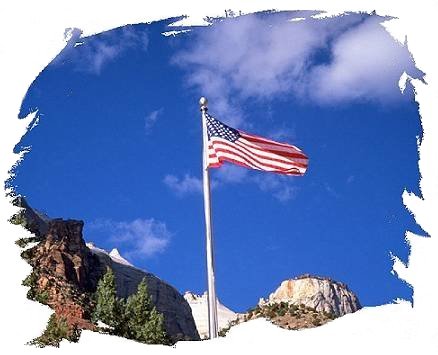
I Pledge Allegiance to the flag
of the United States of America
and to the Republic for which it stands,
one Nation under God, indivisible,
with liberty and justice for all.
We the People of the United States,
in Order to form a more perfect Union,
establish Justice, insure domestic Tranquility,
provide for the common defence,
promote the general Welfare,
and secure the Blessings of Liberty to
ourselves and our Posterity,
do ordain and establish this
Constitution for the United States of America.
{Preamble of the Constitution ~ USA}
Excerpt from:
The Declaration of Independence of the
Thirteen Colonies In CONGRESS, July 4, 1776
The unanimous Declaration of the thirteen
United States of America,
We hold these truths to be self-evident,
that all men are created equal,
that they are endowed by their Creator
with certain unalienable Rights,
that among these are Life, Liberty,
and the pursuit of Happiness.
That to secure these rights,
Governments are instituted among Men,
deriving their just powers from the
consent of the governed.
That whenever any Form of Government
becomes destructive of these ends,
it is the Right of the People to alter or
to abolish it, and to institute new Government,
laying its foundation on such principles and
organizing its powers in such form, as to them
shall seem most likely to effect their
Safety and Happiness.
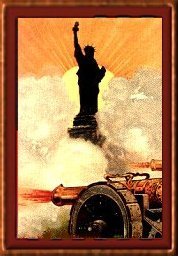
Statue Inscription
The New Colossus
Not like the brazen giant of Greek fame,
with conquering limbs astride from land to land;
Here at our sea-washed, sunset gates shall stand
a mighty woman with a torch
whose flame is imprisoned lightning,
and her name Mother of Exiles.
From her beacon-hand glows
world-wide welcome;
her mild eyes command the air-bridged harbor
that twin cities frame.
"Keep ancient lands your storied pomp!"
cries she with silent lips.
"Give me your tired, your poor,
Your huddled masses yearning to breathe free,
The wretched refuse of your teeming shore.
Send these, the homeless, tempest-tost to me,
I lift my lamp beside the golden door!"
Emma Lazarus (1849-1887)
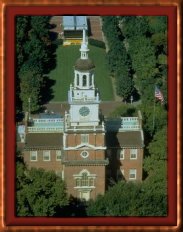
Independence Hall - Philadelphia, Pennsylvania

Click Next to see and hear Fireworks







Site Navigation, Select Below

Copyright © 2000 Shott's Web Design All Rights Reserved

|
