Welcome to the SCURK Renaissance page
Recently, there has been a resurgence in interest in SCURK. It has been called the SCURK Renaissance. In fact it is still going on. This page is here to display all the creations of this Renaissance.



Emerald City
by Pink Tulips
The famous city of the Wizard of Oz.
Goodwin Square in Hartford, CT
by Bill Mocarsky
The red brick structure on the bottom was gutted to make room for complex, which was built in the late 80's. The lower portion has been converted into a hotel and the tower is office space.
Perisphere and Trylon
by Pink Tulips
From the New York World's Fair of 1933.

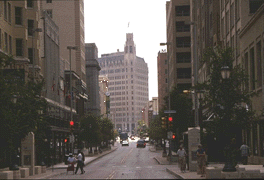
Emily Morgan Hotel in San Antonio, Texas
by Lee Sojot
Constructed in 1926 and originally named the Medical Arts Building, this historic landmark is a picturesque example of Gothic eclecticism, complete with flying buttresses crowning the hexagonal corner tower. The medical-arts type of skyscraper was popular in the 1920's as physicians sought to exploit the benefits of working together in fascilities specially designed for them. The San Antonio Medical Arts Building, designed by architect Ralph Cameron as a flatiron, stands on one of the many irregularly shaped sites created as San Antonio's downtown streets intersect the winding San Antonio River. The particular corner site of the Medical Arts Building is even more interesting as it sits directly next to Alamo Plaza, allowing the building to overlook the historic Alamo shrine and its grounds. Although it was intended that other buildings continue the wall-edge of the flatiron, no such buildings were constructed, leaving the Medical Arts Building to stand alone were it can today be clearly admired.
The Medical Arts Building was renovated in 1984, reopening as the Emily Morgan Hotel. The new hotel was named for the heroine of the Texas Revolution who inspired the "The Yellow Rose of Texas."
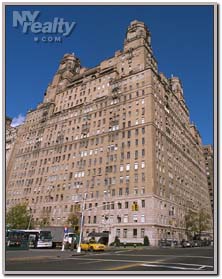

The Beresford in New York City
by David Cavers
One of the world's greatest residential buildings, this huge structure is distinguished by its three towers and its two major facades, one overlooking Central Park and the other Manhattan Square, the park that contains the American Museum of Natural History.
It is one of the masterpieces of architect Emery Roth, who also designed the twin-towered San Remo a few blocks south on Central Park West and whose firm, Emery Roth & Sons would design more office buildings in the city than any other firm.
A monumental palazzo, the building has always been of the city's grandest addresses. The genius of the design is the deployment of three towers, one of which, of course, conceals the building's water tank. The asymmetry distracts from the building's massive bulk while adding a memorable and intriguing skyline. The three towers, which have pyramid roofs capped with copper lanterns that are brightly lit at night, are placed at all the corners, except the northwest one, of the building whose frontage on Central Park West and 81st Street are about equal. (The building is not a square, however, but a U-shape as the middle of its west side is open and the center of the building is a courtyard, which contains a fountain and garden.)
Although the building is only 22 stories tall, its presence is significantly more because of its scale. The towers, which have illuminated finials, are quite large and are spaced far apart. Originally, the north tower was open. The southeast corner tower contains a multi-level apartment that was occupied for a while by Mike Nichols, the director, and, at another time, by Helen Gurley Brown, the magazine editor, and her husband, David Brown, the producer. Other residents have included Isaac Stern, the violinist, Beverly Sills, the opera singer, and columnist Leonard Lyons.
Despite its great size, the building is relatively intimate, at least for its residents, as it is divided, internally, into three distinct structures, each with their own separate entrance and elevator. As originally designed, there were only two apartments per floor serviced by each elevator. The apartments were large and ceiling heights were 10 feet for the lower 16 floors and 12 feet for the upper, terraced floors. Many were designed as duplexes and most have fireplaces and the building was one of the first in the city to have glass-door showers with multiple shower heads. Some bedrooms were as large as 18 by 28 feet.
The facades are very sophisticated with many elements designed to relieve the monumental scale of the project, which was developed by the HRH Construction Company.
The building has a three-story limestone base topped by beige brick and the very handsome entrances are highly reminiscent of Italian Renaissance motifs. The lobbies are exquisite and lavish with marbles and moldings and superb, though restrained detailing. The developers thought that three relatively small lobbies would not waste as much space as one very long one. The building replaced the six-story Hotel Beresford that was erected by Alva Walker in 1889 after Jose de Navarro abandoned plans filed five years earlier for four 12-story apartment buildings and the site. In 1892, Walker expanded the hotel with a 10-story annex at 82nd Street and its top floor containing a dining room for residents as the apartments did not have kitchens, noted Christopher Gray in a September 14, 1977 article in The New York Times.
The Beresford, the San Remo and the Dakota are the three most prestigious and spectacular apartment buildings on the Upper West Side. Each has its merits and advocates who claim it is the best. The Dakota, being the oldest, has tremendous history and mystery. The San Remo, being the tallest, has the highest visibility as well as the best location. The Beresford is just overwhelming: the brass elevator doors have a dragon crested shied with a bear and the motto Fronta Nulla Fides (Place No Trust In Appearances). In 1940, the Beresford, which was completed one month before the stock market crash of 1929, and the San Remo were sold together for $25,000 over the existing mortgages, an indication of how severe the Depression was on New York real estate values.

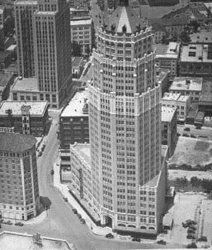
Tower Life Building in San Antonio, Texas
by Lee Sojot
The soaring Tower Life Building was for nearly 30 years the tallest building in San Antonio. Built in 1929 and originally named the Smith-Young Tower, this building still remains the most interesting and locally popular landmark on the city skyline. Though the 35-story tower had been for a time incorrectly labelled as the tallest building west of Chicago, the Smith-Young Tower still was perhaps the most important historic office tower in the South and still remains arguably one of the most beautiful.
The epitome of San Antonio's frenzied building boom of the 1920's, the tower was planned to be the centerpiece of a complex known as Bowen's Island Skyscrapers, but the Great Depression halted the remainder of the project and later also ended San Antonio's position as the leading metropolis in Texas.
For the oddly shaped site along the narrow San Antonio River, architects Atlee B. and Robert M. Ayres designed an irregularly eight-sided, step-backed tower clad in brick and glazed terra-cotta.
In keeping with San Antonio's tendency for historicism, the Smith-Young Tower was eclectically decorated with Gothic-inspired ornament, showcasing one of the many fashionable architectural styles in which Ayres & Ayres were fluent. The syringe-like radio mast was a later addition, and at night the upper setback portions are floodlit to create a brilliant wedding cake display on the skyline. The firm of Ayers B. & Robert M. Ayers, important regional architects in Texas, located both their offices and the public observation deck on the 30th floor, where they had a commanding view of the city. The first five floors were briefly occupied by the a Sears & Roebuck department store. However, the major tenant of the building was Tower Life Insurance, from which the present name derives. Today, the Tower Life Building is listed as a national historic landmark and remains a fascinating focal point along downtown San Antonio's Paseo del Rio.


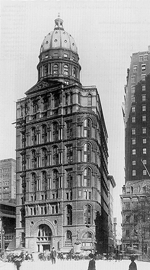
Version 1
Version 2
World Pulitzer Building in New York City
by David Cavers
Also called the Pulitzer Building, this striking building was completed in 1890 by G. B. Post for Joseph Pulitzer's World newspaper. Its Renaissance styling had red sandstone walls up to the fourth story, buff-colored brick and darker buff terra-cotta above, base columns in red granite, base spandrel panels in gray granite, bronze statues, and a gilded copper dome. Critics called it a hideous monstrosity, and it was demolished in 1955 to make way for the widening the Brooklin Bridge approach.
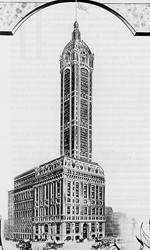

Singer Building in New York City
by David Cavers
This forty-seven story tower the world's tallest skyscraper when completed in 1908 by Ernest Flagg. The Singer Manufacturing Company's 612 foot tower was sumptuously decorated in French Beaux-Arts style. This famed landmark was demolished in 1961 to make way for the more modernist steel and glass United States Steel Building.
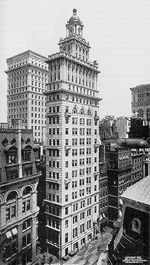

Gillender Building in New York City
by David Cavers
Designed by Berg & Clark and completed in 1897, this narrow 273 foot building sports a very elaborate crown. It was demolished in 1910 and replaced by the Bankers Trust Building.


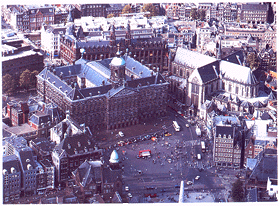
Paleis op de Dam and Monument in Amsterdam, the Netherlands
by Tom Nillesen
-"Paleis op de Dam": This is the Royal palace at the famous Dam square in Amsterdam. The building was actually meant as a city hall when it was built and that's the reason of its odd location and it's simple exterior. The interior however is really beautiful.
-"The Monument": This monument is built to honor all people who died in the second world war. It is a long white tower with statues placed standing on it at different places. Around the back there is a long white wall with other statues and inscriptions.
The monument should be placed in front of the Palace with an road between the tiles. This way you'll have the Dam square the way it originally should be.




New York City style buildings
by Charles Warren



Commercial Block in Sao Paulo, Brazil
by Tom Behrendt
Price Building in Quebec City
by Bill Mocarsky
Central Tower of Chateau Frontenac in Quebec City
by Bill Mocarsky