


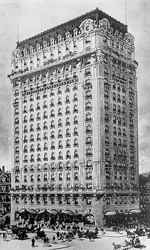
The St. Regis Hotel in New York. NY The St. Regis Hotel in New York
by David Cavers by John Anderson
This fine hotel was constructed by Trowbridge & Livingston in 1904 for John Jacob Astor. This eighteen story, lavishly Beaux-Arts styled hotel was cited as "offensive" in the 1913 report of the city's Heights of Building Commission because of its Fifth Avenue location.
This elegant, Parisian-style dowager hotel set new standards for luxury when it opened and is one of Fifth Avenue's fabled gems.
Its bronze domed doorman's sentry box beneath its large sidestreet canopy proudly announces its high-tone service. Although its main lobby is relatively small, albeit very lavish, the hotel has always been known for its elegant entertaining rooms. Its "roof," as the hotel refers to its enclosed top floor, still has its pleasant, medium-size ballroom that has lost some of its elegance over the years but still has some wonderful window views.
The 1927 expansion extended the hotel down the sidestreet with compatible though less detailed facades. The expansion, by Duke Management, also permitted the hotel to create an enormous and magnificent, club-like bar room highlighted by Maxfield Parrish's large mural of a flatulent "Old King Cole" that originally was in the former Knickerbocker Hotel on the southwest corner of Broadway and 42nd Street that Astor had built shortly after he had erected the larger and more famous Astor Hotel on Broadway between 44th and 45th Streets that was sadly demolished to make way for an office tower.
The "King Cole" room, for many years one of the city's most elegant and largest bars, sadly has been redone twice in recent years and the famous mural put in a smaller bar when the Sheraton Corporation completed a long-overdue renovation in 1991. The hotel now boasts a highly regarded French restaurant, but its famed basement nightclub, La Maisonette, in which Peter Duchin and his orchestra played in the 1960's, has long since been closed.
The hotel originally was reported to contain 47 Steinway pianos and the grandeur of its decor did not preclude the latest technological advances. It was the first hotel in the city, and probably the world, to be air-conditioned.
"The public rooms in the St. Regis were relatively small, a subtle indication that the management did not want the crowds that milled in Peacock Alley at the Waldorf-Astoria or in the vast lobby of the Astor in Times Square," observed Jerry E. Patterson in his excellent book, "Fifth Avenue, The Best Address," (Rizzoli International Publications Inc., 1998). "On the Fifth Avenue side was an outdoor terrace were one could have refreshments, lost when Fifth Avenue was widened...During the nightclub years of the 1930's the St. Regis had many clubs, attracting for the most part a rather conservative and very well-heeled crowd. Joseph Urban[n], the flamboyant architect, designed the Seaglades nightclub, where Vincent Lopez's orchesta played. During the summer they played for dancing in the Japanese-style roof garden of the hotel," Patterson wrote, adding that the hotel was named after St. Regis Lake in the Adirondacks, a popular resort at the time.
Its paneled library adjoins the lobby. Originally, the hotel's main dining room faced the avenue and it and a Palm Room were lined with mirrors.





The above are more from David Cavers.

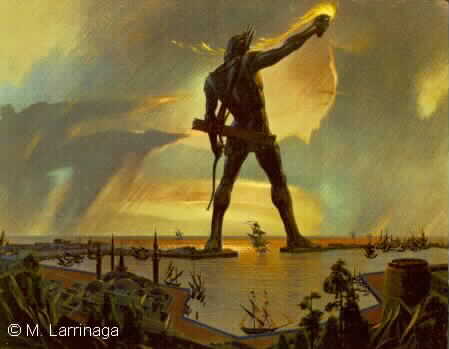
The Colossus of Rhodes
by Lee Tong
The shortest-lived wonder of the ancient world, standing about 110 feet high, the same height as the Statue of Liberty (minus the Pedestal).
The Colossus stood for about half a century before an earthquake felled it in 226 B.C. It broke off at the knees and landed on shore, where the pieces remained for another eight hundred years or so. There are accounts by Roman writers of how the statue was still quite an incredible thing to see, even in bits and pieces along the quay.
Finally, in 672 AD, the pieces were sold to an Arab trader, shipped to Asia Minor,and loaded onto a caravan of camels which shipped the remnants of the statue deep into the Mesopotamian desert. Nobody knows what became of the remains.

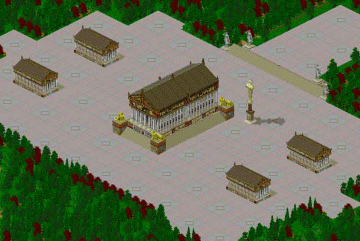
Grand Hotel
by Chris Nacinovich
I originally took a tile by David Cavers, redid the facade, added the left tower, made little extensions on the sides, and added a building behind it.
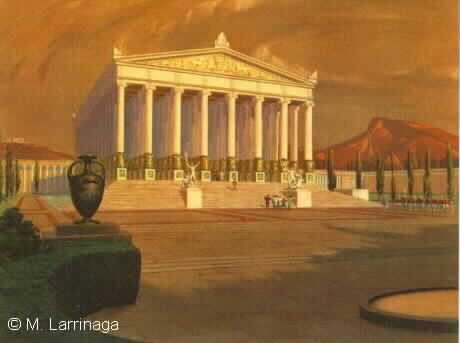
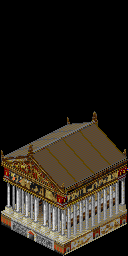
The Temple of Artemis at Ephesus
by Lee Tong
Is it simply a temple? How could it take its place among other unique structures such as the Pyramid, the Hanging Gardens, and the Colossus of Rhodes? For the people who actually visited it, the answer was simple. It was not just a temple... It was the most beautiful structure on earth... It was built in honor of the Greek goddess of hunting and wild nature. That was the Temple of Artemis (Diana) at Ephesus.
Although the foundation of the temple dates back to the seventh century BC, the structure that earned a spot in the list of Wonders was built around 550 BC. Referred to as the great marble temple, or temple D, it was sponsored by the Lydian king Croesus and was designed by the Greek architect Chersiphron. It was decorated with bronze statues sculpted by the most skilled artists of their time: Pheidias, Polycleitus, Kresilas, and Phradmon.
The temple served as both a marketplace and a religious institution. For years, the sanctuary was visited by merchants, tourists, artisans, and kings who paid homage to the goddess by sharing their profits with her. Recent archeological excavations at the site revealed gifts from pilgrims including statuettes of Artemis made of gold and ivory... earrings, bracelets, and necklaces... artifacts from as far as Persia and India.
On the night of 21 July 356 BC, a man named Herostratus burned the temple to ground in an attempt to immortalize his name. He did indeed. Strangely enough, Alexander the Great was born the same night. The historian Plutarch later wrote that the goddess was "too busy taking care of the birth of Alexander to send help to her threatened temple". Over the next two decades, the temple was restored and is labeled "temple E" by archeologists. And when Alexander the Great conquered Asia Minor, he helped rebuild the destroyed temple.
When St Paul visited Ephesus to preach Christianity in the first century AD, he was confronted by the Artemis' cult who had no plans to abandon their goddess. And when the temple was again destroyed by the Goths in AD 262, the Ephesians vowed to rebuild. By the fourth century AD, most Ephesians had converted to Christianity and the temple lost its religious glamor. The final chapter came when in AD 401 the Temple of Artemis was torn down by St John Chrysostom. Ephesus was later deserted, and only in the late nineteenth century has the site been excavated. The digging revealed the temple's foundation and the road to the now swampy site. Attempts were recently made to rebuilt the temple, but only a few columns have been re-erected










Special thanks goes to Tom Nillesen, Lee Sojot, www.nyrealty.com, http://ce.eng.usf.edu/pharos/wonders/, David Cavers, www.aoc.gov, and Tom Behrendt for providing descriptions of all the real-world buildings.