Kilian Roberts
Keeping mom, dad, the doctors and the nurses in suspense for
twenty-eight hours, Kilian made
his entrance on September 27, 1995. After nine (and a half) uneventful
months, Kilian decided to provide some excitement.
He was born with a diaphragmatic hernia (CDH).
[A diaphragmatic hernia is a hole in the diaphragm, allowing the stomach,
intestine and/or other organs to move into the chest cavity. It causes the
lung(s) to be under developed (hypoplastic). In many babies this can cause
respiratory distress, leading to respiratory failure. Web links:
ECMO Home Page,
Cherubs Home Page,
Pediatric Points of Interest
and
Extracorporeal Life Support Organization]
Kilian was operated on the following day. The pediatric surgeon put everything back
where it belonged (or as close as he could get) and repaired the hernia. That was
the easy part. After the surgery, Kilian started experiencing some respiratory distress.
Using conventional ventilator management the staff at Providence Hospital's
Newborn ICU (Anchorage, AK) attempted to stabilize young Kilian. He
responded well, but on the fourth day after surgery he became "unstable."
The doctors in Anchorage sent the babe to Seattle for a type of respiratory treatment called
Extracorporeal Membrane Oxygenation (ECMO).
Kilian traveled "out" in style. He was the sole passenger on a Lear jet used for medical
evacuations with the flight crew, a flight nurse and a respiratory technician tending
to his well-being. Let's not discuss airfare.
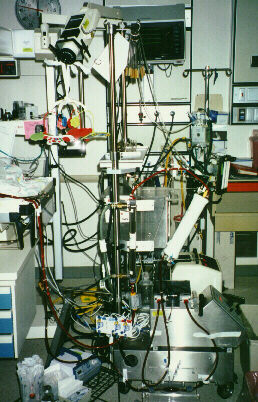 (This is the ECMO unit. The blood (dark) flows from the baby's jugular vein,
down to the bottom where a bladder would trap any air in the circuit. It then
moves up to the pump and on through the oxygenator (the white cylinder.) You can see
the blood is much lighter red after being oxygenated. The blood then flows
through a heater before returning to the baby through the carotid artery. The ECMO unit
takes over the pulmonary function of the body and allows the baby's lungs to rest and heal.)
(This is the ECMO unit. The blood (dark) flows from the baby's jugular vein,
down to the bottom where a bladder would trap any air in the circuit. It then
moves up to the pump and on through the oxygenator (the white cylinder.) You can see
the blood is much lighter red after being oxygenated. The blood then flows
through a heater before returning to the baby through the carotid artery. The ECMO unit
takes over the pulmonary function of the body and allows the baby's lungs to rest and heal.)
The doctors at Childrens Hospital in Seattle placed Kilian onto the ECMO circuit
even before mom and dad arrived in town. He tolerated the surgery well and was
very stable on the circuit.
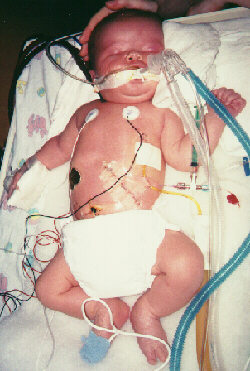 (A photo of Kilian while on ECMO. The cannulae are visible in the upper left.
He has monitor leads attached, an oxygen probe on his foot, is connected to a ventilator,
has a chest drainage tube and the scar from the hernia surgery
is visible on his abdomen.)
(A photo of Kilian while on ECMO. The cannulae are visible in the upper left.
He has monitor leads attached, an oxygen probe on his foot, is connected to a ventilator,
has a chest drainage tube and the scar from the hernia surgery
is visible on his abdomen.)
After six days on ECMO, Kilian's respiratory system was functioning well enough for
him to come off ECMO and back onto a conventional ventilator at moderate settings.
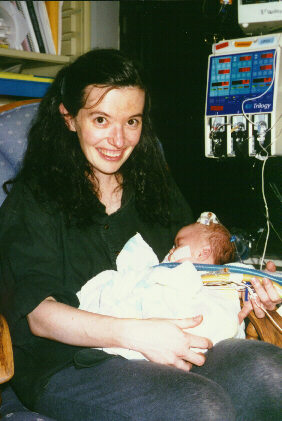 (This is the first time Renata was able to hold Kilian. It was October 9, 1995
twelve days after he was born.)
(This is the first time Renata was able to hold Kilian. It was October 9, 1995
twelve days after he was born.)
Kilian spent nine more days on a ventilator and another week after that on oxygen
before he was completely on his own and enjoying room air.
While on ECMO and the ventilator, he was fed intravenously. Kilian spent about three weeks
learning to eat. When your stomach and intestines have been in your chest
cavity, it's not always clear that they'll work properly without a little training.
He started with a nasal-gastric tube (a tube through the nose to the stomach) and
1 tablespoon of breastmilk per day. Once he made it to 60 ml every 3 hours, he got to try
oral feeds. He'd take as much as he could by mouth and then get the rest through the n-g tube.
(To figure out how much a baby is getting from the breast, you weigh the babe before and after
feeding him. Think about the errors inherent in that measurement!) After a mere five days,
he was taking all his food by mouth.
Then we got to take him home!!!
This page hosted by
 Get your own Free Home Page
This page last updated on November 30, 1997.