Three Stands for October Whitetail
By Bill Winke in the October 1999, Petersen's Hunting Magazine
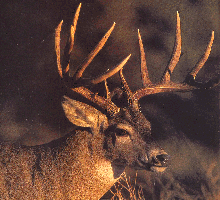
Bowhunting - This time has multiple phases of Big Buck Activity
During the early portions of the bow season bucks are still following some semblance of a pattern. If you can figure out the travel patterns of an individual buck you have a decent chance of taking him, but your stand placement has to be perfect.
Stand No. 1: Opening Week
Behavior: During the first week of the season buck behavior is pretty simplet ot understand. At this time they live their lives between bedding and feeding areas. These may not be exactly the same places every day, nor will they use the same trails in between all the time. Some days they'll arrive at the feeding area before dark and some days after dark. But if undisturbed, even mature whitetail bucks tend to be fairly patternable at this time of season - as patternable as they get anyway. Unfortunately a buck on feeding pattern is very sensitive to pressure. Do everything possible to make the first hunt count.
The Best Stand: Hunt right at the food source, but not without a plan. It is always best to spend plenty of up-front time glassing from a distance. Learn how the deer are approaching their feeding area before setting up a stand. Sure, you can set up on a heavy trail with the intention of fine tuning your stand location later, but what if the buck you're hunting picks you off on the first night? It can sure happen. Hang back and learn as much as you can before making your first move. Keep your stand well away from any suspected bedding areas. There is no need to hunt right in the buck's living room when he'll probably get to his feeding area before darkness at least part of the time.
Stand No. 2: Mid-October Transition
Behavior: Hunting pressure and growing levels of testosterone in their bloodstreams make bucks extremely reclusive from about October 10 through the 25th (in most whitetal states). They'll still feed, but seeing them during daylight is rare. This can be a very tough time to arrow a good buck- maybe the toughest of the year.
The Best Stand: Since the buck is almost entirely nocturnal, you can only hope to catch him, soon after he rises in the evening or right before he beds in the morning. The closer you can hunt to the buck's bedding area, the better are your odds of taking him. Unfortunately the closer you hunt to his bedding area the more likely he is to realize you're after him and clear out. This is a high-risk strategy.
Stand No. 3: Late Pre-Rut
Behavior: Though not as good as the peak of the rut, this period of pre-rut can be a very good time to take a big buck. The bucks will be staying pretty close to home and most importantly, they begin to move more during daylight hours. They'll often stop to make rubs and scrapes that reveal their routes to knowledgable hunters.
The Best Stand: If possible your stand should overlook a line of well-used scrapes located in some type of belivable buck-travel corridor. In other words a scrape along the edge of a field (which was probably made randomly at night) is not what you're looking for. However a deeply dug scrape found back in the the cover adjacent to a heavy creek crossing or ridgeline saddle, etc., could be red-hot. You've got about a week to take him before the first estrus doe whisks him away.
October isn't just a time for scouting to get ready for the rut. It can be a serious time to shoot a big buck. The middle of the month is definitely tough, but the first week of the season and the last week before the rut kicks in can produce the biggest buck of your life.
Get Ready-- If you'll be hunting from a tree stand, spend at least a few days practicing from an elevated position. You may notice a different impact point. It's important to maintain the form you practiced on the range as closely as possible, so bend at the waist to achieve downward angle instead of simply dropping your bow arm. (In other words keep your bow arm at 90 degrees to your upper body.) Wear your hunting clothes to get used to the new feel and to troubleshoot any problems that may arise from face masks, gloves and bulky sleeves.