The moon is the earth's only natural satellite. Its average distance
from earth is 384,400 km. The moon rotates once every 27.3 days, the same
length of time as its period of revolution. Thus the same side of the moons
diameter, 3476 km, is about one fourth of the earths diameter. The moon mass is about one eighth of the mass of the earth. The force of gravity is one sixth of that on the earth. The same elements that make up the earth make up the moon. But the elements are formed different movements on the moon. The moon is thought to have layers. The crust or top layer called mantle. It is also thought to be made of rock material. Beneath the mantle, the moon probably has a small core. This core may contain iron and other metals. The moon does not produce its own light. Its a reflection of the earths sunlight. The moon seems to have different shapes depending on its lighted side we can see. The different shapes that the moon appears to have are called phases. There are six phases: new-moon, crescent, first-quarter, gibbous, full-moon, and last-quarter. (See chart on page)
The sun is the source of the earth's light and heat. Fusion in the sun produces the suns energy. Fusion is a kind of nuclear reaction. The sun also gives off a steady stream of electrically charged particles called solar wind. The sun is a larger sphere of very hot gases. Its diameter is 1.392 million km. It is so large that all of the planets and moons in the solar system could easily fit inside. Nearly 99 percent of all of the matter in the solar system is in the sun. The sun contains at least 80 percent of all the elements found on the earth. Hydrogen makes up 92.1 percent of the atoms in the sun and helium makes up 7.8 percent. All of these elements are in a form of matter called plasma. Plasma is matter in which atoms have lost their electrons because of very high temperatures. The center of the earth is called the core. It is small compared to the rest of the sun. The next layer of the sun is called the radiation zone, the thickest layer of the sun. The next
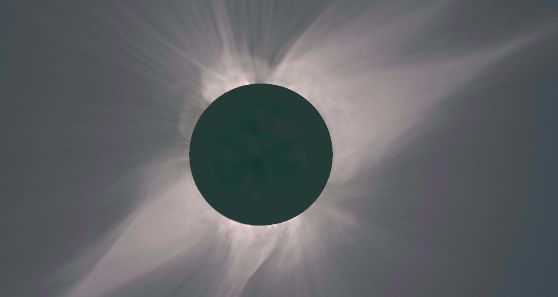
layer of the zone is called the convection zone. The photosphere, which is next, is the visible surface of the sun. Most energy that reaches this level is turn into light. Next, is the chromosphere. The chromosphere, meaning “colored sphere,” is used because of the faint red light of this layer. The outer (last) layer is called corona. This layer is less dense than the chromosophere. The corona of the sun visible during a solar eclipse. (See structure of the sun below ).
Mercury, Venus, the earth, and Mars are the inner planets. They each seem to have a metal core surrounded by a eroding mantle. The inner planets are very different from the giant outer planets. In time only the dense material that the solar system wind could not remained close to the sun. These dense materials formed the inner planets. In this way the inner planets become smaller and denser the outer planets.
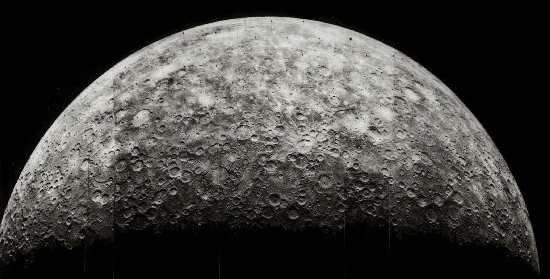
Mercury is the planet closest to the sun. For this reason Mercury is difficult to see from the earth. At times Mercury is seen in the sky just before the sun rises. At other times, it is seen just after the sun sets.
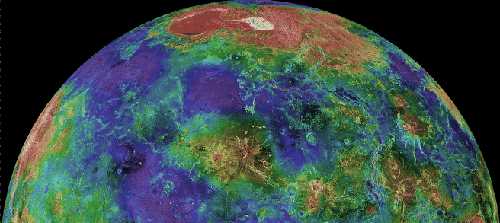
Venus is the second planet from the sun. It is the brightest object in the slum expert for the sun is the more. Venus also appears in the sky shortly after sun set. Venus comes closer to the earth than any other planet. Several spacecraft's have studied Venus. The studies have shown that the clouds in the upper atmosphere of Venus contain sulfuric acid. These clouds are swept along by winds that travel at 360 km/h. Beneath the acid clouds the wind speed is slower and the atmosphere is mostly carbon dioxide. The thick clouds around the planet attract heat from the sun, making Venus warmer than Mercury. At the surface of Venus the temperature is around 470C and the pressure is 91 times greater than that of the earth is atmosphere.
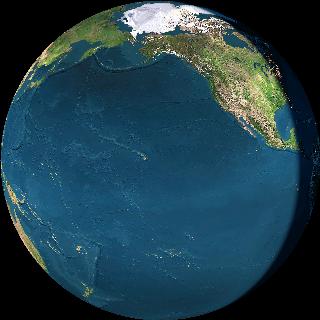
Earth is located in a solar system. Through most of recorded history, people thought the earth was flat. Today we know that the earth is round. This was proven in 1522 when one of Ferdinand Magellan's ship circled the earth. The distance around the earth is about 40,000 km. Precise measurements have shown that the earth is not a perfect spear. The earth is slightly flatten at the poles and it bulges at the equator is the layer of water that curves the earth. The lithosphere is the solid surface of the earth. The earth rotates on its axis once each day or every 24 hours. Since the distance around the earth is about 40,000km, an object at the equator travels 40,000km in 24 hours or about 1670km/h. While the earth is rotating it is also revolving or moving around the sun at a tremendous rate. It takes 365.24 days for the earth 942 million km. The earth is divided equally into 24 segments called time zones. The time zone to the east of your time zone is one hours later. The time zones to the west are me hours earlier (see chart below).
In addition to days, years, and seasons, can be used to measure. The change of seasons is carried by the tilting of the earth’s axis and by the earth’s revolution around the sun. As the earth revolves around the sun, its axis always points in the same directions.When the earth's axis points toward the sun the region of the earth that leans towards the sun received the sun’s rays directly.
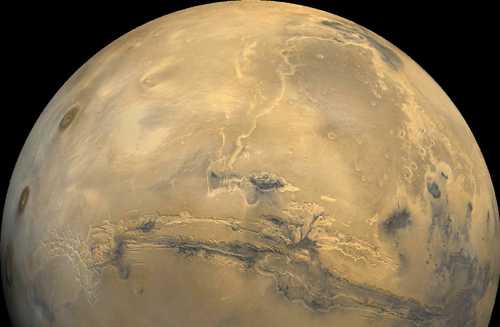
Mars the forth planet from the sun, is often called the red planet. Reddish brown sand and rocks surface acid dust in it atmosphere give Mars a reddish look Mars is similar to earth in some ways. For example Mars rotate on it’s axis in just over 24 hours. Mars is tilted on it axis. It is almost the same tilt as earth. As a result of Mars have seasons as does earth. The north and south poles are covered in ice shapes. The atmosphere of Mars is thin. As a result the surface of Mars is always cold. A high temperature of Mars is 0 degrees c. Mars has two moons: Photos and Seimos. Both moons are arrogantly shown Photos the layer of the two is only 25 cm wide. Diemos is only 15 cm action. They look more like asteroids than like moons. (See on chart below).
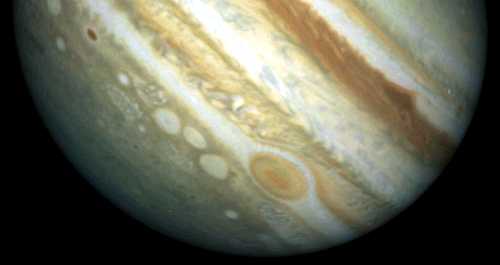
Jupiter the fifth planet from the sun is by for the largest planet in our solar system. Jupiter to the mass is more than twice that of all the other objects in the solar system except the sun.
Jupiter turns on it’s axis about every 9 hours and 50 minutes. This rapid rate of rotated can see the planet top bugles at the equator and flatter at the poles.
Jupiter’s atmosphere is 98 percent hydrogen and 11 percent airpressure within Jupiter's atmosphere increases with depth. The gases became thinker and denser until finally they becomes liquid. An ocean of liquid hydrosome surrounded the core. Deep within the planet increases pressure produces metallic hyillism. The metallic hydrogen along with the planet’s rapid rotation creates a strong magnetic fill. Jupiter’s off more energy than it receives from the sun. The temperature at Jupiter’s core is around 30,000 degrees c. Heat from the planet causes some parts of the atmosphere to be warmer and less dense than other planets. As a result, Jupiter’s atmosphere is in constant motion. Storms appear as colored spots in the atmosphere. The most striking of these is the great red spot. Jupiter has a ring and 16 known moons. The four largest were seen by Galileo. (See chart below).
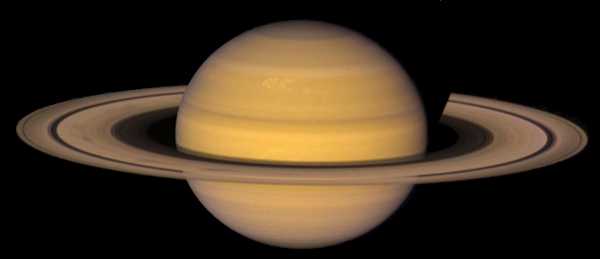
Saturn, is the sixth planet from the sun, is the second largest planet. Saturn is well known for its system of rings. The rings of Saturn can be seen from the earth by using a small telescope. Saturn’s rings are probably made of flecks of frozen gases and tiny chunks of matter covered with ice. Sunlight bouncing off these materials makes the rings appear more solid than they actually are. The Pioneer 11 spacecraft passed through the rings without serious damage.
Saturn is similar to Jupiter in many ways. Saturn is made mostly of hydrogen. The planet is thought to have a dense, hot core surrounded by metallic hydrogen, and a strong magnetic field. Like Jupiter, Saturn gives off more energy than it takes in and has a stormy atmosphere. Saturn turns on its axis in 10 hours and 40 minutes. (See chart below).
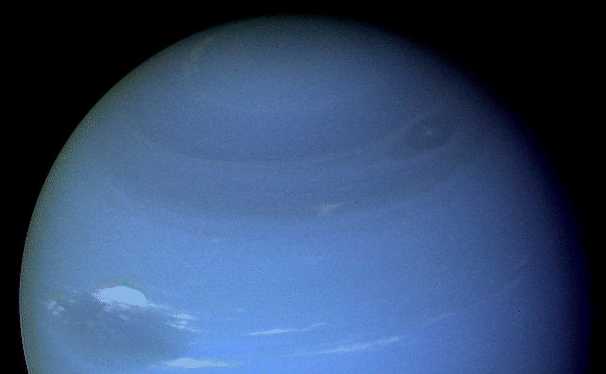
Uranus is the seventh planet from the sun and Neptune is the eight planet from the sun. These planets are often called twins planets because they are much alike. Each has a diameter about four times that of the earth. Each is composed mostly of hydrogen and helium. And each appears to be bluish-green with shaded bands.
Uranus is more tilted on its axis than is any other planet. Uranus is almost lying on its side. As a result of this tilt, at certain places on its orbit, the north poles of Uranus points almost directly at the sun. On the other side of its orbit, the north pole points away from the sun.(See chart).
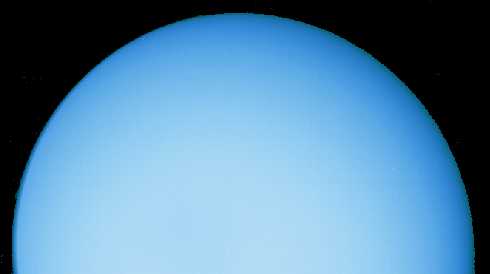
A system of dark rings encircles Uranus. Some scientist think that the dark rings contain pieces of rock. In fact the rings may be moons in the making. Besides having dark rings, Uranus has a number of moons. No rings have been found around far-off Neptune. But scientist think there may also be dark rings there. Neptune is known to have two moons, and it may have a third.(See planet).
Pluto was the ninth planet to be discovered in the solar system. Most of the time, it is the ninth planet from the sun. Notice that Pluto’s orbit crosses inside that of Neptune. So at times, Pluto is closer to the sun than is Neptune. This is the case now.
Pluto is very different from all other planets. It is the smallest planet. Pluto does not have large mass like the other outer planets. Nor does it have high density like the inner planets. It is so small and far away that little is know about it. Pluto has one moon, named Charon.(See chart).
