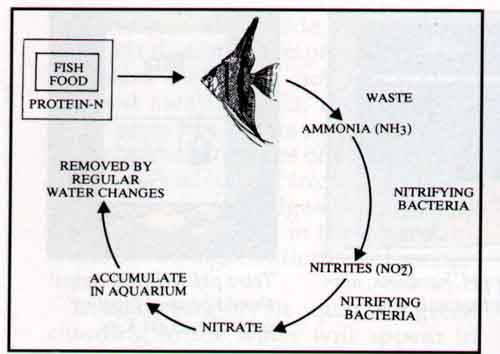

Perhaps one of the most frustrating events for a person to have to endure in this hobby..."THE DREADED TANK CYCLE." I will try to keep this as simple as possible and because I am not a scientist, I am going to use simple terms (ones that I know).
Basically, as the picture above shows, food is introduced into your tank to feed your fish and keep them healthy. The fish, in turn, excrete their wastes into the water which is usually in the form of ammonia. Ammonia is very unhealthy for fish and at high levels is deadly. This ammonia is consumed by a nitrifying bacteria that turns the amonia into Nitrites. Nitrites are also very deadly at high levels. The nitrites are then cosumed by another set of bacteria and turned into Nitrates. These nitrates are not harmful to fish unless they are left to accumulate over a long period of time and you get a huge build up of them. The Nitrates are removed by doing regular water changes and tank maintenance (which I will link below).
So what happens when you first set your tank up. The bacteria mentioned earlier live in your gravel, on your rocks, and any other type of ornaments you have that these little guys can cling to. The first bacteria to show up in your tank are the ones that convert ammonia to nitrites. These guys grow fairly fast, but they are not the bacteria that you are looking for when your tank is cycled. Don't get me wrong, they are very benificial for you tank. The next set of bacteria to show up are the ones that turn the nitrites into nitrates. These guys take a fairly long time to cultivate (usually about 3 weeks to1 1/2 month for a healthy bed of these critters). These are the guys you want in your tank. They are what help convert the toxins to a level where your fish can thrive.
During this growth period, you should never touch your gravel with a gravel syphon or moving stuff around with your hand. The reason being is because these little guys take a while to cultivate and if you move the gravel around, you break them up and in some cases, kill off some of them.
During this tank cycle these are some of the things you may experience: Dead fish, cloudy water, slow moving fish, fish breathing heavily, high ammonia, and high nitrites. Just sit tight through the tank cycle and do the following to help you through it.
Do water changes once a week. Do not touch the gravel. If you tank is cloudy, do them every other day or every day. Only take out 20% of the water. Should you do more, never exceed 50%. You will read about how to do this in tank maintenance. Don't worry about the cloudiness in your tank. It is part of the cycling process and it is only bacteria blooms in which some of your bacteria is free floating throughout your tank.
Limit your feeding as this is another way in which more ammonia is added to the tank. Only feed what your fish will eat in 5 minutes. Scoop out any excess food that is left behind. Should your ammonia levels be really high, do your water changes and cut back your feeding to every other day. Your fish will be fine.
Get your water tested either by purchasing a test kit or having your local fish store test it for you. If they are not willing to test your water for you for free, you may want to consider going to a pet store that will.
Start out with only a few fish (depending on tank size). Don't overload your tank. Should all of your fish die (rarely happens, unless an extreme error was commited) do a water change and go back to the fish store and purchase one or two more.
Be patient and sit tight. This thing will end. I promise you.
If you are unsure, e-mail me.
Once you have read about the tank cycle, you are ready to read about tank maintenance.
Questions??? [email protected]
Back to main page