Main Page
Bad Quartos?
Postmodern Shakespeare
Variant Sonnets
Poems
Links
All Content © Edmund King, 2000.
In the second half of the Sixteenth Century, a number of religious, political and literary traditions established in England since the Middle Ages were disrupted - or erased - by ideas arriving from Europe. Clerics under the influence of Luther gained ascendancy during the reign of Henry VIII, and used their authority to reform the English Church. While Henry's successor - Mary - reinstated the old religion, the unpopularity of her rule marginalised Catholicism further. When prominent Maryan exiles returned from Europe under Elizabeth, the Calvinist thinking they brought with them set the pitch of English religious opinion for the following decades.
The Reformation's attack upon Catholicism also helped to reform the economy. Church lands were broken up and sold, as were the material possessions of monasteries and convents. Many of the merchants who oversaw these exchanges grew rich by them; accordingly, much of the economic power held by the Church prior to the Reformation passed to those in trade. In turn, Puritanism gained a large number of adherents from the newly ascendant merchant middle classes. Puritanism's emphasis upon individual faith shared much ground with the ethos of early modern capitalism, and merchants found that Calvinism could also accommodate their newly obtained wealth. Financial success and the accumulation of objects could be looked upon as signs of spiritual election as well as signifiers of social status.
The lines drawn by the breaking-up of Church property, Elizabeth's accession to the throne, the return of the Maryan exiles and the rise of Calvinism intersected in the poetry of the 1580s and 90s. Verse of the earlier sixteenth century had tended to be political and prophetic. Poets such as Wycliff and Langland used the personae of shepherds and ploughmen and a rough, vernacular register to attack abuses of power and social injustices. Their work reflected a widespread dissatisfaction with Church hierarchies that intervened between God and the individual; the rural characters and their earthy, individuated language suggested that a more personal engagement with the scriptures was possible1. However, the disillusionment evident in Edwardian poetry no longer held sway during the early years of Elizabeth's reign. A belief - not unencouraged by Elizabeth - that England was an elect nation, and that Christ had already re-entered the world there in preparation for the Millennium, had gained widespread currency. Many saw Elizabeth's survival during the rule of Mary as Providential; evidence that she was among the Elect, and therefore an Elect Queen. A new kind of poetry was deemed necessary to reflect this happy state of affairs. Accordingly, poets under Court patronage began to write in a style indebted to the poetry of the Italian Renaissance, appropriating the sonnet form and neo-platonic signifiers of Petrarchan love poetry. The lushness of the Italianate forms was associated with the lushness of Italian painting, and they were seen as trappings with which to adorn the Elizabethan Court. So decorated, the status of the English Court would rise among the Courts of Europe, and it would have signs to display demonstrating its Election.
The neoplatonism that the English Court poets inherited from their Italian predecessors interpreted Classical poetic conventions from a Christian perspective. It linked platonic ideas of eternal Truths with a belief in Humanity's Fallen Condition. The timeless perfection of the Platonic ideals was seen as that of the prelapsarian world; after the Fall, earthly things were made subject to Time, and therefore to mutability. Although Platonic ideals were thought to still inhabit the world, the Fall had opened a gulf between the way objects seemed and their inner worth. No necessary connection was thought to bind an object's external appearance to its inner reality. Everything registered through the senses was therefore viewed as subject to the inconstancy of worldly things, and therefore unreliable. However, a place was reserved for poets as the diviners of the eternal haeceity of objects; it was they who could extract Golden Nature from ordinary Nature.
While appropriating these aspects of the neoplatonic tradition, poets of the English Renaissance augmented Petrarchan conventions surrounding Time with preoccupations drawn from the late sixteenth century world. The neoplatonic tradition bore the Ovidian conceit of Poetic Immortality as a counter-balance to Time as Devourer of earthly things. However, advances in clock making had given rise to a new preoccupation with Time by the time of the English Renaissance. While Time had been under Church control until the Reformation - its texture punctuated by the repeating feasts, holidays and rituals of the ecclesiastical calendar, and therefore cyclical: in the pattern of preceding years - it became an increasingly private possession subsequently.
Reforming clergy discontinued many of the Church's calendrical observances, and discouraged such yearly undertakings as Corpus Christi plays, which they saw as tainted by Catholicism. Such policies helped to open a gap between time as medium for divine action and religious observation, and the subjective experience of Time by individuals. The growing availability of timepieces, as they decreased in size and price and became practical as consumer objects, accelerated this disjunction. The movement of hands provided an image of time's passage; owners of timepieces could see their lifespans measured as they watched. By pinpointing the present moment so precisely, clocks drew attention to the segment of time lying between it and the point of death. As possession of time moved out of the Church's sphere, and into that of individuals, it became a source of preoccupation. The attention that Elizabethan poets gave to the passage of Time reflected a society-wide obsession. 2 The Ovidian idea that poetic immortality might allow author and subject to escape the reach of Devouring Time, and images of Saturn, Chronos and the Grim Reaper culled from emblem-books, are commonplaces in Elizabethan verse. 3
This paper will examine the ways in which Sidney's Sonnet 1, Spenser's Sonnet 75 and Shakespeare's Sonnet 55 - poems drawn from sequences spanning the period between the early 1580s and the beginning of James I's reign - treat ideas of time and immortality.
Sidney's Astrophil and Stella sequence was written in 1582, but not published until 1591 - five years after his death. In it, he describes Astrophil's pursuit of the unresponsive Stella, which ends fruitlessly - unconsummated. Its debt to the lexicon of Petrarchan signifiers is evident in the names he gives the characters. The likening of the Beloved to a star is a commonplace of neo-platonic poetry, while Astrophil translates as star-lover. The Astrophil contains part of Sidney's own name suggests that there is something of him in the character. Indeed, one could see this ac as a gesture towards poetic immortality by Sidney. By incorporating a syllable of his own name in the sequence's title, he is binding his identity with his poems. It seems likely that Sidney intended those among whom the poems circulated in manuscript to interpret them in the light of Sidney's attraction for - and rejection by - Lady Penelope Rich, nee Devereaux during 1582.
Sonnet 1 introduces the sequence by laying out the means and motivations that generated it. The voice is Astrophil's, but the references to poetic inspiration, writing, and the reading of others leaues (line 7) apply to actions performed by Sidney in producing the sequence. Sidney imagines himself in several positions with respect to the sonneteering tradition. In lines 7 and 8, his brain is parched ground, which he hopes to have nourished by the influence of other writers. Their work - reduced by metonymy to the leaues on which it is printed - has generative power; Sidney imagines it as spring weather, bringing fresh and fruitful showers that might germinate some seeds of creativity within him. It is as though his Beloved generates destructive waves of heat and light - likening the love object to the sun was a convention of Petrarchan sonneteering - that render the poet's mind blank, stricken, a tabula rasa. Thus sun-burnd - devoid of ideas - he looks to the tradition laid down by others to provide the fit wordes needed to fill out the volume.
In the sestet, however, he finds that his verse merely halt[s] forth; the limping metaphor provides an analogy for the unsteadiness he imagines his poetry has under the burden of others' ideas. Instead of flowing from them, he finds that they impede his verse, as though he were a child finding his route blocked by the legs of adults:
...others feet...seemde but strangers in my way. (line 11)
He is other than the Petrarchan poets who are his literary forbears. In following them, he finds himself veering from the path he wants to take; his pen is trewand (line 13) - it won't follow his will. Instead, in the last line, he resolves to set his own course across the face of the neoplatonic tradition - to look in [his] heart, rather than at others' pages, for inspiration. Rather than aiming for mere imitation, Astrophil and Stella becomes a kind of critique of Petrarchan conventions, and a demonstration through narrative that neoplatonic love cannot be practically applied.4
This approach to poetic inheritance - the reception of literary style from the past - is evident in the childbirth metaphor Sidney uses to describe his relationship to the Petrarchan canon in line 12:
...great with childe to speak...helplesse in my thowes.
Here, the poet figures himself as an expectant mother, as though impregnated by the tradition. Accordingly, neoplatonic poetry becomes a kind of legacy, or familial likeness, passed down from the past to the present. Remaining intact - constant - in this transaction, it transcends Time and therefore allows dead writers to persist into Sidney's present. Similarly, Sidney will persist after his death, imitated in the works of other writers, and living - vicariously, through his verse - in the minds of future readers. However, Sidney seems to feel uncomfortable with the way this role will make him subject to the tradition's authority. Just as a pregnant woman has no control over which familial characteristics her child will possess, Sidney feels helplesse; a mere vessel in which the past gestates, and is reborn. The lines he throws off seem to him as involuntary as the throwes a woman experiences in childbirth.
By Sonnet 50, Sidney imagines the poetry produced in this relationship with Petrarchism stillborn - finding its death in birth as soon as committed to paper (line 11). It is as though they are non-viable infants, made so by some genetic flaw. In trying to write verse so that
...in words, [Stella's] figure [might] be expressed (Sonnet 50, line 4)
Sidney finds his efforts self-defeating - ill-conceived. Thus represented, Stella's features are in weak proportion to their physical equivalents (line 7). The Platonic ideal of love lies in a different realm to that of Earthly things - one spiritual, the other unavoidably sensual and debased. Sidney/Astrophil cannot express the ideals he senses in Stella in words; to do so would be to translate her from one realm to another, to describe her in terms of Earthly things. This act would not merely sully the Platonic ideals she encapsulates, but transmute them into different stuff. Once the celestial realm is pinned down in language, it ceases to be what it was.
Sidney's attempts at linguistic reification parallel Astrophil's sexual attempts upon Stella. The only way he can imagine grasping Stella's perfection is to have sex with her - transmogrifying the ideal into the sensual (and therefore tainted and sinful), and defeating his intentions. Although he may be in love with her,
...in Stella's self he may By no pretense claim any manner place (Sonnet 52, lines 10-11).
In doing so, he would be possessing only her fair outside, not the virtuous soul, heir of heavenly bliss which marks her out from others5. Astrophil wishes in the couplet that he could have both Stella's virtue and her body granted to him, but he realises that this is not possible. Sidney's point is that the Petrarchan signifiers he puts in Astrophil's mouth do not merely miss their mark, or glance off its surface; they annihilate what they are meant to describe6. All a poet working in the Petrarchan tradition can do is create a simulacrum of his subject - a poor reflection, in earthly terms, of the Ideal Realm.
Sidney finds his legacy from the past to be a collection of signifiers that cannot, in the end, signify. He portrays himself as being as rebuffed by language as Astrophil is by Stella's virtue. However, the sense of stalemate generated by this state of affairs can be seen as an end in itself. Humanity, in the postlapsarian world, cannot encompass both the spiritual and sensual realms. The spiritual can be grasped only imperfectly, through analogy with earthly things, as the idea of a four-dimensional object may be grasped in three dimensions.
While Astrophil And Stella largely conforms to the Petrarchan tradition in having no completed structure - the characters never consummate their relationship, and the narrative trails off into anti-climax - Spenser deliberately departs from it. His Amoretti incorporate Petrarchan elements, but combine them with a hidden calendrical structure and material drawn from Scripture. While the subject matter in conventional sonnet sequences often seems random - even self-contradicting7 - that in the Amoretti appears in comparison almost mechanically generated. Each Sonnet in the sequence corresponds to one of the days preceding Spenser's second marriage on the Eleventh of June 1594. Topics, images and word-play in each have their sources in the readings set for that day in the English Book of Common Prayer.
Rather than being in conflict with Time, as Shakespeare is in his Sonnets, Spenser attempts to reconcile with it. Time in the Amoretti seems in sympathy with narrator. The Lenten period becomes a simulacrum for Spenser's fasting and self-denial in the lead up to marriage. There is an unspoken covenant in both. The penitent Christian commemorates Christ's time in the wilderness, and in turn expects to share in the fruits of the Resurrection; Spenser denies his fleshly impulses in expectation of the fruitfulness of marriage8. Time in the Amoretti has shape. It is not solely a destructive force aiming to jade the poet's love or attack the beloved's beauty, but a medium to be lived in while awaiting reconciliation, which comes at the end of the Epithalamion.
The Amoretti are Spenser's attempt to bind elements of the neoplatonic tradition to a sixteenth century Protestant framework. While in Petrarch the Ideal and the Earthly inhabit different realms, making sexual union an invalid means of yoking the two, sexuality is sanctified in Protestant marriage. Accordingly, it provides Spenser with a means to resolve neoplatonic ideals of love and human Eros into a single point9.
Shakespeare's Sonnets and A Lover's Complaint - most of the former probably written in the fifteen-nineties and perhaps revised when the latter was written, in the first years of the seventeenth century - also read like an attempt to subvert Petrarchan modes; perhaps even to subvert the traditions laid down by Sidney and Spenser. Instead of addressing a female love object, the first one hundred and twenty six sonnets are written to young man. Neither sexual union nor Protestant marriage can provide resolution for the poet's love for him. Sonnets One hundred and Twenty Seven to One hundred and Fifty Two, (with the possible exception of One Hundred and Forty Five), address a Dark Lady who seems to be the opposite of the Young Man in every way. One is fair and blond, the other dark-haired and dark-complexioned; one male, the other female; one apparently sexually unavailable, the other all too available to the poet, and others. Unlike the beloveds in Amoretti and Astrophil and Stella, the Dark Lady of the Sonnets is sexually rapacious and represents no Platonic ideals (Sonnet 130). These sonnets are separated from the Lover's Complaint by two anacreontics (153 and 154). Just as Stella is inaccessible to Astrophil because of her unyielding chastity10, the "I" of Shakespeare's Sonnets appears unable to realise his love for the Young Man because of his gender:
...Nature... ...by addition me of thee defeated, By adding one thing to my purpose nothing. (Sonnet 20, lines 10-12)
As Sidney does with Stella, Shakespeare renders the Young Man according to a variety of Petrarchan signifiers - elevating him to the level of a Platonic ideal. In Sonnet 7, for instance, Shakespeare likens him to the Sun; travelling above worldly things - set in another sphere. The fact that the poet and Beloved have identical genders appears to anchor their relationship more securely in the Ideal Realm than the heterosexual one described in conventional Petrarchan verse, as it precludes even the possibility11 of a sexual dimension. However, despite the poet's12 best intentions, the Young Man becomes sexually compromised - transferred from the Ideal realm into the sensual one. As he comes under the influence of the Dark Lady, Shakespeare depicts him darkened by corruption. Sonnets 33 and 34 return to the Sun imagery of sonnet 7, only now its face obscured in cloud. The Young Man's imagined purity - suggested in the clarity of direct light - is hidden from the poet's view by earthly impurities:
The region cloud hath masked him from me now (Sonnet 33, line 12).
The poet's mistress - the Dark Lady who seduces the Young Man in sonnet 40-2 - gives this darkness human form. Their sexual union is emblematised in the image of the Sun enmeshed in cloud - darkened to its level. While the poet can only watch their relationship take hold - like some meteorological phenomenon, beyond his control - it is he who is responsible for it. By approaching the Young Man - wanting to grasp the perfection he imagines vested there - he brings him into contact with his social circle. The Dark Lady, like some skin infection, migrates from him to the Young Man, debasing the purity he sought there. Just as Sidney finds that his verse fails to represent its subject, and Astrophil that sexual pursuit is self-defeating, the poet in Shakespeare's Sonnets destroys the perfection he seeks in the act of seeking. The effect resembles the Observer paradox in quantum physics, where the mere act of observation alters the object under view, rendering the observation meaningless.
Throughout the sequence, Shakespeare appears obsessed with Time, and its effect upon people. Time seems to him like a conscious entity. In Sonnet 63, for instance, he imagines it deploying its hours like knives to
...drain [the Young Man's] blood and [fill] his brow With lines and wrinkles (lines 3-4).
The active verbs suggest that Time acts intentionally - that it is wilfully injurious to the Young Man's beauty. Just as the poet finds himself crushed and o'erworn by Time, so the Youth will have to travel into age's steepy night (lines 3, 5). As in sonnet 1913, it is as though Time is a rival poet, inscribing a narrative of age into the Youth's brow - lines that run parallel to the poet's attempts to preserve him in verse. In both sonnets, the couplet provides a solution: as long as the poet's work has readers, the Youth will remain green - ever-young - in their minds.
Similar conceits with regard to Time operate in Sonnet 55. Verse in Sonnet 6314 acts as a defensive work within which the Young Man may shelter from Time; Shakespeare in Sonnet 55 imagines poetry offering a similar refuge-space for the Youth's virtues. In the first and second quatrains, Shakespeare compares the effectiveness of poetry to that of princes' gilded monuments15 in allowing their subjects to outdo Time. In doing so, he follows a convention inherited from Ovid's Metamorphoses16, and incorporated into the neoplatonic tradition. While monumental masonry may appear strong and stable, it is immobile and inorganic - unable to defend itself against attack. Accordingly, sluttish time is able to encompass it, as though in a layer of grime, and debase it. Because concrete, it is as subject to decay as the flesh is to temptation and sin. In both cases, Time is sluttish - a wanton inevitable corrupting Earthly things.
In the second quatrain, Shakespeare represents Time in another of its emblematic guises: a wager of war against living things. Just as a city's monuments cannot defend themselves against an army on the sack -
...wasteful war shall statues overturn, and broils root out the work of masonry (lines 5-6) -
the purely physical is wholly subject to Time's spoils. The Young Man's beauty - an expression in flesh of his inner virtues - will inevitably decay, because it exists in a physical medium. However, the poet's verse can preserve the Ideals the Youth contains in a medium outside the physical realm, and therefore not subject to Time. Shakespeare distinguishes between the purely material monument masonry provides, and the one provided by verse. Whereas a monument is fixed in time, inevitably degenerating from the moment it is built, poetry is a self-renewing medium. It becomes a living record17; its subject encoded into the minds of successive generations of readers - as though part of their substance. As long as Humanity continues to renew itself, the Youth can survive beyond death - persisting across many lifespans18.
In the sestet, Shakespeare provides an analogy for this process. The Youth will
...pace forth; [finding] room ...in the eyes of...posterity (lines 10-11).
Just as the Young Man encapsulates all that is worthwhile in Nature, and the child he is urged to produce in the Breeding Group would distil and perpetuate those inherited virtues - leaving them living in posterity19 - Shakespeare aims to pent20 the Youth within his verse. Rather than occupying a grave, he will find lodgings in the eyes of future readers. However, it appears that Shakespeare has in mind a deeper transformation. Pace suggests feet, the structural units from which verse is built. When Shakespeare imagines him pacing forth 'gainst death, his movements might be seen as conducted in measures of verse. It is as though he has been transfigured - still living - from a medium of flesh into one of words. Rather than being suspended in death until Judgment Day, The Young Man will live in - as - poetry - inhabiting the eyes of those who read it during that time.
In lines 11 and 12, Shakespeare attempts to span the distance between the poem's present and the ending doom, after which the Chosen will be no longer subject to Time. While Sonnet 60 likens Time to waves lapping against a beach, each minute
...changing place with that which goes before In sequent toil... (lines 3-4)
it is human lives that are the span - measure of - Time at the end of Sonnet 55. More specifically, Shakespeare focuses attention upon the eyes of this posterity. It is they
That wear this world out to the ending doom (line 12).
Like an object floating upon a medium of waves, he imagines the Youth borne through time upon a chain of temporally overlapping fields of vision. The lines reduce people to their capacity for sight and render Time as a thread of interwoven human lives. Accordingly, Shakespeare is able to render the space between his present and doomsday as a realm of possibility for reading; a space in which The Youth can persist after death21.
Spenser's Sonnet 75 also deals with the idea of poetic immortality. Indeed, it almost certainly provided source material for Shakespeare's poems on the topic. In the first quatrain, Spenser describes twice writing his beloved's name in sand, and seeing it both times erased by the tide:
...came the waves and washed it away (line 2).
The tyde is one of Time's repeating processes - ceaseless but predictable. Here, however, Spenser figures it as an embodiment of Time the Devourer, praying on his paynes as an animal might. The equation is straightforward - emblematic. Spenser does nothing further to suggest that the tide is predatory, or has a maw.
In the second quatrain, his Lady rebukes22 him for his vanity in attempting
A mortall thing so to immortalize (line 6).
Her choice of words emphasises the seeming paradox in Spenser's actions. Mortality and immortality are opposites; they occupy different realms. It is difficult for Spenser's beloved to see how she can cross from one to the other. Indeed, she makes clear her awareness that she is subject to Time the Devourer. Just as the sea washes her name from the sand, she knows that she
[her]selue shall lyke to this decay and [her] name bee wyped out lykewise (lines 7-8).
As Shakespeare later does in Sonnet 55 however, Spenser distinguishes between purely physical commemoration, and one that takes place in a non-physical realm. While characters inscribed in sand are soon erased because of the instability of their medium, verse can eternise its subject. Spenser imagines that his poetry can
...in the heuens wryte [his beloved's] name (line 12) -
transfiguring her from the Earthly to the Ideal realm outside Time.
Other than quoting the authority of Ovid in line 10, Spenser does little to explain by what process his verse will gain his lady immortality. Unlike Shakespeare, he avoids analogies which would create only a simulacrum of understanding. Instead, the greatest justification he provides is that he and his beloved will soon marry. Accordingly, in lines 13 and 14, he invokes the religious commonplace that marriage will continue in heaven once Judgment Day passes:
Where whenas death shall all the world subdew, Our loue shall liue, and later life renew.
Ultimately, Spenser seems to have little trust in the signifying power of Petrarchan conventions. Although he invokes the immortalising conceit, he justifies it using material he has imported into the sequence from outside the Tradition. In Spenser's schema, Neoplatonic signifiers are made subject to those arising from Protestant religion.
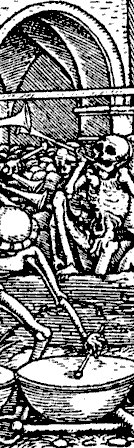
It is evident that the three poets examined here regard neoplatonic conventions as, at best, incomplete poetic solutions. They are useful as source material, but each feels the need to augment, or take issue with, the Tradition as they write. Sidney feels uneasy as an heir to literary forbears and is eager to make his own way. Spenser views the tradition as a storehouse for poetic devices, but it is only a subset of the total number of referents he uses. While he is happy to employ signifiers like the immortalising conceit and Time the Devourer, his conception of Time continues to be an ecclesiastical one. Shakespeare, despite an apparent desire to subvert Tradition, places both classical and contemporary uncertainties about time near the heart of the sequence. Ovidian ideas occupy space next to emblems of Time taken from Holbein, references to clocks and time observed in natural cycles. . The poems catalogue a series of temporal obsessions. The poet wants to arrest ageing in the Youth through his verse, but finds his relationship with him degenerating - as though through natural processes - as it grows older, and both the poet and the Dark Lady lie about their ages. The collection is a microcosm of Elizabethan concerns about Time arising from the disruption of the Medieval order.
All Content © Edmund King, 2000.
___________________________________________

Henginger Jr., S K Sidney And Spenser, Pennsylvania University Press, 1989
Kerrigan, John A. The Sonnets And A Lover's Complaint, Penguin, 1986.
Norbrook, David Poetry And Politics In The English Renaissance, Routledge and Kegan Paul, London, 1984.
Oram, William Allan Edmund Spenser, Twayne, New York, 1997.
____________________________________________
1 Norbrook, David: Poetry and Politics in the English Renaissance, Routledge, 1984, p41-2.
2 Kerrigan, J (ed) The Sonnets And A Lover's Complaint, Penguin, London, 1986, p. 34
3 Idem.
4 Heninger Jr, S K - Sidney And Spenser, Pennsylvania University Press, 1989, p 484.
5 Sonnet 52, line 7.
6 Heninger Jr, S K, p 485 - "To reify is to annihilate".
7 In order to portray the conflict of passion and reason in a mind stricken by obsessive love.
8 Oram, William: Edmund Spenser, Twayne, New York, 1997, p 190.
9 Oram, p 177-8.
10 While the obsessive repetition of Lady Rich's married surname in Sonnet 37 makes clear the reason that Sidney cannot possess her.
11 Disregarding the possibility of a homosexual union, although several commentators feel that sonnet 20, especially, suggests one.
12 Or, perhaps more accurately, the poet's persona's.
13 O carve not with thy hours my love's fair brow, Nor draw no lines there with thine antique pen (lines 9-10).
14 Line 9.
15 Lines 1-2.
16 Kerrigan, pp 240-1 - notes to Sonnet 55.
17 Line 8.
18 A similar voicing of the immortalising conceit occurs in Sonnet 81, lines 9-11:
Your monument shall be my gently verse Which eyes not yet created shall o'er-read, And tongues to be your being shall rehearse.
At the same time, Shakespeare imagines himself lying, unremembered, in a common grave. It is perhaps ironic that the sequence has achieved the opposite of its stated intention. It is the author, rather than his subject, who has remembered because of it.
19 Sonnet 6, line 12.
20 Sonnet 5, line 10.
21 Translated from a physical medium into a mental one.
22 It is unusual for a neoplatonic love object to have a speaking role in a sequence addressed to her. It could be that Spenser is alluding to the ideal of relative equality within marriage that the covenant was intended to promote.
