This is the art section. This section will be lead by Marie Kristine Agunod and Mary Conception Clapano.
I will show you some pictures to start with.
*Note-click on image to enlarge
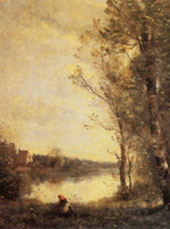
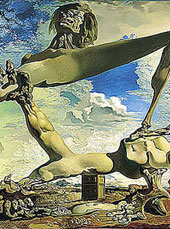
By a Russian painter.
From Kyle Hunter.
A painting by Carlos Diaz.
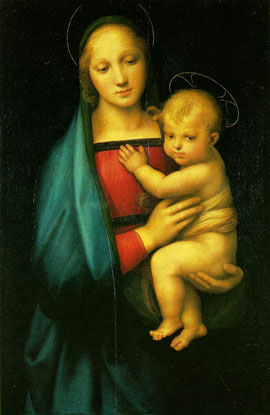
A painting by Raphael.
Now I will give you some ceremonies.
Dance Ceremonies
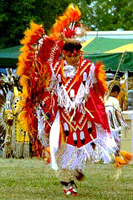 Ladies Fancy
Ladies Fancy, the newest style of Pow Wow dancing, represents the butterfly. The outfits worn for this dance are exquisitely designed and have vibrant colouring. The ladies wear shawls over their shoulders which extend past their knees. Women who dance in this fashion are usually physically fit, for they must jump, spin and use very fancy footwork. When these ladies are dancing, their movements must be synchronized with the fast drum beats of the music. The Ladies Fancy dance style is similar to that of the Men�s Fancy.
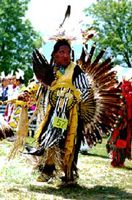 Men�s Fancy
The young men who dance in this fashion perform cartwheels and splits and therefore they are generally quite fit. Fancy dancer outfits are often brightly adorned with colored feathers, fluffs, and very detailed beadwork. This dance style did not originate from our ancestors, but was made to attract and entertain visitors. Women�s Traditional Women�s Traditional is the strongest dance. While gracefully dancing, the dancers� feet never leave the ground. This symbolizes the closeness we have to the earth, our Mother. These dancers are very highly respected, hence, all spectators stand in honor of them.
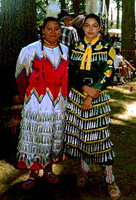 Jingle Dress
The Jingle Dress is very highly respected garment because of its sacred origin. The significance of the dress stems from the following story: The father of a very sick young girl decided to pray and offer tobacco to the creator, to help his daughter recover. In a vision, the man was told to make his daughter a dress composed of metal cones. This dress had 365 cones on it, representing each day of the year. His daughter would have to wear this dress to get well. The girl�s father was then instructed to have a feast, thanking the creator in honor of the dress. This is why the Jingle Dress is to be treated with great respect.
Grass Dance
The Grass Dance is very popular all over the country, especially in the north. Grass dancers are usually smooth and quick. A Grass dancer�s outfit usually consists of a belt, side drops, cuffs, headband, roach feather, moccasins, ribbon, fringe, and a scarf.
Next off, I will give you some of the filipino dances.
Filipino Dances
The coming of the Spaniards in the 16th century brought a new influence in Philippine life. A majority of the Filipinos were converted to Roman Catholicism. European cultural ideas spread and the Filipinos adapted and blended to meet the local conditions. These dances reached their zenith in popularity around the turn of the century, particularly among urban Filipinos. They are so named in honor of the legendary Maria Clara, who remains a symbol of the virtues and nobility of the Filipina woman. Maria Clara was the chief female character of Jose Rizal's Noli Me Tangere. Displaying a very strong Spanish influence, these dances were, nonetheless, "Filipinized" as evidence of the use of bamboo castanets and the abanico, or Asian fan. Typical attire for these dances are the formal Maria Clara dress and barong tagalog, an embroidered long-sleeve shirt made of pineapple fiber.
Alcamfor
(ahl-kahm-FOHR)
From Leyte comes this couples dance in which the girl holds a handkerchief laced with camphor oil, a substance which supposedly induces romance.
Andaluz
(ahn-dah-LOOHS)
Also known as Paseo de Iloilo, for its province of origin, this is one of the most sophisticated courtship and flirtation dances of the Spanish era. The gentlemen compete among each other to win the heart of the dalaga, or young lady, by exemplifying chivalry, grace, and confidence.
Aray
(ah-RAHY)
A dance whose words are sung in "Chabacano-ermitense," a hybrid of Spanish that was only spoken in the Ermita district before the turn of the century and today is extinct. The dance itself is a flirtatious one that involves graceful use of the pa�uelo, or shawl, and tambourines. Aray means "ouch" in Tagalog.
Balse
(BAHL-seh)
Derived from the Spanish "valse" (waltz), this dance was popular in Marikina, Rizal province, during the Spanish times. Balse was performed after the lutrina (a religious procession), and the music that accompanied the dancers was played by the musikong bungbong (musicians using instruments made of bamboo).
Cari�osa
(kah-reehn-YOH-sah)
This flirtatious dance is known throughout the Philippines. Cari�osa means affectionate, lovable, or amiable. With a fan or handkerchief, the dancers go through hide-and-seek movements and other flirting acts expressing tender feelings for one another. There are many versions of this dance, but the hide-and-seek movements are common in all.
Next Page