
If you have already read "The
Standard Book of Spells Grade 1" you might have realised that what
you shall learn this unit are the basic spells you MUST learn in your first
year, if not, then you'll have a hard time as you go through HOL.
The art of spellcasting is a very refined and
ancient art, dating back to 20000B.C..
One of the most important parts of casting a
spell is the mental connection of the wizard/witch with:
a) the wand in his/her hand
b) the magical core substance
at the center of the wand.
You'll usuall get a tingling feeling through
your fingers as you recite the incantation, this is the core "saying":
"I hear you, I shall do as
you say!"
after a while, this will also tell you if you
have recited the incantation correctly.
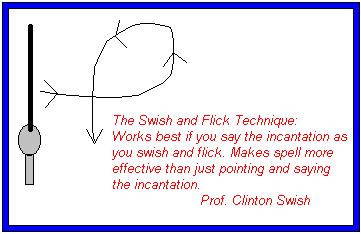
Also, don't forget the Swish and Flick
Technique developed by myself 30 years ago ((below)). It is widley
accepted by many wizards and witches as it helps the flow of magic.
The age old Point and Recite technique
can still be used, but you won't get the same energy flow, as the wand
itself isn't moving.
Homework: Lesson 1; Piece 1
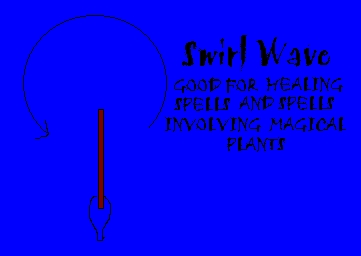
Draw up another wand movement (invent one) and give a detailed
explanation, at least half a page, stating how it works to help the
flow of magic.
Extra Homework:
Write a half page stressing th need to pronounce an incantation properly (you may use your parents old spell books or the Charms Library for this)
Magic (sorcery), art of influencing the course of events or gaining
knowledge by supernatural means. Magic is linked to alchemy, occultism,
spiritualism, superstition, and witchcraft. The term is derived from the
ancient Persian magi, whose priestly occupations included dealing with
the occult. The ancient Greeks and Romans also practiced magic. According
to anthropologists, magical beliefs and practices exist in most less-sophisticated
cultures. Moreover, magical beliefs and practices, such as fortune-telling,
communication with the dead, astrology, and belief in lucky numbers and
charms, survive even in the most advanced cultures.
Magic in simple societies utilizes nearly all knowledge, including
scientific and medical knowledge and practices. The modern sciences trace
their origins from practices and beliefs that were originally magical.
Thus, medieval alchemy led to the development of modern chemistry and physics,
and astrology led to modern astronomy.
Magic is divided into two main categories: white (or good) magic and
black (or evil) magic. White magic is used to heal and to counteract the
effects of black magic; the latter is invoked to kill or to injure, or
for selfish gain. During the Middle Ages black magic consisted of witchcraft,
sorcery, and the invocation of demons; white magic consisted of the tolerated
forms, such as astrology, hypnosis, and herbalism.
Magical practices may be grouped under four headings. The first, called
sympathetic magic, is based on symbolism and wish fulfilment. Desired effects
are accomplished by imitation or by making use of associated objects. Thus,
it is thought, one may injure enemies by sticking pins into images of them,
by mentioning their names in a spell, or by burning hair or nail parings
from their bodies. Similarly, the strength, fleetness, or skill of an animal
may be acquired by eating its flesh or by using tools made from its skin,
horns, or bones. The practice of cannibalism is based on the belief that
by eating the flesh of an enemy one will acquire the qualities of that
person. A second major magical practice is divination, the acquisition
of secret knowledge by sortilege (casting lots), augury (interpreting omens
or portents), astrology (interpreting the positions and conjunctions of
the stars and planets), and tongues (inspired utterances by people in a
state of trance, by oracular priests, or by mediums). The third form of
magic is thaumaturgy, or wonder-working, which includes alchemy, witchcraft,
and sorcery. The fourth form of magic is incantation, or the chanting of
spells, verses, or formulas that contain the names of supernatural beings
or of people who are to be helped or injured. Magic rituals are generally
a combination of these forms.