a Catholic Church
Corpus Christi Church
Clifton Nottingham
| Around and About a Catholic Church |
A Tour of Corpus Christi Church Clifton Nottingham |
|
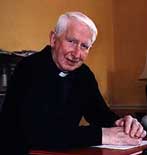 |
Cardinal Basil Hume wrote a number of Spiritual Reflections. Among them was a Reflection on the Mass. This has been reproduced below. The Mass Every time we celebrate Mass all the suffering and agony of mankind is present. Through that offering, love, forgiveness and hope are in some way being given. Not just to this community; round this altar but, like the pebble cast into the pond, the ripples go on and on outwards. So the Mass makes present that one complete Sacrifice of Christ, reenacted through the consecrated bread and wine - the Body and Blood of Christ transcending time and space, enabling us to be present at the foot of the Cross, and close to the empty tomb. It is our earthly way of being involved in the great heavenly liturgy which is going on all the time. It is the Church's most precious treasure. It must be ours. The Mass meant so much to the English martyrs, they risked so much just to be present. I feel just a little ashamed when I think how devoted they were. But these great people inspire us to find out more about the Mass, and to love it as they did. At the heart of that worship (Mass) must be a profound faith in the real presence of Our Lord in the Blessed Sacrament, and, as a result, an attitude of adoration and reverence. Is not the Mass both Sacrifice and Communion? And the altar, is that not both the place upon which the Sacrifice is offered, and the table for the sharing of His Body and Blood? If we forget either aspect, we fall into error. You cannot live without food, you cannot live without love. Now you see why He gave us Himself in the Eucharist. He would not abandon us. He would give us love, give us food. No greater proof of His love for us can there be than the Eucharist. It is a personal gift every time we receive Him in Holy Communion. He meets the need we have for spiritual food. In a lifetime of attending Mass, or celebrating it as a priest, we shall never; never begin to understand all the riches which are contained in the Mass. Choose a moment in your life where you would like to be, if you had the choice. I would like to think we would choose to stand at the foot of the Cross and somehow share His suffering, to be one with Him, giving ourselves to our heavenly Father. Whenever we attend Mass we are able to be, so to speak at the foot of the Cross, sharing in His Sacrifice. If there is another moment where you would choose to be, it might be on that first Easter Sunday, in the garden with Mary Magdalen. What a joy to see His hands - with the wounds still in them - touching us out of love. I was once invited by a Jewish family to celebrate with them the Passover, and the experience was almost transforming in my understanding of the Mass. It was at the Paschal meal that Our Lord took bread and changed it into His Body and took wine and changed it into His Blood, so that this meal should commemorate events more important than those concerned with what we call the Exodus. There was a great difference between the two meals. The first merely commemorates past events. The Mass does more. It is a way of bringing into the present what took place on Calvary and at the Resurrection, through the consecrated bread and the consecrated wine; "Do this in memory of Me." You and I could not have devised a way of making the Passion, death and Resurrection present for all men for all time. Only God could devise what He has, in fact, devised; for every time the Mass is said the Sacrifice of Calvary is repeated. Every time you receive Holy Communion the life of the risen Christ is given to you. We witness two things: our gift to God and the gift of God to us. It is Christ who gives Himself to His Father together with ourselves, and it is Christ who is given to us in Holy Communion. The Real Presence God is everywhere, in everything. When you see something beautiful - a sunset, a mountain, a stream - these are reminders of God's presence, revealing His beauty. But when we talk about the Real Presence, His Sacramental presence, that is a very, very important concept. The Real Presence is actually in the consecrated bread and wine. When I go into a church I always genuflect. Why? Because I believe that in a marvellous way, far beyond our understanding, Christ is truly present in the Tabernacle. If you ask me how this is, then that is theology. But you genuflect because Christ has said it is so. If you try and work out how and why it is, you will never get there. You receive that truth from Him. As in friendship, love between two people, you don't work out why you love them - it would kill the spark between you if you analyse it. But once you love a person then you grow in the knowledge of them. That is what faith is like, the beginning of a love story. The more you get involved then the more you begin to trust. Cardinal Hume wrote the following in his book "To be a Pilgrim" You should make the Sunday Mass the high point of your week. It should be recognised as the most important event in your life. Much of the Mass may be uncongenial to you. I mean it may not be celebrated in a dignified manner; you may dislike the translations of the prayers and the readings; you may find the singing and the music hard to tolerate; you may even find attendance at Mass boring. At one level of our experience, this does, of course, matter; but in fact at another level - the more important one - it should not. The Mass is always the Mass, and the reality of Christ's sacrifice made sacramentally present is always achieved when Mass is celebrated The Mass is always a sacrifice, the Sacrifice of Calvary re-presented, made present for us once again so that we may be, in some manner, involved in it. Here is one of the deep mysteries of our faith; in his death is our life. Sacrifice as a concept, as an idea, is always related to adoration, to worship. Awe and respect should never be absent from any Mass. Yet there is another aspect which is no less important. We see it clearly in St Mark's account of the Last Supper. Although the Last Supper was a ritualistic meal, the annual celebration of the Passover, the high point of the Jewish year, nonetheless it was clear that Our Lord was with friends. The atmosphere was, as it were, more relaxed. This aspect we call communion, which suggests intimacy, closeness and love. That aspect should always be present too. |
| Return to The Mass | Return to Sanctuary | Return to Tour Plan | Return to Web Homepage |