Horse Trainer. . .
Dodson Continues Family Tradition
Story and Photos
by Mildred L. Brown
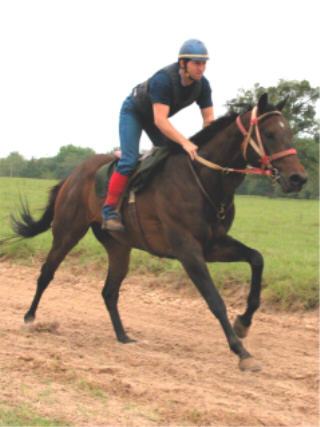 Whether it is thoroughbreds or quarter horses,
the Dodson name is well known. You will find the name in winning
records at horse shows and racetracks. Cliff Dodson of Athens is a
second-generation trainer of racehorses and well known in the horse
industry.
Whether it is thoroughbreds or quarter horses,
the Dodson name is well known. You will find the name in winning
records at horse shows and racetracks. Cliff Dodson of Athens is a
second-generation trainer of racehorses and well known in the horse
industry.
In 1999, Dodson began operating the training facility his
parents built many years ago north of Athens, off of Texas Highway
19. Horses in his barn include both thoroughbreds and quarter
Horses. They come from farms as far away as Georgia and Kentucky.
His
mother was a trainer and his dad was a jockey. At age 2, his
parents followed racing circuits from Texas to Broken Bow, Neb. to
Tioga, N.Y. When the New York meet ended, the Dodsons returned
to Athens, where Dodson graduated from high school in 1993.
Having
grown up around racetracks, Dodson said he would never work with horses
when he finished college.
�After being away from them for a
while, I discovered that I missed working with horses,� Dodson said
of his first year at college. �I began working for area trainers
and soon realized that�s what I wanted to do.�
Pari-mutual racing
was new to Texas when his horse was entered at Manor Downs near Austin. She placed second, her only race after returning to the track. Dodson
was still in high school.
Dodson�s mother, Janie Smith was training
a gelding that ran third in his only race, but the owner was impatient
and decided to sell. Dodson bought the horse for $500. Two weeks later, he won his first race by 18 lengths. The horse entered
the winner�s circle five times earning money for college tuition fees. His next horse won four races at Lone Star, earning about $40,000.
Cliff
Dodson�s workday is from sunup till whenever. He feeds, waters,
mucks stalls, trims hooves and fits horses with racing plates. He is trainer, exercise rider and groom. At times, he acts as
a vet. He is a hands-on trainer who strives to keep in touch with
the horses he is training.
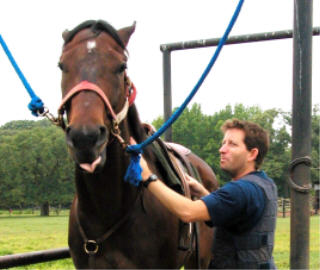
The first stage of any horse�s training
is termed breaking. It is the foundation for any horse that
is to be ridden. His young horses begin their training from the ground. After learning that a saddle isn�t their enemy, Dodson drives them. Next, he rides them under western saddle for several weeks.
Dodson
exhibits remarkable patience with young horses that greatly enhances
his ability to win their confidence. The bond that man and horse
develop during early stages of training will affect their working
relationship. Even under the best conditions, situations can
turn bad resulting in injury for the rider or the horse.
 �A lot of
trainers rush them too fast to the track. The breaking phase teaches
them to listen to their rider,� Dodson remarked. �This way,
when they reach the track, they respond to the jockey�s commands.
�A lot of
trainers rush them too fast to the track. The breaking phase teaches
them to listen to their rider,� Dodson remarked. �This way,
when they reach the track, they respond to the jockey�s commands.
�Teaching
them to ride,� he said of a young horse he was breaking, �builds a
foundation that allows them to become good riding and using horses
when they are sent home.�
When asked why he returned to Athens rather
than remaining near Stephenville where he had earned a good reputation
as a young trainer, Dodson replied, �Mostly the soil.�
The area north
of Athens where Dodson�s stable is located consists of sloping hills
and deep sandy soil. The soil provides an excellent base for conditioning
the feet and legs of the horse in training as they gallop around a
five-furlong exercise track.
�Another reason is location,� Dodson
continued. �It is closer and more centrally located to a number
of tracks, Lone Star, Sam Houston, Delta and Louisiana Downs.�
�I look
at a horse�s confirmation,� Dodson answered when asked what he looks
for when considering a horse for training.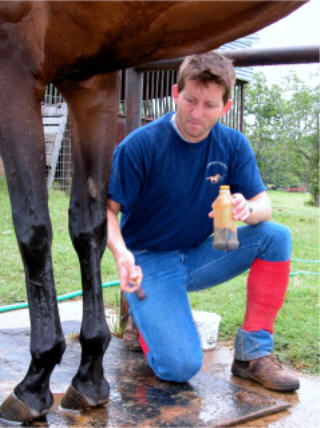
�I want a horse whose confirmation
is balanced, and its pieces fit together. Straight legs are
important, but they need more.
�Attitude is also important. A willing
horse is usually a better runner because they try harder,� he continued.
�Breeding,
of course, must be considered, but isn�t as important as most people
believe,� Dodson remarked. �Just because the horse isn�t by a $50,000
stallion doesn�t mean he can�t win races!�
�I want a horse that gets
a check every race. A bad race would be fourth or fifth, but
it would still earn a check. It�s a good feeling to know that they
put in a good effort every time. These are the horses that will
evidently make the winner�s circle.�
Listening to him talk, and watching
him work one easily understands why horses respond to his touch and
command. Genuine concern for the well being of the animal is
displayed in every move this young trainer makes.
�Perhaps the hardest
thing is knowing when a horse is ready to run.� Dodson continued,
�A horse must be in shape but sound � too much work and they get sore;
too little work and they�re not fit.
�If you want to get into racing
fast, the best thing to is claim a horse that is already on the track,�
the trainer said. �Doing this gives the owner an opportunity to be
in the money the next time the horse runs.
�Of course, if a person
wants to feel the pride of their own horse winning, they should raise
a foal to racing age,� Dodson advised. �There is a lot of work to
raising a horse, with a lot of expense involved. You�re looking
at three years before most horses are track ready.�
One challenge that
every trainer faces is telling an owner that his horse will not make
the track. Everyone who puts an animal in race training believes
that his horse will reach the winner�s circle.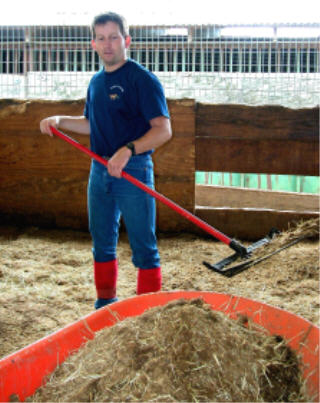
�It is difficult telling
people their horse doesn�t have what it takes to race,� Dodson said. �Not everyone can win. Somebody has to be last!�
Dodson said
his goal isn�t to have a Kentucky style farm with rows and rows of
horses in training. He doesn�t think he�ll ever be a trainer
who tells others what to do and let them do the work he loves so much.
He simply hopes to create a nice stable of steady runners for his
clients and himself.
�I don�t think I will ever give up exercising
them,� Dodson said, and then laughed. �But, I could do without cleaning
stalls!�