
CCC 1933-1942

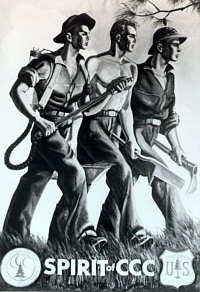
painted in 1938 by Harry Rossoll
Harry later became well known as one of the artists of Smokey the Bear.
Camp S-57 �Fishing Creek�
Company 2302 was organized in the spring of 1933 of approximately 200 men that were already being condition at Ft. Meade. They were sent to Camp S-57 located at Fishing Creek, 10 miles north of Frederick Maryland. Until November of that year the camp consisted of tents. In November work was completed on seven buildings, which consisted of a headquarters, a mess hall, a sawmill, and four barracks. Thus making living conditions more comfortable for both the officers and the men. Some other items including a common area with a fountain and a picnic area were also added to the camp.
The camp remained in operation until the early 1940�s when the CCC was disbanded due the war effort. During this time the camp kept a steady roster of men. These men or �boys� as they were commonly referred to worked on many projects throughout the area including Gambrill State Park (they built a portion of the building you are currently in as well as the 3 overlooks, the Tea Room, and a park headquarters). They did a large amount of work in the Frederick Watershed as well including building roads, fire lanes, fire towers, and blazing trails just to name few of the projects. The work was hard and carried out in all types of weather.
The �boys� worked a 40-hour week and were paid $30 a month of which $25 was automatically sent home to their families. The additional $5 was for their spending money during the month. Most of this money was probably used during visits to nearby Frederick or as trip money to get home.
Along with the work the �boys� also had the option of attending classes ranging from general subjects such as physics, citizenship and first aid to academic subjects such as reading, writing, civics, and arithmetic. Vocational subjects were also offered such as typewriting, forestry, and auto mechanics. The �boys� also learned while working on the varied projects that were assigned. Skills such as masonry, woodworking, and plumbing were able to be put to use by many of the enrollees in their professional careers.
During free time the �boys� had several recreational choices to choose from including reading, shows, and several competitive sports. Baseball games were held between other camp teams in the district and allowed the �boys� to cheer for their team. Boxing was also quite popular with matches being held in Frederick from time to time.
We owe a lot to the �boys� of Camp S-57 as well as those that served in several hundred other camps across the country. Much of the work the CCC did is still with us today.