
previous
Now don't get me wrong, I'm all for conservation. I even use those new 11 watt bulbs that cost me like 5 bucks each at Ikea. The problem is that conservation reduces energy demand but it does not eliminate it and it certainly will not stop it from climbing higher. Some policies that I have seen published advocate closing existing plants or at the very least banning construction based on claims that conservation makes them unnessecary. This there is no doubt about it...this is rubbish and their own math does them in. It is literally beyond me how someone can advocate an agressive (and very expensive) conservation program to save 40 MW of demand and then turn around and call for the closure of a 600 MW plant because "we don't need that supply anymore."
Every major indicator of standard of living climbs higher closely with energy demand. This used to be a 1-1 relationship. In recent years with advances in efficiency and conservation efforts that 1-1 symmetry has been broken. But they still climb higher together and always will. Conservation will lessen the rate at which we need to add more supply but it will not eliminate it.
What about renewables? Wind, Solar, Biomass, Hydro??
Well first hydro which qualifies as a large scale source of power. The problem is major eco-system changes so opposition is fierce to new plants. But also, most sites for these major dams are already built on. There is literally no room for expansion (in North America). So the supply from this source is constant and as a result the percentage of supply it provides will gradually diminish.
Solar and biomass have their supporters. I'm not so familiar with biomass but hear very low potential numbers because of expensive processing facilities which are needed. Solar is very low efficiency and as a supplier to the grid probably not ever going to be cheap and reliable enough.
That leaves wind as the major candidate.
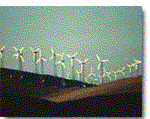
Plus would the installed capacity equal the same electricity? Nope. Wind turbines usually max out their capacity factor at around 30% while Nuclear Plants operate in the 80-100% range. That means, essentially, that the supply from wind power is unstable. This is a direct result of it being a diffuse and intermittent source. The practical side of this is that to keep the grid stable wind power cannot supply more than 10% of peak demand. That's a tough concept to grasp for traditional environmentalists. We can look at Denmark, 2400 MW wind capacity, 18% of demand...a beacon to the rest of the world on many enviro websites. What they fail to mention is that Denmark has to import huge amounts of electricity from neighboring countries because their grid is unstable. If they didn't: brownout or blackouts...constantly.
Let's do a little math to show this phenomenon in action. These numbers come from Ontario Power Generations website about their wind turbine at Pickering, Ontario.
Turbine: 1.8 MW
Turning: 99% of the time.
Electricity: 2.9 GW-hours
Pretty impressive, eh! Turned 99% of the time...where does the diffuse and intermittent come in?
Let's look:
1.8 MW / 1000 = 0.0018 GW
0.0018*0.99*365*24=15.6 GW-hours
So, in other words, a 1.8 MW turbine turning 99% of the time shouuld have produced 15.6 GW-hours but this turbines only produced 2.9 GW-Hours. Around 18% of what it was supposed to.
That is diffuse and intermittent in action. it occurs because the turbine acheives peak efficincy at one speed, as the speed differs the efficiency drops rapidly to either side of ideal. While wind may blow almost constantly in some areas it certainly doesn't blow at constant speed (wind gusts!) and that creates instability.
Well if wind can't provide all our energy Nuclear certainly can't either. Putting your eggs in one basket is not the name of the game in electricity generation. Nothing is a panacea. The key to a succesful, reliable, envrionmentally sound, cost effective grid is diversity.
This means incorporating nuclear (capable of large scale), hydro (large), wind (10%), other renewables (5-10%), and yes even fossil!
Fossil is needed because of their great flexibility. They can run cost effectively at low capacity and can rapidly change their output to meet peaks and valleys of demand and help smooth out instability from renewables.
The lesson is that if we want a zero-emmision power generation infrastructure a large portion of that must come from nuclear power.