
Previous
Next
There are every so often news reports or studies done that claim to have uncovered huge numbers of cancers directly attributable to Nuclear Plants. The follow up is that nearly all of them are subsequently proved to be false, or data to have been manipulated, or written by no one in the scientific community. One good standard is to see whether the research has been published in a recognized, peer reviewed journal. Although this process is not foolproof it seperates, on the surface at least, the wheat from the chaff. With one exeption every "killer radiation" study I have seen does not pass this most basic of tests.
Let's step back and grab a little context. Radiation is complicated and hard to summarize but a few points are key. Large, acute (immediate) doses cause death, radiation sickness or cancer. This would be the situation in , for example, a nuclear bomb drop. Since all large scale data on radiation effects was in this level (from Hiroshima and Nagasaki) when civilian nuclear plants came on-line; regulators chose to err on the side of caution and adopt a "Linear No Threshold" approach to radiation safety. What this means is the doses and results of an atomic bomb explosion were extrapolated in a straight line to 0 dose and 0 effect...assuming there was no safe threshold for radiation exposure. This led to the ALARA approach (as low as reasonably acheivable) to limit exposures.
Now that we are 50 years on some data has been collected from various sources regarding low level(small), chronic (long term) radiation exposure that is directly applicable to Nuclear Power. There is, however, three seperate arguments about the effects. This ambiguity stems from the fact that both radiation and cancer are extremely complicated subjects governed by probabilities and huge numbers of factors. Nevertheless here are the three schools of thought:
-Low Level radiation causes cancer. As I mentioned above I have come across only one group, radiation.org, who even claims they have been published in scientific literature.
-Low Level radiation is beneficial. A new development, radiation hormesis states that between certain levels radiation is good for you. It has been proven that in the absence of backround radiation health deteriorates. A study of sailors working in nuclear submarines found a boost in the immune system when they were exposed to low level radiation.
-Low level radiation has no effect. A little simplistic but this is the view of the majority of professionals in the radiation industry. Simply put, the exposure an individual receives is so low when compared with natural backround radiation that it has no discernable effect. The ALARA principle should be maintained for safety sake but it is merely precautionary. In conjunction with the National Cancer Institute the HPS points out a landmark study during which 52 nuclear installations (some with several reactors) and the cancer rates in surrounding counties were compared to control counties of similar size. The result: no effect on cancer rates.
It is an intersting fact that one receives less radiation from an entire year of nuclear operations (maximum doses) than they do from one coast to coast flight! Similarly moving from a sea level location to Denver can almost double your yearly exposure!
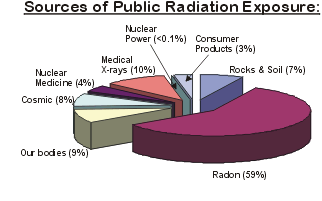
It is interesting to note that human beings themselves contain enough radioactive elements that if 2 of us were to be isolated and classified as a nuclear experiment we would be monitored and controlled by a regulatory body!