Provisions
for the Permanent Disposal of Nuclear Fuel Waste.
Andrew
L. Daley
Department of Mechanical
Engineering
Abstract
Around the world the disposal of nuclear waste
is an important issue. Philosophies for
disposal may vary in different regions and the response of
- Introduction
The life cycle of the nuclear fuels used in power
production is a long one. Residual radioactivity
from this fuel means that in order to protect humanity there must be provisions
to isolate the fuel for time periods of the order of 10 000 years [1]. Currently, there is no operation in place
that is capable of storing nuclear material for these significant time periods
[2]. At this time the spent nuclear
fuels are placed in containment devices located in on-site repositories. For the first 3-10 years they are kept in
pools of water which helps to dissipate the large amount of heat that the spent
fuels will initially emit [3]. After
this they are transferred to dry storage for the remaining life cycle of the
plant. This method of storage was
implemented with the assumption that, at a later time, a permanent repository
would be built and the waste from each individual plant would be transferred to
this central repository [4]. Despite
this assumption only two countries, the
Because of the heel dragging by lawmakers in
deciding what to do the problem has started to creep up on society. Current projections indicate that the current
availability of short term storage facilities (both wet and dry) located
on-site at reactors will be exhausted in 2017 [4]. Either more short term storage or permanent
repositories will
have to be built by then. There are several philosophies regarding long
term handling of waste. The so called
“wait and see” approach depends on dry storage exactly as is already involved
in the life cycle of nuclear fuel. By
building more dry storage facilities the capacity will increase. These facilities have proven to be safe and
may be readily supervised. Another
approach is to deposit the waste in repositories deep underground with many
barriers in place. This would eliminate
the need for human supervision. The
technical aspects are compelling themselves but there are many non technical
issues involving the decision on how to store nuclear waste. It is important to investigate what these are
and how they can be resolved.
- Non Technical Issues [7]
The non-technical side of nuclear waste
disposal issues centres on ethical, social, and economic aspects of the
problem. Each of these aspects must be
properly addressed before the development of permanent repositories can
proceed. There are, of course, people
and organisations that would prefer nuclear power to be shut down altogether. This paper assumes that nuclear power
generation will, in the future, be an important, greenhouse gas free, source of
power. As a consequence of this
assumption, and since there is already nuclear fuel waste waiting to be
disposed of, the
following discussion will be a comparison of two forms of handling nuclear
waste. The first form is long-term
storage. Essentially, this means
continuing to hold waste in dry storage containers for an indefinite amount of
time. The second form is disposal,
specifically the emplacement of waste in a geological repository. It must be mentioned that many of the
non-technical issues share many of the same arguments. A discussion that incorporates this fact
would quickly degenerate into a circular one so each aspect will be presented
separately.
2.1
Ethical Issues
Regarding disposal in geological repositories,
the IAEA states that, “It is impossible to describe completely the evolution of
an open system, such as a repository and its environment…” This is undoubtedly true and represents the
basis of the argument that building repositories that may in fact hinder future
generations is unethical. In essence,
since humans cannot completely predict what will happen in a repository and
geological system over the 10 000 years it is required to be stable, this
approach is therefore unethical. The
counter argument starts with considering the alternative of leaving future
generations the task of disposing of waste produced for the current
generation. This would be equally
unethical, however many point out that long term storage is taking action and
is therefore an ethical alternative to geological repositories since it would
allow time to come up with conclusive evidence on disposal options. Essentially not shoe horning future generations
with our decision. The IAEA states its
position on the ethical issue: “…
pre-emption of future options is acceptable ethically provided that the current
action is well motivated and reasonable in the light of current
knowledge.” In other words, since the
intention is right i.e. protect humans from waste for a long time, and as long
as all necessary studies and calculations are undertaken at the chosen sight
then geological disposal is an ethical approach to disposal of nuclear waste.
2.2
Social Issues
One aspect of the social issue is the “not in
my backyard” attitude that society has towards nuclear power in general. It is hard enough to find a site for building
a plant let alone a place to store the dangerous waste from that plant. The argument that favours a long-term storage
option is bolstered by this attitude.
Studies have shown that above ground facilities such as these are much
more publicly favourable, especially in communities where a nuclear facility
already exists. While this is undoubtedly
the result of both knowledge of the hazards by the residents, and the
demonstrated safety of this storage method, it has also been shown to have a
strong correlation to the fact that these structures are understood to be
temporary. In other words, public
support for any kind of disposal still seems to elicit fear. To counter this, the public needs to be made
aware of the studies and tests conducted over the last twenty years at
facilities such as Yucca Mountain and AECL’s underground research laboratory
(URL), which have demonstrated successfully many concepts of underground
geological repositories. The next aspect
of societal issues depends on the nature of society itself and how this affects
the relative merits of either long-term disposal or disposal. What about access to the fuel? If in the future information becomes
available about the nature of nuclear waste it may be prudent to keep the fuel
accessible. Also, if something should go
wrong with waste containers or the waste, access would be a priority in order
to perform maintenance and supervision operations. Both of these points seem to favour a
long-term storage approach. A surface
facility would be much easier to access.
However, a geological repository does have access to the fuel, at least
at first. This supervision period could
be as little as 50 years or last for several hundred. The geological option, for the same reasons
above, is a good option in terms of security.
If the repository is sealed off then access is practically impossible to
any terrorist or criminal who wants access to nuclear waste. Even if the resources to obtain it are
available the attempt to reach the waste would almost certainly be noticeable
and thus stoppable. The surface
condition is much easier to break into and the release of nuclear waste by
criminal elements is much more likely.
The argument of access and supervision is also dependent on society
itself and the institutional controls provided by society. The assumption being that there will always be
a government and regulations to look after any surface waste. This assumption may not be valid. Throughout human history society has been particularly
unstable, and should society descend into anarchy, then any surface level
long-term storage facilities would be vulnerable to attack and
exploitation. Also, with no society the
benefit of maintenance and supervision against degradation disappears. Geological repositories are inherently
protected against societal breakdown because they are inaccessible (if sealed)
and because they are designed not to rely on direct supervision, in contrast to
long-term storage. Another related
social issue, not only may future generations not have the institutions in
place to supervise nuclear facilities but they may no longer have the knowledge
to adequately do the supervising. Paper
records are vulnerable to decay and computer records to obsolescence. If information cannot survive into the future
then the ability to deal with nuclear matters will be lost.
2.3
Economic Issue
Contrasting the two methods, they can be
summarized economically by saying that disposal has a large capital, or
construction, cost and long-term storage has a significant operating cost. In other words, disposal will cost much in
the short term and storage will build up in the long term. The problems economically seem to all lie in
long-term storage. To finance the long
term operation either a trust fund must be set up to provide revenue, which
adds considerable capital cost or future generations must in turn pay for the
operation. This is irresponsible and
unethical and may not be feasible. The
ability of future generations to pay for storage depends just as much on society
as does their ability to supervise, therefore this active approach may be
insufficient. This is also true for a
trust fund approach, if society breaks down then the bank will no longer exist
and the money wouldn’t be able to do anything anyway.
3.0 Geological
Repositories
The message about dealing with nuclear waste is
mixed at best. Based on non technical
issues there is no clear winner in disposal methods. After consulting around the world the IAEA
has determined that, “… disposal in deep underground engineered facilities –
geological disposal – is the best option that is currently available or likely
to be available in the foreseeable future.”
when dealing with nuclear waste.
This opinion is based on around 20 years of research around the globe at
places like
3.1 Confidence in
Safety [8]
As previously stated, the disposal of nuclear
waste in underground geological repositories comprises an “open system”. This renders the assessment of these
repositories into an unusual realm of engineering design where a complete
design is not possible until construction is underway. This presents problems in convincing the
public, especially opponents of nuclear energy, that the safety of the
repositories can be assured. Some of the
relevant concerns include: model validation, characteristics of the site, and
assumptions made. All of the
uncertainties result in the design approach employing a “flexible, step-wise”
method. Essentially, as the design
progresses, new information about the site, the assumptions made, and the
validity of the models used in the design will become available. It is of utmost importance that all new
information becomes incorporated into the design and that the design is able to
accommodate any unforeseen problems. If
the problems become insurmountable, then the project should be terminated or
changed to ensure safety. In order to
have this confidence in the design process a strong external and independent
regulator must be visible to the public.
This regulator must, in essence, try to shut down the project unless the
designers can resolve all questions through fact or by positively indicating
where a factor is critical and solvable or is, with a high level of confidence,
not critical to the safety of the facility.
3.2 Canadian Disposal
Concept [3, 9]
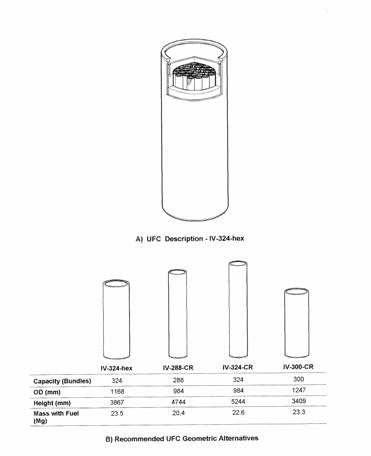
Figure 1: Used Fuel Containers
[3]
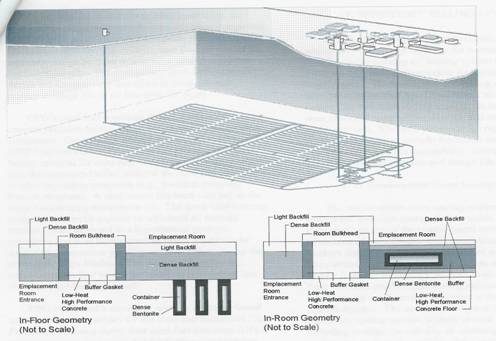
Figure 2: Geological Repository
Concept [3]
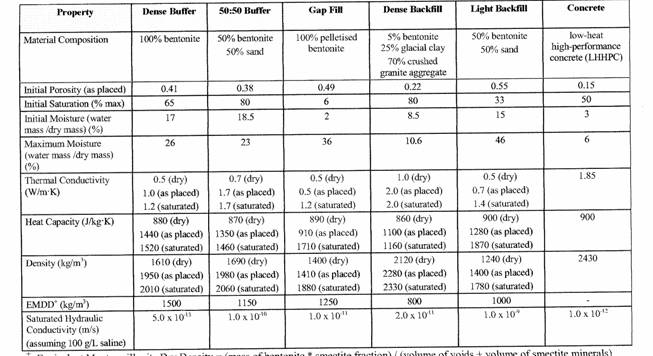
Table 1: Sealing Material [3]
Perhaps the most difficult portion of designing
underground repositories is determining the behaviour of the regions
surrounding the emplacement rooms. Since
the surrounding rock is also an essential component of the repository barrier,
the behaviour of this rock must be characterized and understood. Unfortunately the determination of the relevant
properties is very site specific.
3.3
The
4.0 Conclusions
Nuclear waste is here to stay. Even if all the nuclear facilities in the
world shut down today, there would still be a 10 000 year waiting period before
the waste that has already been produced is no longer completely dangerous to
humans. It is only ethical that the
generation that produces the waste must also dispose of it and that means
action has to be taken now on how to permanently dispose of it. Weighing all the factors is a difficult task
but the consensus of the international teams of experts consulted by the IAEA
is that underground geological repositories are the best option to dispose of
nuclear waste. These facilities are
advantageous in numerous areas, in particular they may remain open and under
human supervision for as many years as deemed necessary but they also do not
depend on human intervention to remain safe.
These repositories will be constructed 500-1000 metres underground. They will employ multiple barriers to prevent
contamination getting in or waste getting out.
Research has been done over approximately two decades. While these systems are inherently uncertain,
it has been shown that they are indeed feasible. Humans must take steps to dispose of nuclear
waste and the clear step to take is underground geological disposal.
5.0 References
[1] International Atomic Energy Agency (IAEA), “Nuclear
Waste Bulletin #13”, December 1998.
[2] IAEA, “
[3] Russell, S. & Simmons, G., “Engineered
Barrier System for a Deep Geological Repository in
[4] Fakuda, K. et al., “IAEA Overview of Global
Spent Fuel Storage”, IAEA-CN-102/60
[5] IAEA, “High Science Inside the Belly of the
[6] Russell, Sean., “Canadian Developments in
Nuclear Fuel Waste Technology and Regulatory Activities”, The 5th
Plenary Meeting of the OECD/NEA Integration Group for the Safety Case,
[7] IAEA, “The Long Term Storage of Radioactive
Waste: Safety and Sustainability”, IAEA-LTS/RW
[8] Nuclear Energy Agency, “Confidence in the
Long-term Safety of Deep Geological Repositories”, 1999.
[9] Russell, S. et al., “Deep Geological
Repository Technology Program Annual Report 2002”, Report #:
06819-rep-01200-10100-r00, Ontario Power Generation, 2003.
[10] Office of Civilian Radioactive Waste
Management, “Executive Summary”, http://ocrwm.doe.gov/documents/ser_b/execsum.htm