
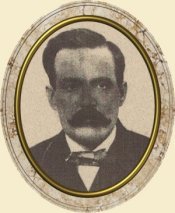

Thomas Edward "Black
Jack" Ketchum

THE STORY OF Black Jack
Ketchum
by sue richardson
One hundred years ago, on April 26, 1901, Thomas Edward Ketchum--cowboy, outlaw, and train robber--was hanged in Clayton, New Mexico. His life and story have attracted the imagination of countless people ever since that fateful day.
Tom Ketchum was born in San Saba County, Texas, on October 31, 1863. His father died when he was five and his mother passed on a few years later. His oldest brother became a wealthy and noted cowman and horse breeder. His other brother Sam, also elder, was a cowboy who never made a decent living for his family.
Both Tom and Sam worked on ranches in West Texas and Eastern New Mexico and participated in trail drives through the area, getting to know the country and the ranchers and settlers. If they had not turned outlaw, their lives would have been the same as the majority of men trying to make a living in the late nineteenth century.
During his trail riding days, Tom was well known in Clayton, which was the trail head for cattle drives, and he had a reputation as a prankster.
The first major crime attributed to Tom was the murder of a neighbor inTom Green County, Texas, in 1895. In early June of 1896, after working for the famed Bell Ranch in New Mexico, Tom and Sam are believed to have robbed a store and post office at Liberty, New Mexico, northwest of present-day Tucumcari. After a pursuit and gun battle, the store proprietor Levi Herzstein was killed. (Levi was the uncle of Albert Herzstein, the gentleman who generously helped the museum in Clayton become a reality.)
Following this event, the Ketchum brothers joined other outlaws and pursued a life of crime, focusing on train robbery. During this time, Tom Ketchum was mistakenly identified as "Black Jack", and that nickname has stuck with him ever since. However, he was never known as "Black Jack" among those who rode with him, and he consistently denied that he was "Black Jack."
The Ketchum gang were responsible for three separate hold-ups of the Colorado and Southern Flyer near Folsom, New Mexico, in western Union County. During the first incident, on September 3, 1897, the gang held up the train and escaped without incident.
The second incident occurred July 11, 1899, when Sam Ketchum and other gang members again held up the train, then retreated to Turkey Creek Canyon northwest of Cimarron, New Mexico. This time, a posse tracked the outlaws and during a gun battle, a Colorado sheriff was killed and several outlaws and posse members were wounded. Sam Ketchum was caught a day or two later and taken to the Santa Fe penitentiary, where he died of his wounds.
On August 16, 1899, tom Ketchum, knowing nothing of the July 11 hold-up or the death of his brother, single-handedly attempted to rob the same train. He was wounded by a blast from Conductor Harrington's shotgun, and staggered away into the night. He was captured without resistance the next day by Sheriff Saturnino Pinard of Union County.
Tom was eventually taken to the Santa Fe Penitentiary, where his arm was amputated. He was tried first at Las Vegas, New Mexico, on a federal charge of delaying the U.S. Mail, but that sentence was suspended. He was tried again in Clayton on September 6, 1900, for felonious assult upon a railroad train, a charge that carried the death penalty, and he was found guilty.
Shortly after 1 p.m. on A;pril 26, 1901, Tom Ketchum climbed
to the gallows which had been erected inside a hastily-built stockade next
to the Union County jail. The noose was pulled down over his neck, a black
hood was fitted over his head, and then Sheriff Salome Garcia asked the
condemned man, "Are you ready?"
Ketchum replied, "Ready, Let 'er rip."
It took Garcia two blows with a hatchet to sever the control rope. The trap flew open and Ketchum plunged downward, all the way to the ground. Spectators saw blood flowing from under the black hood as the body landed on its feet for an instant before tumbling forward. Tom Ketchum had been beheaded.
After the undertaker sewed the head to the torso, Ketchum's
body was placed in a simple pine coffin and taken to Clayton's Boot Hill
on the open prairie.
On September 10, 1933, Ketchum's body was disinterred and moved to the
new Clayton Cemetery. The coffin was opened and Ketchum's body was found
to be well preserved. Jack Potter, who had known Ketchum in his trail driving
days, placed flowers in the casket with a card that read, "To a cowboy
that went wrong."
Although Tom Ketchum's grave was not marked, it's location
was a poorly kept secret, and flowers often appeared on the grave, placed
by unknown persons.
In 1987, some restoration work was done at the gravesite, and a grave marker
was finally erected.
Thus ends the saga of a Western cowboy who became famous for his misdeeds. The centennial of his death is observed not in a spirit of admiration, but in the knowledge that his life and times were important historical events.
