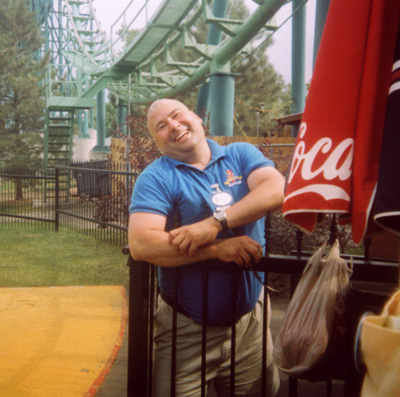
Guess what I did this summer. I went to the amusement park... to work. Denver's famed Elitch Gardens (also known as "Elitches" by the locals) was acquired by Six Flags sometime ago. Well, in addition to my main job, I took up a second job - if that's what you wish to call it - at Six Flags Elitch Gardens. This is the next best job since Starbucks. Come and hang out.
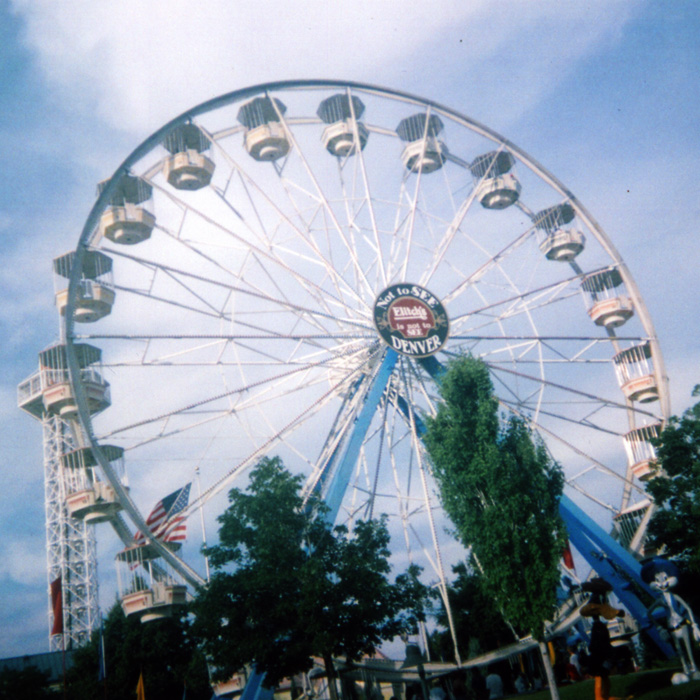
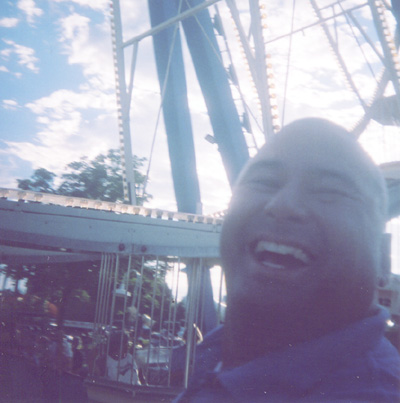
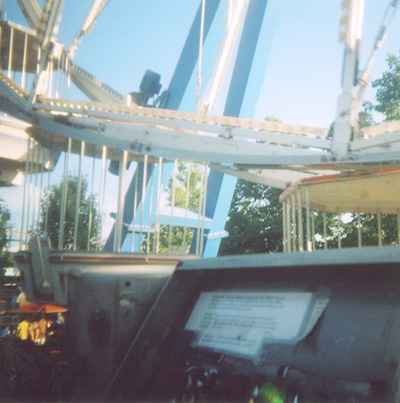
| The Big Wheel. This is the crown jewel as you come into the main park. Standing proudly at about sixty feet, it has twenty gondolas which, in a perfect world can seat up to six adults or eight children each (more about why the perfect world is essential later), that's a hundred and twenty adults or one hundred and sixty children when it is fully loaded. This is one of the rides in which I was trained on and it was the one I operated for the most part during my Summer job. Click on the image to see a larger picture then hover over the bottom right corner until a little logo with arrows appears and then click on it to see the picture in "life-size" |
Oh yeah, there they go. Running the Big Wheel is not without a challenge. You can't just simply load it up and go. Balance is the name of the game here. Whatever kind of load you put into one gondola, or a group of gondolas it has to be similar to the gondola(s) on the side or vice versa. There are five groups of gondolas, each groups consists of four gondolas and each group is a different color. There is Red, Blue, Orange, Green and Yellow. Each gondola is a quarter of the load in it's group. Depending of the turn-out of riders, I may run my ride at quarter, half, three quarter or full load. Loading the Big Wheel from completly empty or going from a different load type means loading the first gondola(s) and then rotating the wheel until the gondola(s) at the top and are the opposite of the ones you just loaded are in the loading area. As I said a similar, if not exact (there's that perfect world) load must be loaded. Repeat until the wheel is loaded at it's desired load.
A perfect world is essential when running the Big Wheel because all people would weigh the same for their stage in development. All children would weigh this much, all teens would weigh that much and all adults would weigh the same. Since that is not attainable sizing up your load to put into whatever gondola or group of gondolas is a big part of running this ride and sometimes means putting people on ahead of others people who were ahead of the people in which you need in order to keep your ride in balance. Sometimes, this can be annoying to those getting "passed over" or the ones who were called ahead may feel guilty.
All in all it's about keeping your ride balanced. If the ride is substantially unbalanced, it can make loading, unloading and running the ride difficult. Here is an example: If I want to unload red and it is much lighter than blue, when I stop the wheel with red in the station, the weight of the blue gondolas will cause the wheel to "drift" (continue to roll when it is supposed to be stopped) and the red gondolas will be pushed out of the station and the blue ones will need to be unloaded in order to be able to get red into the station. Then there is the case that the gondolas going up are heavier than the ones I am bringing down and it strains the motors. If too much weight is a problem, then I have to let the wheel drift backwards until the problemed gondola(s) drift down and unload them or have the riders get out and put a lighter group in and then put the displaced riders in another gondola. If the ride is unbalanced but is able to be cycled (put through it's ride cycle) when the wheel begins to slow down, it will make a squealing sound which is caused by the rubber wheels that turn the wheel as they are trying to slow it down and are slipping as the heavy weight is coming down, sort of like wheels screaching when the breaks are slammed on - this squealing can get very loud (when I suspect that the wheel is going to squeal when the ride cycle ends, I will allow the heavy gondolas to be near the bottom of the rotation and then stop the wheel as they are coming into the station, they will overshoot the platform but then I will reverse the wheel to bring them into the station, this helps reducing the squeals). Such imbalances have made it a real pain to get the ride loaded up.
On the upside, I think I opted to run this ride most of the time becasue I liked that challenge, it was like a puzzle or a game of strategy where you had to remember what you loaded in one side and gather together the groups of riders in order to load up the opposite end accordingly. |
It is imperative for the operator to watch the ride while it is running for any rider horseplay, discomfort or anyone sticking their arms, heads, or other limbs outside of the gondola. Also there are cases where riders throw things out. These riders, if caught can face expulsion from the park and possible prosecution. Sometime you have party spoilers, unfortunately. |
© 2006 clayaikensboy