SITE MAP
powered by FreeFind
Click "Site Map" to explore
the 29 pages of our Website Author_Bronte_Pg5

Pic of  pencil as horizontal divider


March 17, 2003, 1:54PM

New Brontė novella offers another perspective on author
By SUE LEEMAN
Associated Press
LONDON

-- For many years, the kingdom of Angria has been known only to scholars who struggled through a manuscript crammed with tiny, spidery writing.
Now, Charlotte Brontė's novella Stancliffe's Hotel, set in a fictional land she and her brother Branwell created, will be published for the first time, shedding new light on one of Britain's most famous writers.

Brontė scholar Heather Glen said Friday, "I think it will change the way in which she's still seen, rather patronizingly, as a woman writer who wrote only about her own concerns," said Glen, who teaches at Cambridge University. "It's very humorous and racy; there's something almost modernist about it with the odd juxtaposition of scenes."

Written in 1838, when Brontė was 23,Stancliffe's Hotel is a series of ironic vignettes that debunk some of the manners and fashions of 1830s England, Glen said.

Edited by Glen, it will be published by Penguin in June [2003]and later this year in a volume with four other novellas set in the fictional kingdom. The others have been published before, but Glen is editing them for the new edition. A U.S. publication date was not immediately available.

Ann Dinsdale, librarian of the Brontė Parsonage Museum in northern England, said the novellas "have been in our collection for many years."
She said most of the work was in the minute handwriting that originated when the Brontės were children, and readers needed a magnifying glass. "They used to compile little books that were designed to be small enough to be read by a set of toy soldiers Branwell had been given," she said. "It was also a way of keeping the material from adults and an economy measure. They carried on the tiny writing after they grew up."

Glen said Stancliffe's Hotel had not been published before "because there's been a mystique about it because it alludes to this fictional country. So there was a feeling that it was inaccessible, and many people regarded it as juvenilia."

Brontė is best known for Jane Eyre, the tale of a poor governess who survives traumatic events to marry the master of the house. Her sister Emily wrote Wuthering Heights, and another sister, Anne, produced The Tenant of Wildfell Hall.

In Stancliffe's Hotel, the story is told in a series of disconnected episodes, and there are sudden changes in mood and scene. The narrator, Charles Townsend, is a dandy who confesses that he takes "a full half-hour to dress and another half-hour to view myself over from head to foot."

Pic of  pencil as horizontal divider

Our Brontė Corner - Page 5
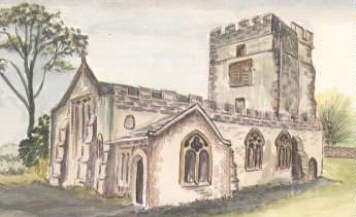
This time the interest lies near Cowan Bridge, the place  where Maria, Elizabeth, Charlotte and Emily were sent to boarding school in 1823 / 1824.  The girls all worshipped at the church of St John Baptist at the village of Tunstall about 3 south of  Cowan Bridge and Kirkby Lonsdale. The founder of the school (the Revd William Carus Wilson)  was also the vicar of the Tunstall church. It was the Tunstall Church  which Charlotte later  used  as her model  for  "Brocklebridge Church",  in "Jane Eyre"
The Church of St John Baptist at Tunstall in Lancashire
The Brontė sisters attended St John Baptist Church every sunday morning  while they were at the Cowan Bridge Clergy Daughters'  School. They stayed at the church all day,  and  ate their sandwiches in the little room above the porch where they wiled away the time till the evening service.
Visitors to Tunstall, Kirkby Lonsdale and Cowan Bridge
If you are a Brontė fan and decide to visit the church at Tunstall, you may be as lucky as we were and find the Field Study Centre with details of many local items of historical interest  to be seen (obviously including the Brontė connection).
Local things worth seeing are
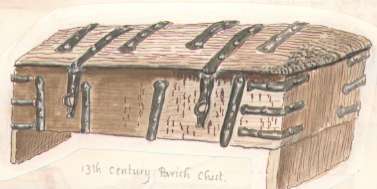
The very  old, scarred, worm-holed and cracked Tunstall Church Parish Chest from the 13th Century
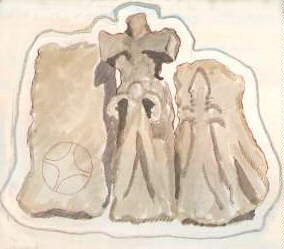
The Roman votive stone at the Tunstall Church
An elegant scallop-shaped marble font (at the same church)  described in the guide book as "white", but  in reality with a translucent pinkish hue to it.
The (originally) very old, very picturesque and much-photographed "Devil's Bridge" over the river Lune at Kirkby Lonsdale (pronounced with a silent 2nd "K" - Kirby Lonsdale).
The lovely  little rural  market town of Kirkby Lonsdale, which is mentioned in the Domesday Book and is a Saxon name meaning "Church in the vale of the Lune"
The beautiful historic Kirkby Lonsdale church 
"Ruskin's View" across the river Lune, where the poet and critic Ruskin used to sit in order to absorb the tranquility of the scene
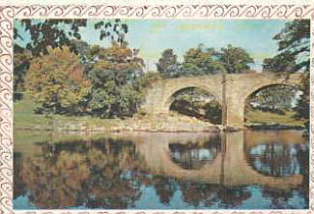
About a mile from the Brontė sisters school was  "Devil's Bridge" over the river Lune at Kirkby Lonsdale. There is a local record of a grant which was authorised in 1275 for the repair of the bridge. So if the bridge was already in need of repair in 1275,  it must be much older than that.
The "Devil's Bridge Legend

The construction of the bridge (at the shallow place where the river could be forded in good weather) is attributed to the devil.  The legend says that one day, when an old woman found the river  was too deep to cross, the devil appeared and told the old woman he would build a bridge there
on one condition. The devil's one condition was that the 1st living creature to cross the bridge would from that time on belong to him.
The old woman agreed to the devil's condition and she went away while the devil got on with building the bridge. When the woman returned,  the bridge was completed and the devil stood over on the other side, waiting to claim the old woman.  But she was a very astute old woman. She flung a piece of cake across the bridge so that her dog ran across to get it. The devil ran off  in a tearing rage because he had been outwitted. He had anticipated that the old woman would be the first living soul to cross the bridge, and it was human souls which he wanted - not a dog!
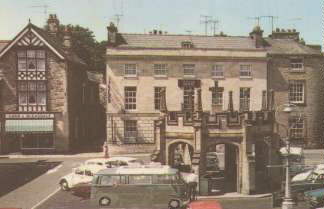
The little Market Town of  Kirkby Lonsdale - about a mile from the Brontė sisters'  school
Kirkby Lonsdale
This little rural town is of Saxon origin and its name means literally "Church in the vale of the Lune". Most of the buildings are made  of  Yorkshire stone, although many have since been whitewashed.  There are little cobbled alleyways and arches where stagecoaches used to pull in. And it is still possible to see the marks where the coaches'  wheel hubs knocked against the sides of the walls. Many of the shops have little bow windows with panes of swirled glass dispersed at intervals between the plain ones - though no longer the original ones any more.
(Yorkshire stone is extremely durable and was the material chosen for the building not only of York Minster but also of  Westminster Abbey)
The main feature of the  town is its beautiful and historic church of St Mary the Virgin. Records show that in or about  the year 1093 "the Church of Cherkeby Lonnesdale and lands appertaining thereto" was "given"  by Ivo de Taillebois, Baron of Kendal, to the Abbey of St Mary at York.  That record refers to the old original Saxon Church which is thought to have been sited slightly to the north-east of the present building. The name "Kirkby"  (middle "k" is silent) is said to be derived either from the Danish Kirk-by, meaning "church village", or from the earlier Norse Kirkja Byr meaning "church farm".
Anybody specially interested may like to know that a full discussion of these names can be found in Sedgefield's  "Place Names of  Westmoreland and Cumberland"
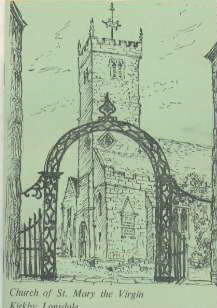
The Church of St Mary the Virgin at Kirkby Lonsdale in Cumbria - about a mile from the Brontė sisters' school
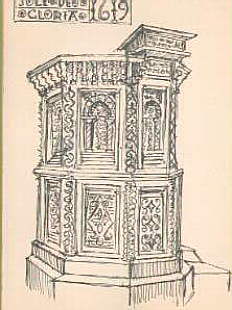
And now, shown below,  is the old  Jacobean oak pulpit  from 1619,  which  is rather special and something not to be missed.  It was originally a three-decker pulpit, but for some reason it was cut down to its present size in 1866.
Triple-Decker Jacobean Pulpit in the Kirkby Lonsdale church.
Now we are back to Tunstall again - just  3 miles down the road to the south, and this is the very long  "Parish Chest"  in the Tunstall Church - the chest is made of light oak, is heavily bound with iron and comes from the 13th Century.
The Roman votive stone cemented into a window ledge in Tunstall Church - slightly hard to find because it is situated just above eye-level.
The votive stone is thought to have come from the Roman camp at Burrow (about a mile to the north of the church). The stone was  dedicated by a certain Julius Saterninus,  to Aesculapius the god of medicine, and to Hygeia the goddess of healing.
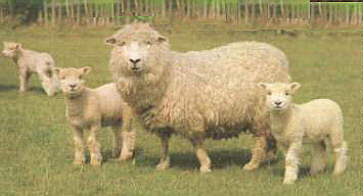
Sheep and sheep-rearing have not changed  for  generation upon generation around Tunstall and Kirkby Lonsdale, and these sheep are the same breed making the very same sounds as when the Brontė girls enjoyed watching them and the way their lambs frisked in the fields near their school.
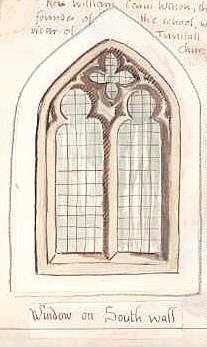
A window in the south wall of the Church of  St John Baptist at Tunstall
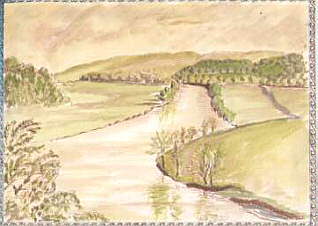
"Ruskin's View" across the Lune Valley is an elevated area where the great poet and critic John Ruskin used to sit  to absorb the tranquility of the scene
Number of visits to this page since October 28th 2000
SITE MAP
powered by
FreeFind
August 2nd 2005
Click "Site Map" to see details of pages on our Website


BIBLE ONLINE


"Pie Jesu" from the Requiem by Gabriel Faure

SITE MAP
powered by FreeFind
Click "Site Map" to explore
the 29 pages of our Website

Hosted by www.Geocities.ws

1