

Erin and Jul's 3rd Bronte Page with yet more treasures connected with that Haworth Family
powered by FreeFind
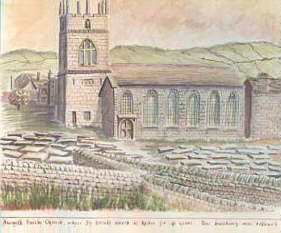
Church, where
Charlotte's father
served for 41
years. This
building was
replaced by the
present one in 1879
If you are a lover of the Bront� poems and novels and have the good fortune to visit the Bront� parsonage and museum at Haworth, you will be rewarded and fascinated. On the other hand if you are just killing time while on holiday, try going somewhere else so as to leave the place less crowded for the rest of us !! - - because if you are not really keen you are certain to be dead bored !
When you begin the tour you will see that the hall is quite elegant with its Georgian arch, wide staircase and large window which lets in plenty of light - - Mrs Maria Bront� may have been rather pleasantly surprised on her arrival there in February 1820 (in spite of her gruelling journey there from Thornton with her 6 young children all under 7! )
Is on the left of the hall where the family (except for Mr Bront�) had their meals. It was in this room that the sisters wrote their amazing novels. You will see in there the picture of Charlotte hanging above the very couch upon which Emily died in December 1848, just six days before Christmas.
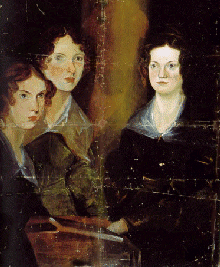
which was opposite the dining-room which the Revd Patrick Bront� used as a study and where he wrote his sermons and took his meals. On the walls are watercolour paintings of his daughters, and there is a cottage piano which was used by Emily in particular. An open psalter now lies upon the table, together with spectacles, a pipe and a tobacco box. A newspaper lies upon the wicker-seated chair beside the table, and a shiny black top hat and walking stick are upont the chair by the piano. The entire scene is giving the impression that the occupant has left the room only a moment or two earlier.
where the children used to huddle around the fire, is one of the two main rooms to have benefitted from the resoration work in the 1920's and '30's. There are now once again many of the items there which the Bront�s used: the kitchen table, the cupboard, a bread tin, toasting-iron, a crimping-iron for pleating starched linen, and the salt-box. The crockery is decorated with pictures of Christian, from Bunyan's "Pilgrim's Progress", and inscribed underneath the pictures are captions such as for example "Christian at the wicket gate".
there are bonnets, gloves, Charlotte's slender boots, embroidery done by the girls etc., etc. Also on show are the tiny books in which the children wrote the sagas of "Gondal" and "Angria". There are over 400 of these little books in microscopic writing, the smallest being only an inch and a half long. Some pages contain 1500 words - - - the world of "Angria" became a dominating influence in the lives of the Bront� children and proved to be an astonishing apprenticeship to literature.The visitor may be surprised to find that the house is less foreboding than might have expected for a building of its age.
Is the tiny room opposite the staircase, where many of the girls' manuscripts were written, you can see on the walls many little heads and figures they did.
is In the front of the house on the left. This is the room where he and Branwell slept and in which later they both were to die. You can see Mr Bront�'s stock or neckerchief, his fruit knife, gloves etc.
At the far left of the hall the family stored the peat to be burnt on the fires, and it was the peat store where the Bront� children kept Adelaide and Victoria, their two tame geese ! But later on Charlotte had this area turned into a study for her husband Mr Nicholls, and she made some green and white curtains for the window.
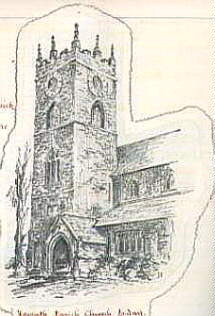
Its beginnings lie in the remote past, but its name is not in the Domesday Book because at that time it was a berewick of Bradford manor. A century later there was one oxgang of land (15 acres) under cultivation. After another century, 60 acres had been intaken from the moor and many more freeholders had settled in the district and were engaged in sheep farming.
Pigs roamed the village.
Drinking water was polluted and inadequate for the people's needs.
There occurred frequent outbreaks of typhus, cholera, dysentry and smallpox. And tuberculosis was common.
So high was the death rate at Haworth that in 1850 the General Board of Health instituted an enquiry. Its subsequent Report stated that, because of bad sanitation and polluted drinking water the average age of death was 25.8, while 41.6% of the population died before reaching the age of 6 (yes six!) years
Under such dreadful conditions it is not surprising that the Bront�s, never physically strong, became constant sufferers from a low type of fever which prevailed. This undoubtedly undermined their general health and contributed to their untimely deaths.
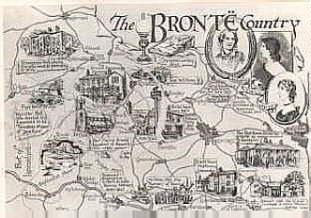
A close scrutiny with a magnifying glass may reveal the following items in the above fantasy picture:
Thornton - At this house were born Charlotte, Branwell, Emily and Anne
Haworth Church -Revd Patrick Bront�, incumbent 1820-1861
Haworth main street
The Bront� Parsonage Museum
Stonegappe Hall on the way to Skipton, where Charlotte went as governess in 1839
Sowerby Bridge and Luddenden Foot - Branwell employed at these railway stations, 1840 - 1842
Near Rawdon - Charlotte as governess at Upperwood House in 1841
Near Rawdon - Woodhouse Grove School
The Red House, Gomersall - original of "Briarmains"
Earliest "Bront� House" at Liversedge near Dewsbury (Patrick Bront� was serving as curate at nearby Hartshead when he first met the woman from Cornwall he was to marry)
Heckmondwike - Centre of Luddite riots
Oakwell Hall near Birstall - the original "Fieldhead" in which "Shirley Keeldar" lived
Kirklees Hall near Halifax was the "Nunnely" of "Shirley"
Wycoller Hall near Colne is now derelict but supposed to be "Ferndean Manor" of "Jane Eyre"
Pack Horse Bridge near Wycoller
Bront� Bridge near Heptonstall Moor
"Top Withens" near Keighley (Wuthering Heights)
Charlotte's writing desk.
Mr Bront� was a poor man and so it was necessary for the girls to earn their own living, which was quite an unusual thing for young women in those days. The Bront� sisters first became governesses. But because they were always unhappy when they were away from home they decided to start a school of their own. You can still see the school house to this day situated just across the cobbled path from the Bront� Parsonage, and you can see the commemorative plaque on the wall. But the school venture could hardly be considered a success. Very few people would send their children to the school because it was in a rather remote place and another problem was that brother Branwell's bad behaviour had become widely known.
In order to be able to teach foreign languages, Charlotte and Emily spent a while at a school in Brussels kept by a Monsieur Constantin Heger and his wife. Monsieur Heger had a considerable influence upon Charlotte and she began to move away from her make-believe stories to concentrate more upon real life.
It was in 1845 that Charlotte found some very good poems which Emily had written. And by 1846 the sisters had managed to publish a book containing poems by all three of them. As mentioned earlier in this Bront� Corner, they were worried about their father's reaction to their publishing the poems, so they wrote them under the assumed name of "Bell"and the publication contained the poems of Currer Bell (Charlotte), Ellis Bell (Emily) and Acton Bell (Anne). The book of poems was not a success at the time though - it is thought that only two copies were sold! So I think all you budding poetesses should take some encouragement from that !! Despite the miserable sales results however, the very fact of seeing their own work in print acted as an encouragement and a spur to the girls seriously to set about writing their novels.
"The Professor" was Charlotte's first book. It was about an English professor in a Brussels school, but it was rejected by numerous publishers. When Charlotte submitted her "Jane Eyre" it was a very different matter, and apparently the publisher's reader was so taken up with her novel that he stayed up the entire night to finish it !
Emily's only novel, "Wuthering Heights", is a somewhat strange but very powerful book.
Anne's two novels were much more religious and less exciting and dramatic than the work of her two sisters. Her book "Agnes Grey" is the story of a governess and a curate, and her "Tenant of Wildfell Hall" tells of the terrible life of a drunkard. Understandably it is drawn from Anne's personal experience of her own brother Branwell.
When Branwell died in the September of 1848, Emily caught a chill at his funeral and died in the December. And then shortly afterwards Anne became ill, and died 5 months later in May 1849, leaving Charlotte feeling very lonely indeed. She occupied her time with writing "Shirley" and "Villette", and in 1854 she married her father's curate, the Revd. Arthur Bell Nicholls. But sadly her marriage lasted less than a year, and in March 1855 she died.
Or for the full menu of cards, click and then scroll down to the bottom of the page


powered by FreeFind


Website
# 3 Bronte page since October 28th 2000
August 2nd 2005