
Musical Instruments | Updates | Cairo Opera House | Links
| |
Home | Composers Index
| Musical Epochs
| Musical Forms | Contact Musical Instruments | Updates | Cairo Opera House | Links |
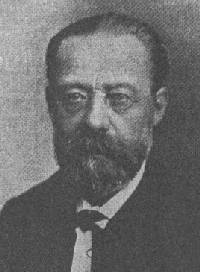 |
He took music lessons from his father, a keen violinist, and from several local teachers. In his teens he attended the Academic Gymnasium in Prague, but neglected school work to attend concerts (including some by Liszt, with whom he became friendly) and to write string quartets for friends, until his father sent him to the Premonstratensian Gymnasium at Plzen. At first he earned a precarious living as a teacher in Prague until, in January 1884, he was appointed resident piano teacher to Count Leopold Thun's family, which provided him with the means to study harmony, counterpoint and composition with Josef Proksch. When he failed in an attempt to launch a career as a concert pianist in 1847, Smetana decided to found a school of music in Prague. This showed little profit, but he was able to earn something by teaching privately and by playing regularly to the deposed Emperor Ferdinand, and in 1849 he was able to marry Katerina Kol�rov�, whom he had known since his Plzen days.
Smetana's financial situation improved little in the years that followed, and political uncertainty and domestic tragedy only added to his unrest: three of his four daughters died between 1854 and 1856. When he heard there was an opening for a piano teacher at G�teborg he jumped at the chance. In Sweden his prospects improved, and he was in demand as a pianist, teacher and conductor. Inspired by Liszt's example, he composed his first symphonic poems. His wife's health forced him to return to Bohemia with her in 1859, but she died at Dresden on the way home. After two further summers in G�teborg, between which he found a second wife in Bettina Ferdinandov�, Smetana felt the need to return permanently to Prague in order to play an active role in the reawakening of Czech culture that followed the Austrian defeat by Napoleon III at Magenta and Soferino.
He was disappointed to find himself no more successful in Prague than he had been before. It was not until his first opera, The Brandenburgers in Bohemia, was enthusiastically received in January 1866 that his prospects there improved. His second, The Bartered Bride, was speedily put into production and soon found favour, though (as with his other operas) foreign performances long remained rarities. As principal conductor of the Provisional Theatre, 1866-74, Smetana added 42 operas to the repertory, including his own Dalibor (on a heroic national theme) and The Two Widows. Dalibor and Libuse (performed at the opening of the National Theatre in Prague in 1881) are Smetana's two most nationalistic operas; when completing the latter he also planned a vast orchestral monument to his nation which became the cycle of symphonic poems entitled M� vlast ('My fatherland'), including the evocative and stirring Vltava (Moldau), a picture of the river that flows through Prague.
In 1874 there appeared the first signs of the syphilis that was to result in Smetana's deafness. The String Quartet From my Life (1876) suggests in its last movement the piercing whistling that haunted his every evening, making work almost impossible. He somehow managed to complete two more operas, a second string quartet and several other works, but by 1883 his mental equilibrium was seriously disturbed. In April 1884 he was taken to the Prague lunatic asylum, where he died the following month.
Smetana was the first major nationalist composer of Bohemia. He gave his people a new musical identity and self-confidence by his technical assurance and originality in handling national subjects. In his operas and symphonic poems he drew on his country's legends, history, characters, scenery and ideas, presenting them with a freshness and colour which owe little to indigenous folksong but much to a highly original and essentially dramatic musical style.