
Travels in the Morea
By William Martin Leake, published at London in 1830.
Volume II, Chapter XVIII, pages 433-435. Rhamnous.
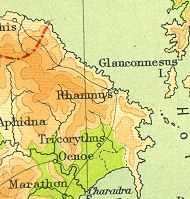 Having
sent my baggage by the ordinary route to Grammatiko and Kalamo by Upper
Suli, I proceed with a single attendant to visit the sites of Tricorythus
and Rhamnus. That of the former demus is at thirteen minutes from
Kato-Suli, on the right of the road to Rhamnus, where a rising ground is
covered with fragments of Pentelic marble, many wrought blocks, and in
one place some remains of columns without flutings. The plain of
Tricorythus is of a semicircular form, and terminates in a pass, from which
a torrent issues, and, after crossing the plain, joins the marsh.
Having
sent my baggage by the ordinary route to Grammatiko and Kalamo by Upper
Suli, I proceed with a single attendant to visit the sites of Tricorythus
and Rhamnus. That of the former demus is at thirteen minutes from
Kato-Suli, on the right of the road to Rhamnus, where a rising ground is
covered with fragments of Pentelic marble, many wrought blocks, and in
one place some remains of columns without flutings. The plain of
Tricorythus is of a semicircular form, and terminates in a pass, from which
a torrent issues, and, after crossing the plain, joins the marsh.
At 1.4, ten minutes beyond the ruins of Tricorythus, we enter the pass, which at 1.10 opens into a plain, about three miles in length, and one in breadth, separated from the shore only by a rocky ridge, and inclosed on the opposite side by the mountain of Dhimiko.
This valley formed the best part of the ancient Rhamnusia.
Like the plain of Suli, it contains many velanidhi trees, has a tolerable
soil, but is ploughed only in a few places. At the northern extremity
are the ruins of the temple of the Rhamnusian Nemesis, lying in a confused
heap on the peribolus, the wall of which is still a conspicuous object.
In the plain, at a small distance from the wall, is the foundation of a
square and another of a round monument, of small dimensions, probably sepulchral.
The peribolus included two temples, and stood at the head of a gorge leading
by a regular slope to Ovrio-kastro, which is eleven minutes distant from
the temples on the sea shore; the remains of a wall are observable on the
left  of
the road all the way down. Ovrio-kastro, a common Romaic form of
Ebraio-kastron, or Jewish Castle, is situated on a small height overhanging
the sea, and is closely surrounded on every other side by higher hills,
which are barren and covered with shrubs. To the north the height
is strengthened by a deep torrent, now dry: on the opposite side there
is a hollow and a small level by the sea, so that the fortress itself was
only connected with the hills at the back by a little ridge, on which stand
the remains of a gateway, with the adjacent walls still extant to half
their height. They are of the third order of masonry, built of Attic
marble, and being mixed with shrubs and bushes form a very picturesque
ruin. On the highest part of the hill, a small quadrangular keep
occupied an angle of the inclosure: the walls are traceable in most parts,
but are not of any considerable height except near the gate. The
whole circumference of the inclosure was little more than half a mile,
but the ground about the temples seems also to have been inhabited.
In the middle of the inclosure of the fortress lies a monument of white
marble, concave on one of the sides, and broken into two pieces, on one
of which, in the middle of the concave side, are the words, RAMNOUSIOS
KOMOIDOIS in very neat characters. The name of the man of Rhamnus,
who dedicated the monument, was probably on another stone. Immediately
opposite to Rhamnus, in the narrowest part of the Euboic frith, where the
breadth is only two miles, is the entrance of Porto Bufalo, which I take
to have been anciently the harbour of Porthmus. The occupation and
destruction of the fortress of Porthmus by Philip, after expelling the
Eretrians, to whom it belonged, was one of the accusations repeatedly urged
against him by Demosthenes: the orator particularly alludes to its position,
“apantikru tes Attikes,” or opposite to Attica, and his commentator Ulpian
observes, that Porthmus was a harbour dependent on Eretria. The advantages
of this harbour seem to have given importance to Porthmus during a long
succession of ages.
of
the road all the way down. Ovrio-kastro, a common Romaic form of
Ebraio-kastron, or Jewish Castle, is situated on a small height overhanging
the sea, and is closely surrounded on every other side by higher hills,
which are barren and covered with shrubs. To the north the height
is strengthened by a deep torrent, now dry: on the opposite side there
is a hollow and a small level by the sea, so that the fortress itself was
only connected with the hills at the back by a little ridge, on which stand
the remains of a gateway, with the adjacent walls still extant to half
their height. They are of the third order of masonry, built of Attic
marble, and being mixed with shrubs and bushes form a very picturesque
ruin. On the highest part of the hill, a small quadrangular keep
occupied an angle of the inclosure: the walls are traceable in most parts,
but are not of any considerable height except near the gate. The
whole circumference of the inclosure was little more than half a mile,
but the ground about the temples seems also to have been inhabited.
In the middle of the inclosure of the fortress lies a monument of white
marble, concave on one of the sides, and broken into two pieces, on one
of which, in the middle of the concave side, are the words, RAMNOUSIOS
KOMOIDOIS in very neat characters. The name of the man of Rhamnus,
who dedicated the monument, was probably on another stone. Immediately
opposite to Rhamnus, in the narrowest part of the Euboic frith, where the
breadth is only two miles, is the entrance of Porto Bufalo, which I take
to have been anciently the harbour of Porthmus. The occupation and
destruction of the fortress of Porthmus by Philip, after expelling the
Eretrians, to whom it belonged, was one of the accusations repeatedly urged
against him by Demosthenes: the orator particularly alludes to its position,
“apantikru tes Attikes,” or opposite to Attica, and his commentator Ulpian
observes, that Porthmus was a harbour dependent on Eretria. The advantages
of this harbour seem to have given importance to Porthmus during a long
succession of ages.
Visitors to Classical Backpacking in Greece - Early Travelers, since 5.6.99