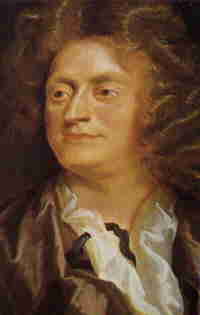
Purcell, Henry
(1659-1695)
England's greatest native composer, who wrote with consummate skill music of virtually every kind known during the Restoration period. His compositions combined elements of the French and Italian Baroque and traditional English musical forms.
Born in Westminster (now London), Purcell was the son of a court musician and became a chorister in the Chapel Royal at the age of ten; when his voice broke, he was apprenticed to the keeper of the royal instruments and tuned the organ in Westminster Abbey. Purcell was appointed composer for the court violins in 1677 upon the death of Matthew Locke. Three years later he succeeded John Blow as organist of Westminister Abbey. He became organist at the Chapel Royal in 1682 and was appointed composer in ordinary to the King's Musick (1683), a major post, under Charles II; later he was harpsichord player to James II. Purcell also taught music to the aristocracy, wrote ceremonial odes and anthems for royal events, and composed for the stage, church, and home. He died in London on November 21, 1695, and was buried under the organ in Westminster Abbey.
Among Purcell's earliest surviving works are the fantasias for viol consort (1680), representing a final flourish for the form that had been a staple of Elizabethan music. Already they show the young composer's complete mastery of all the contrapuntal techniques of the old-style polyphony, as well as the emotional depth and expressive control of dissonance that had characterized the best of the Renaissance style. This can also be seen in Purcell's anthems of this period, such as Remember not, Lord, our offences (1682), and his first setting of the funeral sentences (c. 1683).
In 1685 he showed his ability to produce grand ceremonial music in the coronation anthem My Heart is Inditing, while also beginning to produce instrumental chamber music—the 12 Sonatas of three parts (1683) and the 10 Sonatas of four parts (published 1697)—that shows the influence of Italian models such as the sonatas of Corelli. In the anthems French influence predominates (Charles II's taste had been formed at the court of Louis XIV) but Purcell's unique contribution was in the style he developed for setting English words—rhythmically lively and irregular compared with Renaissance polyphony, but still effortlessly graceful. This characteristic can be seen in every genre of the music for voices that lies at the heart of his achievement.
Apart from the music for stage productions, Purcell also wrote some 80 individual songs and duets which cover the gamut of emotions, often within a single song, as the music follows every twist and turn of the text. A technique that he commonly used to build tension as well as a sense of inevitability was the ground bass (or chaconne), in which harmony and melody are continuously varied over a repeating bass line—a development that reached supreme expression in the lament “When I am laid in earth” from Dido and Aenaeas.
Purcell is perhaps most famous for his music for the theatre, which began to occupy him more as opportunities for church music in the more serious-minded court of William and Mary diminished. His only true opera is Dido and Aeneas, a masterpiece based on a tragedy by Nahum Tate and first performed in about 1689. Other dramatic works, sometimes called semi-operas, are masques of instrumental and vocal music written to accompany such plays as Thomas Betterton's Dioclesian (1690); John Dryden's King Arthur (1691); The Fairy Queen (1692), a masque adapted from Shakespeare's Midsummer Night's Dream (1692); and Dryden and Sir Robert Howard's The Indian Queen (1695; completed by Purcell's brother Daniel), which contains some of Purcell's most famous music.
Purcell's
early death had, in retrospect, a profound effect on music in England. Had he
lived, he might, for instance, have produced a body of operatic work that would
have established an English-language opera tradition; in the event, it was
Italian opera that dominated 18th-century London under Handel. In choral music
the situation is similar—music such as the chorus “Soul of the World” from
the 1692 Ode on St Cecilia's Day shows Purcell to be fully Handel
's equal in music of grandeur and pomp. However, the rediscovery of
Purcell's music has played a large part in the revival of British composition in
the 20th century, so that the influence which faded soon after his death has
played its part more than 200 years later.


