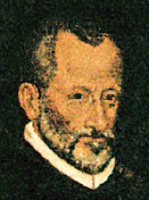
Palestrina, Giovanni Pierluigi da
(? 1525-1594)
Italian composer, ranked among the greatest of Renaissance composers.
He was born in the town of Palestrina, southeast of Rome. He studied singing at the Church of Santa Maria Maggiore in Rome beginning about 1537. In 1544 he became organist and choir director at the cathedral in Palestrina, leaving in 1551 to become choirmaster at the Julian Chapel at St Peter's in Rome.
His next positions were also in Rome, at St John Lateran (1555-1560), at Santa Maria Maggiore (1561-1566), and as master of music at a seminary for Jesuits (1565-1571). From 1567 to 1571 he also held the secular post of music director at the villa of Ippolito II, Cardinal d'Este. In 1571 he returned to the Julian Chapel, where he remained until his death. His music remained close to the mystical and highly ritualized spirit of the church.
The serenity of Palestrina's style arises from several technical sources. His music is vocal; no parts are written specifically for instruments. All the voice parts have a similar character, producing a homogeneous sound. The music is almost always contrapuntal, with simultaneously sounding, equally important melodic lines. Although Palestrina used only a few chords in any one composition, he altered the manner in which the individual notes of each chord were spaced among the various voice parts. He thus achieved subtle changes while maintaining a general feeling of constancy. In rhythm he avoided the feeling of a strong pulse by allowing each voice part to have its own accent patterns independent of the other parts.
He created a subtle pulse by confining dissonant, or unstable, notes to weak beats within a bar and always placing consonant, or stable, notes on strong beats. Finally, his melodic lines unfold in long, gentle curves in which any large leaps upwards or downwards are balanced by a return to the centre of the curve.
Palestrina's religious music includes 102 masses, 250 motets, 35 magnificats, 68 offertories, 45 hymns, and other works. His second marriage, to a wealthy widow in 1581, enabled him to publish a huge quantity of his music in his own lifetime (16 collections in his last 13 years).
His
secular works include many madrigals. Unlike most influential composers,
Palestrina was not primarily an innovator in musical technique. Rather, he
provided a model for other composers to emulate when they wished to recapture
the mystical religious tone that his music exemplifies.


