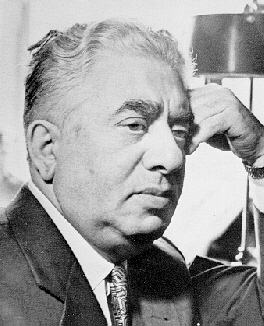
Khachaturian, Ara
(1903-1978)
Soviet composer, born in Tbilisi, Russia (now in Georgia) of Armenian descent, and educated at the Moscow Conservatory.
His early work, such as the Trio for Clarinet, Violin, and Piano (1932) and the First Symphony (1934), demonstrate lyrical power, skilful use of dissonance, traditional techniques, and the influence, apparent in his subsequent work, of Armenian folk music. His piano concerto (1936), written in a heroic vein, was the greatest success of his early years.
His style became slightly more experimental harmonically in the 2nd Symphony (1943) and cello concerto (1946) and in 1948 he was one of a group of composers, including Prokofiev and Shostakovich, to be denounced by the Soviet authorities for writing music that was “formalist”, that is, not reflecting the optimism and simplicity of the principles of “socialist realism”.
Some of his later works are Gayaneh (1942), a ballet that includes the well-known Sabre Dance; the ballet Spartacus (1956), that was acclaimed as his masterpiece at its first performance; and Rhapsody for Violin and Orchestra (1960). In 1959 he was awarded the Lenin Prize.


