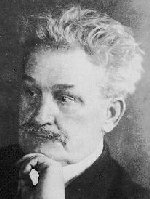
Janácek, Leoš
(1854-1928)
Czech composer, the most eminent of the early 20th century, known for his style derived from Moravian folk music.
Born in Hukvaldy and trained as a choirboy in Brünn (now Brno), he later studied in St Petersburg, in Leipzig, Germany, and in Vienna. He directed the Czech Philharmonic (1881-1888); founded and taught in the Brünn Organ School (1882-1920); and taught at the State Conservatory of Prague (1920-1925).
He also collected folk music and briefly published a folk music journal. His international reputation was established with his opera Jenufa (1904, revised 1916), which, like his Glagolitic Mass (1926), was influenced by the rhythms and accents of the Moravian language.
The slow maturing of his style, an unrequited love affair, and an upsurge of nationalist feeling at the creation of Czechoslovakia in 1918, were among the factors that produced an astonishing burst of creativity, with the result that most of the works for which he is best known were written in the last ten years of his life. For this reason he is thought of as a 20th-century composer, even though he was 47 when the century began. This period saw the two string quartets, the wind sextet Mladi, the orchestral Taras Bulba and Sinfonietta, and five more operas, including Káta Kabanová (1921), The Cunning Little Vixen (1923), and The Makropulos Case (1925).
It is for his operatic achievements that he is perhaps most widely remembered today.


