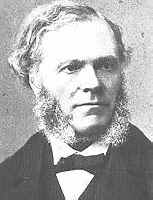
Franck, César
(1822-1890)
Belgian-born French composer and organist, whose work during the late-19th century significantly influenced the direction of French music.
Franck was born in Liège. A precocious musician, he made a piano concert tour of Belgium at the age of 11. He studied music in Liège and, from 1837 to 1842, at the Paris Conservatoire, where he revealed great ability as an organist and composer. From 1844 he taught music privately in Paris. In 1872 he became professor of organ at the conservatory, and from 1858 to 1890 he was organist at the Church of Sainte Clotilde, Paris. Among his pupils at the conservatory were the French composers Vincent d'Indy and Ernest Chausson. Franck became a French citizen in 1873. He died on November 8, 1890, following a street accident in Paris.
Franck's work is characterized by the use of classical forms, including the symphony and sonata, which he imbued with a Romantic aesthetic, strongly influenced by Wagner. He alternated between themes of a mystical and brooding nature and those of a dramatic and emotional type. He was one of the outstanding practitioners of the cyclical form, in which themes recur in modified form throughout a work—a technique derived from Berlioz and Wagner.
Although Franck's work was neglected during his lifetime, his compositions are now part of the standard repertoire of instrumentalists and orchestras. His Symphony in D minor (1886-1888) ranks among the most popular of all symphonies and has served as the model for many important French symphonic works.
Among Franck's other compositions are the oratorio Les béatitudes (1869-1879); orchestral works, including three symphonic poems; Variations symphoniques for piano and orchestra (1885); the Sonata for Piano and Violin (1886); and organ works, including Six pièces pour grand orgue (1860-1862) and Trois chorals (1890).


