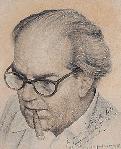
Villa-Lobos, Heitor
(1887-1959)
Brazilian composer, the country's foremost of the 20th century.
Villa-Lobos was born March 5, 1887, in Rio de Janeiro and was primarily self-trained. In 1912 he accompanied a scientific expedition to the interior of Brazil to study the music of Native American tribes, later an important influence on his own music. Villa-Lobos also came in contact with contemporary European music while studying in Paris from 1922 to 1930 on a fellowship from the Brazilian government. He absorbed elements of the Neo-Classical style then fashionable in France, under the influence of Stravinsky and Satie, but particularly of Milhaud, who had befriended him in Brazil in 1919.
After 1931 he was director of musical education in the public schools of Rio de Janeiro. In this position he revolutionized public musical education throughout Brazil. He also supervised the systematic accumulation of a large collection of Brazilian folk and popular music, which served to focus nationwide attention on this rich source of musical material. He conducted orchestras in Brazil, the United States, and Europe
.
A prolific composer, Villa-Lobos wrote about 2,000 works, employing almost every existing form of musical composition. In his works he did not generally use actual Brazilian folk tunes but rather wrote original melodies in a Brazilian folk style, developing them in his own manner. From a popular Brazilian dance, he developed the chôros (“serenade”), expanding its form from the guitar solo of his first chôros to the large orchestral and choral ensembles of his later ones.
Also famous are his Bachianas brasileiras (1930-1945), nine suites, varied in their instrumentation, in which the musical idiom of Johann Sebastian Bach is ingeniously blended with the powerful rhythms and melodic styles of the folk music of northeastern Brazil. Villa-Lobos's other works include operas, ballets, symphonies, concertos, chamber music, piano pieces, and songs. He died in Rio de Janeiro on November 17, 1959.


