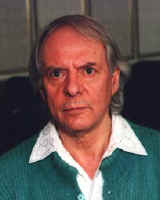
Stockhausen, Karlheinz
(1928- )
German composer, who was one of the most prominent avant-garde composers of the mid-20th century.
Born in Cologne, Germany, he studied with the Swiss composer Frank Martin and the French composers Olivier Messiaen and Darius Milhaud. At the University of Bonn, Stockhausen studied electroacoustics, phonetics, and information theory. In 1953 he helped found West German Radio's important Electronic Music Studio in Cologne.
He has been active as a teacher, conductor, and performer of his own work. Much of his early music uses serialism, or predetermined series of pitches, rhythms, dynamics, tone colors, and other elements, but from the 1950s onwards he experimented with indeterminacy (use of chance and improvisation) and freedom for performers in deciding their own speed and dynamics. Fluctuating tempos and indeterminacy prevail in the wind quintet Zeitmasse (Time Measure, 1956). His Gesang der Jünglinge (Youthsong, 1956) projects a singing boy's voice, mingled with electronic sounds, through five spatially separated loudspeakers. In Gruppen for three orchestras (1955-1957) his design was to submerge individual players and whole groups of players into a multiple assemblage, creating a new sonic organism.
Other works include Zyklus (1961), for solo percussionist; the multimedia work Beethausen, opus 1970, von Stockhoven (1970); and chamber works such as Ylem (1973) and Tierkreis (1977). In contrast, Sternklange (Star Sounds, 1971) is a large work, composed for five separate groups and open-air performance, in the course of which the names of the constellations are called out.
Many of Stockhausen's works have a meditative atmosphere built in a large time-scale, such as Mantra (1970) for two pianos, and Stimmung (1986) for six voices, a 70-minute work built on different voicings of a single chord. The wide-ranging profusion of ideas stemming from various spiritual and literary sources, inspiring works conceived on a grand scale, combined with his compelling personality gave Stockhausen a following in the 1960s far beyond the relatively small number of contemporary music enthusiasts of the time. Although he has maintained a lower public profile since the mid-1970s, he has been engaged on his most grandiose project to date: LIGHT—the seven days of the week is a cycle of seven large operas to be performed on seven consecutive days, based on the creation myth and employing elemental figures such as Eve, Lucifer, and the archangel Michael.
So far completed have been Thursday (1980), Saturday (1983), Monday (1988), Tuesday (1991), and Friday (1994). Currently being worked on is Wednesday.


