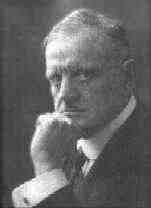
Sibelius, Jean
(1865-1957)
Finnish composer, whose symphonies and symphonic poems reflect his Romantic and intensely nationalistic approach to music.
Sibelius was born in Hämeenlinna on December 8, 1865, and named Johan Julius Christian Sibelius. He was educated at the Helsinki Conservatory and studied composition in Vienna under the Hungarian composer Karl Goldmark. Originally planning to become a violinist, he eventually abandoned it to concentrate on composition. Sibelius taught theory at the Helsinki Conservatory from 1892 until 1897, when he received a government annuity that enabled him to concentrate solely on composition. With the exception of a few trips abroad, he lived for the rest of his life at Järvenpää on the outskirts of Helsinki. He stopped composing in 1929 and died on September 20, 1957, at the age of 91.
The leading composer of Finland, Sibelius is also considered one of the chief symphonic composers of the 20th century. His music is inspired largely by nature and by Finnish legends, such as the Finnish national epic the Kalevala. Although actual folk songs are not employed in his compositions, Sibelius used melodic and rhythmic patterns characteristic of Finnish folk poetry and music. One of his most famous pieces, the tone poem Finlandia (1899; revised 1900), was banned by the Russian rulers of Finland because it aroused much patriotic fervour among the Finns.
A characteristic feature of Sibelius's style is the frequent use of short motifs that are continually transformed and that finally evolve into complete melodies. At his best in symphonies and symphonic poems, he was also a master of orchestration. One of the last exponents of 19th-century Romanticism in music, he was concerned with preserving formal structure and in this way was influenced by Johannes Brahms.
His view of the symphony complemented that of Gustav Mahler, who told Sibelius that for him it was “the world—it must embrace everything”. For Sibelius, by contrast, the important thing was the “profound logic creating a connection between all the motifs”. Thus his symphonies tend towards austerity, and a compression of form that became more pronounced as he grew older. The first two movements of the fifth symphony were eventually condensed down to one movement, and in his seventh symphony, the traditional four-movement structure of the entire work is pared down to a single movement.
The principal works of Sibelius include seven symphonies (1899-1924) and the symphonic poems En Saga (1892; revised 1901), The Swan of Tuonela (1893), Nightride and Sunrise (1909), The Oceanides (1914), and Tapiola (1925). Sibelius also wrote a violin concerto (1903), chamber and choral music, and pieces for the piano as well as songs.


