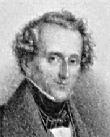
Mendelssohn, Felix
(1809-1847)
German composer, one of the leading figures of early 19th-century European Romanticism.
Born Jakob Ludwig Felix Mendelssohn-Bartholdy on February 3, 1809, in Hamburg, he was the grandson of the noted Jewish philosopher Moses Mendelssohn. (The name Bartholdy was added to his surname when the family inherited property from a relative of that name, but he was always known by his original name.) As a child he converted with his family to Protestant Christianity. Mendelssohn first appeared in public as a pianist at the age of 9 and performed his first original compositions when 11 years old. His masterly overture to A Midsummer Night's Dream was composed at the age of 17; the famous “Wedding March” and the rest of his incidental music to the play were written 17 years later. His teachers included the Bohemian pianist-composer Ignaz Moscheles and the German composer Carl Zelter. A revival of public interest in the works of Johann Sebastian Bach was directly attributable to Mendelssohn, who in 1829 conducted the first performance since Bach's death of his St Matthew Passion
Mendelssohn appeared as a pianist and conductor throughout Europe, making frequent trips to England, where he was a favorite of Queen Victoria and Prince Albert. He was musical director for the city of Düsseldorf (1833-1835), conductor of the Gewandhaus Orchestra in Leipzig (from 1835), and musical director to King Frederick William IV of Prussia (from 1841). In 1842 he helped organize the Leipzig Conservatory. He suffered a physical collapse at the death of his favorite sister, Fanny Mendelssohn Hensel, and died a few months later in Leipzig on November 4, 1847.
In spite of an enormously strenuous schedule as pianist, conductor, and teacher, Mendelssohn was a prolific composer. Of his five symphonies, the best knows are the Italian Symphony (1833) and the Scotch Symphony (1843). His organ and choral music is among the best of the 19th century and includes, for choir and orchestra, the oratorios St Paul (1836) and Elijah (1846), which were instrumental in the huge growth of amateur choral singing in Great Britain, and the cantata Erste Walpurgisnacht (First Walpurgis-Night, 1832; revised 1843); and his organ sonatas, preludes, and fugues, which constituted the most important addition to the organ repertoire since the works of J. S. Bach. Also important are the Variations sérieuses (1841) for piano; his concert overtures, including The Hebrides (1832); his concertos for violin (1844) and for piano (1831, 1837); and the eight volumes of Songs Without Words for piano (1830-1845); some of these are by his sister Fanny).
His Romanticism shows most clearly in his use of orchestral color and in his fondness for programmed music depicting places, events, or personalities. Structurally, Mendelssohn's music adheres to classical forms. It is lyrical and graceful, and in a harmonic idiom that places him among the more conservative composers of his time.


