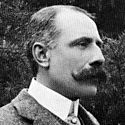
Elgar, Edward William
(1857-1934)
The first modern English composer to write important choral and orchestral music, and one of the major figures of European late-Romanticism.
Elgar was born June 2, 1857, near Worcester. As a young man he filled several musical posts before succeeding his father as organist at St George's Roman Catholic Church, Worcester, in 1885. In 1889 he married and resigned his position to devote himself to composing. Elgar then lived alternately in London and near Worcester.
The 1890 performance of his overture Froissart brought Elgar some recognition, but he did not become well known until 1899, when the Hungarian conductor Hans Richter performed Elgar's Variations on an Original Theme in London. That composition, better known as the Enigma Variations because the central theme is suggested but never overtly stated, is one of his most highly regarded and popular works. The Dream of Gerontius, based on a poem by the British churchman John Henry Newman, and generally considered Elgar's masterpiece, firmly established the reputation of the composer.
Elgar's work, an example of late Romanticism showing the influence of Wagner and Brahms, is notable for its wit, lyrical beauty, and distinctive form. Elgar also wrote the cantatas The Black Knight (1893) and Caractacus (1898); the oratorios The Apostles (1903) and The Kingdom (1906); a concerto for violin (1910) and one for cello (1919, becoming in recent years perhaps his most popular work); and the five popular Pomp and Circumstance marches (1901-1907, 1930).
His orchestral works include the overture Cockaigne (1902); the symphonic study Falstaff (1913); and two symphonies, in A-flat (1908, with which his international reputation really took off) and in E-flat (1911). He was at work on a third symphony and an opera, The Spanish Lady at the time of his death on February 23, 1934, at Worcester.


