This web page was composed for the San Diego State University Theatre 460A final project. I hope you find the information presented here useful as well as interesting. This page is a work in progress, and I will try to updated it weekly. Please feel free to e-mail me with questions or comments about the site.
This is an outline of the information presented on this web site. If you click the outline heading you will be taken to the appropriate passage.
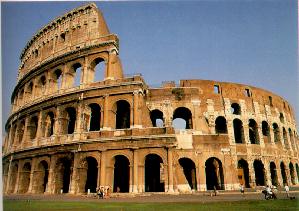
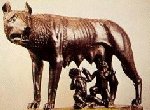
The nature of Rome's founding is not quite clear. There are many myths and speculations of how the great empire was established. Historical records from that time period are insufficient, so Rome's history is largely based on patriotic legends and myths. A popular legends begins with the brothers Amulius and Numitor, the sons of King Proca of Alba Longa. Amulius dethrones his brother and makes Numitor's daughter Rhea Silvia (Ilia) a Vestal Virgin. Mars, the god of war, became enchanted with Rhea Silvia and she bore him twin sons--Romulus and Remus. When Amulius found out about their births he became convinced that they would mature and eventually try to kill him and take the throne. To avoid this fate, he ordered their deaths and had them set afloat in a basket on the Tiber River. The twins landed on the shore of Germanus and were found and nursed by wolves. They grew up and eventually returned to their homeland. After Remus has a quarrel with Amulius' swine and cowherd, he is taken to Numitor and the twins discover their true origins. The twins then reinstate Numitor as the rightful king.
According to myth, the twins wanted to found a new city, but could not decide which of them would find the site. They decided to consult the gods through augury. Remus sat on the Aventine and saw six vultures fly overhead, but Romulus, who sat on the Palatine, saw twelve vultures. Since Romulus saw more vultures than his brother, it was decided that he was favored and should found the new city. Consequently, Romulus founded the city of Rome around 753 B.C. It was said that Romulus decided to set the city boudaries with a plough. Remus jumped over the boundaries in jest, and Romulus lost his temper and killed his brother. The new city was not much more then a small settlement, and had virtually no women, so Romulus invited the neighboring tribe of the Sabines to a harvest festival. When their guests arrived, the Romans abducted six hundred Sabine daughters at swordpoint. From such humble beginnings, Rome flourished as a city, and became the center of arts and government for the largest empire the world had ever witnessed.
The Romans were remarkable in their ability to adapt the unique elements they found in other cultures and assimilate them into their culture. They discovered drama in Greek colonies in Sicily and Southern Italy and brought it back with them to Rome. The Etruscans, who lived to the north of Rome, were seen to be decadent and weak. However, the Etruscans were more developed and civilized than the cultures in the east, and they were also influenced by Greek culture. The Romans eventually recognized the merits of Etruscan culture and borrowed many forms of entertainment from their northern neighbors. Among these novel Etruscan entertainments were several varieties of musical and dancing performance, chariot racing, boxing, and the infamous gladiator games. These new diversions became so popular that the Romans turned to then to appease their gods when a plague ravaged their city in 364 B.C. Roman drama became extremely popular and was eventually incorporated into the majority of other entertainments. This created a circus-like atmosphere that encompassed Roman theatre.
Livius Andromicus created the first regular theatrical performances in Rome in 240 B.C. He was a black slave brought from Egypt. His works were alterations of Greek theatre practices. He took pre-existing Greek plays and tried to improve on them and increase their appeal to the Roman populace. He is regarded as the father of Roman dramatic and epic poetry. He also translated Homer's Odyssey into Latin verse. It wasn't long before plays were being written by native-born writers. By approximately 200 B.C. the Romans had successfully adapted Greek drama to their own unique cultural preferences.

Click here to visit Ancient Roman Empire Costume Links at The Costumer's Manifesto
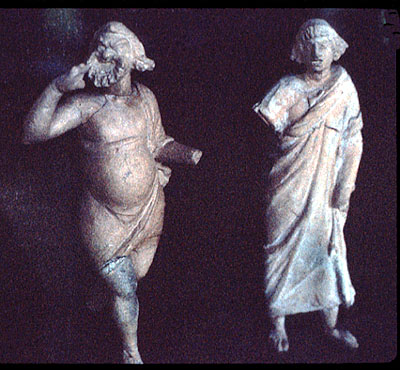
Conventions of Roman Comedy
The only comedic Roman works to survive were composed by Pluatus and Terrence.
Titus Maccius Plautus (254-184 B.C.)
Publius Terentius Afer (Terrence) (195-159 B.C.)
Terrence was a native of North Africa. He was brought to Rome as a slave, but was later freed because of his ability to write.
Lucius Annaius Seneca (4 B.C.- 65 A.D.)
Roman tragedy was generally an unsuccessful attempt to reproduce tragic works in the Greek style. The scenes and situations were horrifying. The characters were either completely good or completely evil, and used bombastic speech. The only Roman tragedies that exist today are based upon the works of Seneca. Seneca came from a prominent family and was well educated. His father concentrated on writing technical rhetoric and he had a profound influence on his son. Seneca eventually started to write speeches for emperors and generals. He became the first speech writer known in history. In 49 A.D., Seneca was made a praetor and appointed tutor to Nero, the adopted son of the Emperor Claudius. Nero became emperor in 54 A.D., when Claudius died. Seneca gave Nero guidance and tried to guide the boy to become a responsible young man. However, by 62 A.D., Seneca had lost all control over Nero. Seneca's inhewrited and acquired wealth made Nero jealous. The young emperor attempted to have Seneca poisoned but failed. In 65 A.D., after Seneca had retired, he was implicated in a conspiracy to kill Nero. Seneca was sentenced to death, and committed suicide under imperial order.
Structure of Seneca's Plays
After the first Century B.C., there were no known authors making a living from comedy or tragedy, however, a number of other dramatic forms were developed and performed in Rome. The other forms of entertainment included the fabula Atellan, mime, and pantomime.
Fabula: Roman word for play
Fabula Atellana: a short farce.
Used the same types of characters: Maccus, a fool or stupid clown; Bucco, a glutton or braggart; Pappus, a foolish old man; and Dossenus, a cunning swindler.
Mime Troupes or "Strolling Players"
Pantomime
Theatre went into a further decline after the Roman Empire superseded the Republic in 27 B.C. Gladiator events sometimes used the orchestras or stages of theatres. Even more evidence of this decline is that some of the orchestras were flooded for water ballets or sea battles (called naumachia).

Amphitheatres and circuses held many events such as human-animal fights, chariot racing, acrobatic shows, gladiatorial contests, and sea battles.
Construction
Roman Theater Construction Illustrations

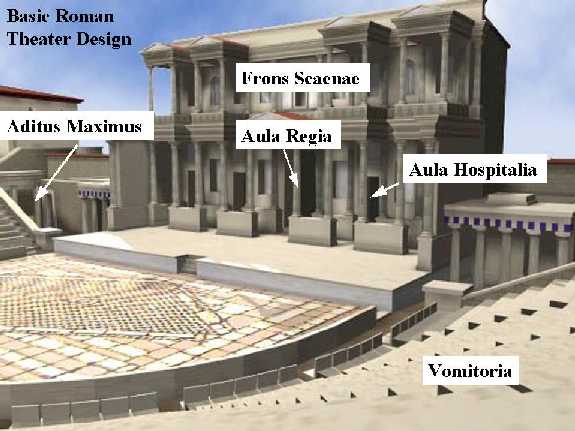
Follow this to a very informative Roman Theatre architecture site.
The Emperor Constantine, who ruled from 312 A.D. to 337 A.D., recognized Christianity as the official religion of Rome. The moral degradation of Roman theatre caused the Christians to put increasing pressure on the empire to close the theatres. In the fifth century, mime performers were excommunicated and their souls were damned to hell. In the sixth century, theatres were closed by Pope Justinian because he decreed that they were an evil influence on the populace. The most probable reason for the complete abandonment of the theatre was constant invasion from northern, "barbarian" tribes. The fall of the Roman Empire is still a highly controversial topic. However, it is safe to assume that, whatever the cause, those conditions that caused Rome's decline directly impacted Roman theatre. Eventually, as the Empire crumbled, Romans most likely spent the majority of their leisure time attending events that helped them forget their troubles and allowed them an avenue to focus their frustrations. The gladiator games likely became more popular than the theatre, and dramatic audiences surely evaporated. As the great Empire's infrastructure finally collapsed, so did the theatres.