TOPICS GROUP TWO – JULY 2001.
1. REFERENCES
AND SOURCES:
|
a) The current F2B rules plus Judges Guide: Source:
FAI Sporting Code, 2001 edition, “Volume
F2” (the F2B rules are numbered in the 4.2.1 to 4.2.16.16 range of this
document; the Judges Guide is at Annex 4B). For those without a current FAI rule book, this is
available by download in Acrobat .pdf format from the FAI web site (address: http://www.fai.org/aeromodelling/documents/sc4.asp). For those not familiar with downloading and the FAI
web site, see the downloads info in the box right at the end of this paper. b) The Control Line Organisers Guide, plus other
related information: Source: The Organisers
Guide is Annex 4E to the above “Volume F2” document. The references to other
parts of the FAI Sporting Code which you will see to from time to time in the
new F2B rules are spread across 2 other parts of the Sporting Code - “General Section”; and “Volume ABR”. You can download both
from the above address. c) The
“1st Draft New F2B Rules & JG” (presently a “Discussion Only”
document): Source: This already exists but has not yet
been circulated to anyone. You will be receiving extracts from this with each
of the Topics Groups during the coming months, and then you will all get a
“Final Draft” copy (after Peter and I have incorporated all your inputs!). |
2. RESPONSE
DEADLINE:
ALL ANSWERS BY 20th AUGUST LATEST
PLEASE (EARLIER
IS “OK” TOO!!)
You
don’t need to answer if you and your contacts have no comments and/or suggestions
– for any nation not answering at all by the above date we‘ll just assume that
no answer means “we agree”.
3. TOPICS
IN THIS GROUP:
A) Grass circles; B) Weather &
Safety; C) Scoring Zero in an
Official Flight (mainly related to B); D) Re-flights (partly related to B).
4. THE
TOPICS, A through D:
Just like Topics Group 1 last month, below you will find introductory info from your Coordinators (the reasoning, etc for each topic), followed by our proposals for fixing “the problem”:
A) Grass circles:
A substantial number of open international contests are already flown on grass circles and these often demonstrate the problems that judges can have when scoring the Take-off (including the ground run, and the lift-off - “unstick” - segments). And exactly the same problems often occur on grass circles when scoring the Landing Manoeuvre (including the actual touch down, and then the ground roll out after touch down segments). The result is that in both manoeuvres, when flown on grass circles, the awarding of points often seems to depend as much on how well the contest organiser prepares and maintains his grass circle (coupled with an element of the pilot’s luck in hitting (or missing) “the holes in the grass”), as it does on the actual skill of the pilot in flying those manoeuvres!
There’s more. If, as we have assumed throughout this whole
new rules exercise, it is likely that future F2B World Champs events could have
entries of 100+ contestants, then the only way we can see to avoid a
significant increase in the present 6 to 7 days length of such events whilst
also ensuring a reasonable “working day” for everyone (especially judges) will
be to allow F2B Official Flights to be run simultaneously on multiple circles.
But limiting such events to hard circles only (concrete, tarmac) will impose
severe site availability – plus possibly also cost limitations - for potential
future World and Continental Championships organisers. We therefore propose
that the new F2B rules allow the use of both hard and/or grass circles (and even the simultaneous use of both during
the same event), but subject to
defining both how the site should be set up and maintained; and also by
ensuring that all contestants fly an equal number of Official Flights on each
circle. That 2nd point will be covered in more detail in the
“Contest Procedures” section which will follow in Topics Group 3, but the
proposed text for the 1st point (the “Flying Sites” part) is quoted
below.
Also quoted below are our proposed new “Take-off Manoeuvre”
and “Final Approach Manoeuvre” descriptions. Why change these manoeuvres?
Because although the new “Flying Sites” paragraph can (has?) set what we hope
are good practical limits for the preparation and maintenance of grass circles
for F2B contest use, we do not believe that it is reasonable to assume that all
future grass circles will be to “English Bowling Green” standards (not even at
World Champs events)! So eliminating the scoring of both the Take-off ground
run and the Landing ground roll-out segments from these 2 manoeuvres allows for
equal scoring of flights when operating from both grass and hard circles.
In addition to all of that, we think it is vital that if a
contest is flown on 2 circles, then everyone should have a minimum of 4
Official Flights (this will also be covered in much more detail in TpcsGrp3,
“Contest Procedures” next time). But sticking to the scoring aspect of this
point, we think that especially (but not only) when a contest site has 1 grass
and 1 hard circle, then 2 Official Flights must be made on each circle. That of course leads back to the changes we've made to
the Take-off and “Landing” Manoeuvres, because clearly for hard circle Official
Flights it is not necessary to change the start of the manoeuvre to exclude the
present ground roll portion by starting the scoring of the manoeuvre at 30cm (1
foot) above the ground as we are suggesting below - but going back to the point
above about not being able to "guarantee" that all grass circles used
will be to "English Bowling Green" standard, clearly if there is a
contest being run with 1 each grass and hard circles, and if every contestant
has to fly on both of those circles, then it becomes extremely complicated for
everyone if there are, in effect, 2 different Take-off Manoeuvre descriptions (one
for grass circles, plus a different one for hard circles). The same comments
apply to the Landing Manoeuvre too.
Not only that, but as you will also see in a Topics Group 3,
we are also going to propose that calculating the position of each entrant in
the contest should be done by taking his 3 scores (if the contest is a 1 circle
contest), or his 4 scores (if it’s a 2 circle contest) and simply dropping the
lowest score to work with the remaining 2 (or 3) scores. Clearly that approach
would also result in all sorts of complications if we had 2 separate Take-off
and Landing Manoeuvre definitions (one for grass circles, plus a different one
for hard circles), so we settled on the single, modified “Take-off” and
“Landing” (now “Final Approach”) Manoeuvres that you will see below.
Why the change from the current “Landing” title to the new
“Final Approach Manoeuvre” title? When you get the complete Final Draft New F2B
Rules & JG doc you will see that we have gone to considerable lengths to
ensure that the descriptions of all manoeuvres
accurately describe the respective manoeuvre. That includes the headings (titles) of each manoeuvre description.
Because in all branches of aviation the word “landing” is usually interpreted
to mean the procedure flown by an aircraft just before/at the moment of/just
after it actually touches its wheels onto the runway, we felt that to keep the
current title “Landing” for this manoeuvre could cause confusion. What we are
now suggesting is that, literally, it will be the last lap (i.e. “Final
Approach” in full size aviation jargon) that should be scored by the judges,
plus the moment of actual touch-down, but not
the ground roll-out afterwards.
By the way, as you will also see in the final part of the
new “Final Approach Manoeuvre” description, this proposed change does not mean that contestants will now have
carte blanche to “bury the nose of the aeroplane in the grass up to the Leading
Edge of the wing” and still walk away bravely claiming “that was a 10 point
landing”! And here’s a thought
addressed to the traditionalists: If you have just bravely demonstrated one of
those super-soft greaser touch-downs, then we bet that you did some “dragging
it in” at just about a zero rate of descent for a couple of METRES before
letting the rubber kiss the ground. True? So where was your continuous rate of
descent then? You can wave good-bye to a couple of points and start complaining
about the judges instead!
Here
are the proposed new rules:
First,
the proposed new "Flying Sites" rule - QUOTE:
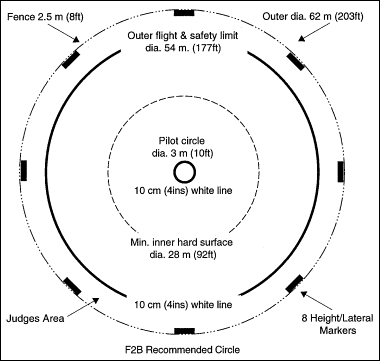
4.2.4 Flying Sites
a) Contest
organisers shall provide a site with Flight Circle/s which are substantially
horizontal, flat, and level, and which have smooth and ridge-free surfaces. If
surfaced in tarmacadam, concrete, or similar hard material, the surface should
be dust-free (that is: not gravel, nor sand, nor paved or tiled with openings
between the paving material). Hard surfaces should, as a minimum, provide
sufficient areas to include at least the whole of the pilot’s circle plus a
“ring” for models to use during Take-off and landing (see diagram below).
b) If grass or
similar surface, the same requirements as in paragraph a) above shall apply,
and the pilot’s circle and Take-off/landing area should also have an underlying
surface which is free from bumps and holes. The length of grass shall be kept
to a maximum of 2.5 cm (1in) throughout contests.
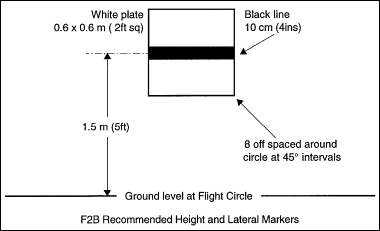
c) The diagrams
below show recommended dimensions for F2B flying sites and the markers erected
to show 1/8 th of a lap intervals and the
normal level flight height (with the related height tolerance). The erection of
such markers at sites which lack fixed terrain reference points is highly
recommended.
d) At all World and
Continental Championships, at other limited international contests, and at
other contests with large numbers of contestants and where the size and layout
of the contest site allows, the use of "Ready Box/es" is highly
recommended. These should be clearly marked, segregated off from general access
by barriers, and be large enough to contain a model with full length lines
attached. Ideally 2 or 3 such Ready Boxes should be provided if the contest
site allows. Also, if the contest site allows, it is recommended that 1
"Exit Box" be provided, this to be positioned on the opposite side of
the Flight Circle to the Ready Box/es, of a similar size to the Ready Box/es,
and similarly marked and segregated. Refer also to the FAI Sporting Code
Section IV, Volume F2, Annex 4E, Control Line Organisers Guide, 6.2.1 (page
59); and 6.5.2 (page 60); and Appendix 1 (page 66).
UNQUOTE:
Next, the 2 revised manoeuvres, "Take-off" and
"Final Approach - QUOTE:
Note: Manoeuvre
Descriptions and Diagrams: All of the following manoeuvre diagrams, 4.2.20 to 4.2.34
inclusive, have been drawn as seen when flying the manoeuvres from the pilot’s viewing point; and
all diagrams and manoeuvre descriptions are for anti-clockwise flight. |
4.2.20 The Take-off Manoeuvre
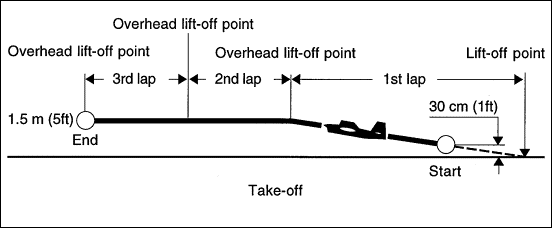
a) Start of manoeuvre:
At the moment when the model’s main
landing gear is approximately 30 cm (1ft) above the ground for the first time.
b) Climb out and
levelling-off segment:
The model should maintain a constant
rate of climb until reaching a height of 1.5 metres (5ft) and the point of
changing from climbing flight to level flight should occur exactly overhead the
point of lift-off. The change into upright level flight should be smooth and
gentle, with no sudden change/s in attitude.
a) 2 laps of
upright level flight segment:
After level-off the model should
maintain a height of 1.5 metres (5ft) and should fly 2 complete laps of stable
and smooth normal upright flight, with no abrupt changes of attitude and
without deviations of more than plus/minus 30 cm (1ft) throughout this segment.
d) End of
manoeuvre:
At the end
of the third lap after lift-off, exactly overhead the point of lift-off.
Recommended exit procedure:
Continue normal upright level flight
at 1.5 metres (5ft).
-----
4.2.34 The Final Approach Manoeuvre
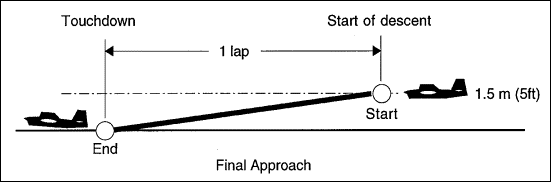
Recommended entry procedure:
From normal upright level flight at a
height of 1.5 metres (5ft).
a) Start of
manoeuvre: As the model leaves a height of 1.5 metres (5ft), plus/minus 30 cm
(1ft), with the engine stopped (gliding flight).
b) The descent
segment:
The model should fly for 1 full
gliding lap (engine out), measured from the start of the descent at 1.5 metres
plus/minus 30 cm (1ft), until the point of touchdown. The rate of descent
should remain constant throughout this complete gliding lap, from the moment
that it leaves the 1.5 metres (5ft) height until the moment that it touches
down. The touch down itself should be smooth and either a “2 point” or a “3
point” touch down shall be judged as being equally correct.
c) End of manoeuvre:
At the moment that the main landing
gear touches the ground for the first time.
Note: Official timing of the flight
shall also be stopped at exactly this moment.
d) Excess time and
“irregular” Final Approach Manoeuvres:
The mark 0 (zero) should be awarded
for this complete manoeuvre if the Official Timekeeper confirms that the first
touch down of the main landing gear occurred after the 7 minutes total time
allowed for an Official Flight has expired (refer 4.2.16). The mark 0 (zero)
points should also be awarded for this complete manoeuvre if:
i) the model
crashes;
ii) the model lands
on its belly;
iii) the model lands
upside-down;
iv) the model flips
over at the end of the manoeuvre (that is: at the moment of touching down);
v) the model is
fitted with a retractable landing gear and if this was not fully extended at
the time of touch down.
UNQUOTE
_______________________________________________________________________________________________
|
SPACE FOR YOUR NATION’S COMMENTS ON
TOPIC A: (write as much – or as little - as
you like, this box will expand to suit) Grass
Circle/site definition: Revised
“Take-off Manoeuvre”: Revised
“Final Approach Manoeuvre”: |
------------------------------------------------------------------------------------------------------------------------------------------
B) Weather & Safety:
The current FAI wind speed limit (12 metres per second) is
the same for all C/L and RC classes except Scale. We feel that for F2B this is
unreasonably high, and it’s certainly a fact that trying to stick to it has
already cost the Stunt community too many F2B models. Reducing the maximum wind
speed limit to 9 metres per second (the same as Scale) seems reasonable to us,
especially in view of the “continuous 30 seconds measurement” requirement
(which we have picked up, unchanged, from F4B & F4C). By the way, 9 metres
per second is still about 35 % of the air speed of a typical F2B model and is therefore
not only realistic but remains more than challenging enough for the pilot! (And
also by the way, “few” - !!! – full-size aircraft are certified for runway
operation in anything like cross winds of 35% of their cruising speed).
Thunder storm build-up in the vicinity of a C/L circle is a
serious potential safety threat for flyers and by-standers alike, so we feel
that a clear definition of how to deal with this must become part of the new
rules. So both in cases of excess wind speed and electrical storm (thunder
storm) activity, we see the need to be clear in the new rules, automatically
granting Re-flights for Official Flights already in progress, plus delaying the
contest in such conditions.
Similarly, although given “a passing mention” in previous
F2B Judges Guides, we feel that safety incidents such as a child wandering into
the Flight Circle during an Official Flight have not been given enough
prominence in the past. Although the new “Contest Site” paragraph (Topic A
above) will recommend fenced Flight Circles (in the diagrams which will be
added soon), it is unrealistic to expect that all contest organisers will have
the money and manpower to erect these. And even if fully fenced, there must
still be entry/exit “gates” to circles, and these still leave the possibility
of incidents like a child wandering into the circle during the “hurly-burly” of
a contest. We therefore feel it is important to make clear to contestants that
in the event of such incidents they will be free to take whatever avoiding action
is necessary/possible whilst being certain that their ultimate position in the
contest will not be affected because they will definitely be granted a
Re-flight.
As you will also see in the text extracts below, we have
taken the opportunity to “tidy up” the whole business of zero points and
Re-flights, the intention being to make the rules crystal clear for everyone involved.
Below is the proposed new rule – QUOTE:
4.2.6
Contest Weather
a)
Any Official
Flight (refer 4.2.10) in progress when the wind speed is equal to or greater
than 9 metres (30ft) per second, as measured for a continuous period of 30
seconds, shall be subject to a Re-flight as set out at 4.2.13. No Official
Flight shall be started under such wind conditions, and in the event of such
conditions occurring the F2B CD and Head Judge shall agree a suitable delay to
the contest timetable and shall inform contestants and contest officials
accordingly.
b)
For safety
reasons any Official Flight in progress during local electrical storm activity
(thunder and/or lightning) shall be granted a Re-flight as per 4.2.13. No
Official Flight shall be started when an electrical storm appears to be
imminent, and if such conditions do occur the F2B CD and Head Judge shall agree
a suitable delay to the contest timetable and shall inform contestants and
contest officials accordingly.
UNQUOTE
Now straight
on to the proposed new rules for "Scoring Zero Points" and
"Re-flights" (because both mainly link into all the above) - QUOTE:
4.2.12
Scoring Zero Points for a complete
Official Flight
a) An Official Flight shall be scored 0 (zero) points if jettisoning of any part/s of the model occurs at any time from the moment of first leaving the ground at the start of the Take-off manoeuvre until the moment the model first touches down from the Final Approach manoeuvre. But 0 (zero) points shall not be recorded if any jettisoning occurs after the model has first touched down from the Final Approach manoeuvre (examples: if a wheel detaches during the roll out after Final Approach; if a propeller blade touches the ground and breaks off after first touching down). In such cases the flight shall be an Official Flight and be scored and processed in accordance with 4.2.18 and 4.2.19.
b) 0 (zero) points shall also be recorded for a complete Official Flight if:
i) wind conditions as specified at 4.2.6, paragraph a) occur during an Official Flight;
ii) an electrical storm occurs during an Official Flight (refer 4.2.6, paragraph b);
iii) in the opinion of the Head Judge and the F2B CD a safety-related incident which is outside the contestant’s control occurs during an Official Flight, and if said incident could have impaired the respective contestant's ability to fly as required by 4.2.20 to 4.2.34 inclusive. For the purposes of illustration only, such a safety-related incident could be, but shall not limited to, an un-supervised child or animal wandering into the Flight Circle during an Official Flight;
iv) a model fails the second official noise test (refer 4.2.8, paragraph g).
-----
4.2.13
Re-flights
A Re-flight shall be granted to every contestant who
experiences any of the circumstances set out at 4.2.12, paragraph b), items i),
ii), and iii), but not item iv). All
Re-flights shall be scheduled in accordance with 4.2.11, paragraph b).
UNQUOTE
Before
closing the proposed new rules for this Topic Group, we have also "tided
up" (clarified) the rules for the judges concerning when zero points
should (and should not) be awarded. That's contained in a complete new 4.2.18
concerning scoring which you will all get to see in Topic Groups 3. But for
now, because it follows on logically from the above, here are the relevant
sub-paras - QUOTE:
(EXTRACT FROM PROPOSED NEW 4.2.18
“Scoring”, sub paragraphs a) and b):
b) A score of 0 (zero) points for a manoeuvre shall only be awarded by the judges for:
i) all manoeuvres which are not attempted at all;
ii) all manoeuvres which are started but not completed;
iii) all manoeuvres with an incorrect number of repeat figures (too few or too many);
iv) all manoeuvres flown out of the sequence 4.2.20 to 4.2.34 inclusive (but see also paragraph d) below);
v) all manoeuvres flown with insufficient laps between manoeuvres (refer 4.2.17);
vi) the Final Approach Manoeuvre under any of the conditions set out at 4.2.34, paragraph d);
vii) an Attempt as per 4.2.11 (when all judges shall mark the respective Score Sheets with 0 (zero) points plus an “A”).
c) In addition, a score of 0 (zero) points shall be awarded:
i) for the complete Official Flight if the contestant’s model fails the second noise test as per 4.2.8, paragraph g), when the F2B CD shall mark the respective Score Sheets with 0 (zero) points plus an “N”;
ii) for the complete Official Flight if wind conditions as specified at 4.2.6, paragraph a) occur during the Official Flight, when the Head Judge and the F2B CD shall agree to mark all the respective Score Sheets with 0 (zero) points plus an “R”;
iii) for the complete Official Flight if electrical storm conditions occur during the Official Flight (again, when the Head Judge and the F2B CD shall agree to mark all the respective Score Sheets with 0 (zero) points plus an “R”);
iv) for the complete Official Flight if a safety-related incident occurs which is outside the contestant’s control and which could have impaired the respective contestant's ability to fly as required by 4.2.20 to 4.2.34 inclusive (when once again, the Head Judge and the F2B CD shall agree to mark all the respective Score Sheets with 0 (zero) points plus an “R”);
UNQUOTE
_______________________________________________________________________________________________
|
SPACE FOR YOUR NATION’S COMMENTS ON
TOPIC B (and C & D): (Write as much – or as little - as
you like, this box will expand to suit) But please show clearly which Topic
B, C, or D your are referring to. B: C: D: |
C) Scoring Zero in an Official Flight:
See above.
D) Re-flights:
See above.
5.
ANSWERING
PROCEDURES:
|
PLEASE SEND ALL REPLIES, QUERIES, etc TO: [email protected] 1.
Save this
file under a new name by adding your country 3 letter FAI code at the front
of the file name (e.g. for France, add “FRA” to the existing file name to get
“FRATpcsGrp1.doc”). 2.
Distribute/copy/print
the original file amongst your Stunt contacts as much as you wish. 3.
Collect and
summarise the resulting inputs, adding
them to your new (re-named) file copy in the relevant topic boxes as you
see them above. (I have already set the “Track Changes” and colour commands
in this file, and those commands should transfer when you save your new copy.
That means that your changes will be marked in a different colour in the
boxes when you return the new file to me). 4.
Return your
re-named file with your comments to me by the date shown at 2 above please. THANKS FOR
YOUR CO-OPERATION, IT WILL MAKE MY PART OF THIS JOB MUCH EASIER. Andy
Sweetland, Zürich, 25th July 2001 |