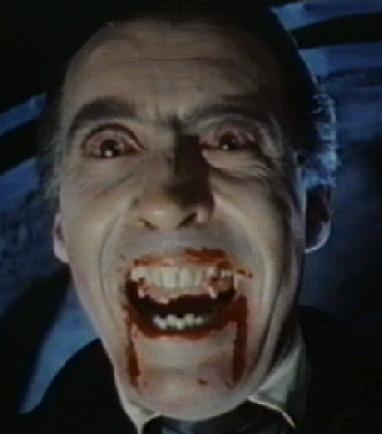
Fear is a force that has many different faces, from a last
minute college paper, to a more relevant facet of a vampire.
The vampire as a machine of fear uses the darkness of night,
by classic depictions, but more theologically, the vampire
represents the fall from grace and suffering that is lost
when one falls from God.
| The vampire as a symbol of anti-Christ works in chilling
perfection. Everything good about the lord is construed
into a sick and twisted form of dishonor, complete with
a form on mockery. Whether it was Stokers original vision
to attack the very essence of Christian theology can't
be known, but a modern day look can see this is the case. |
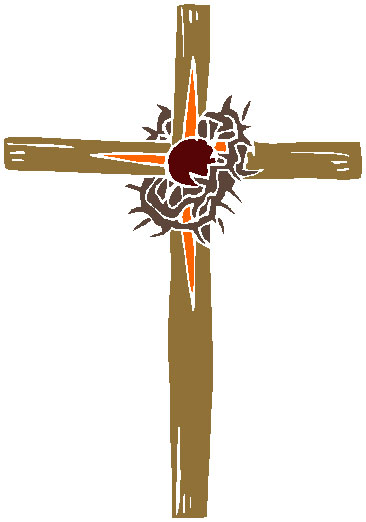 |
The death of Christ represented a moment where the sins of
the world became too much, and someone had to sacrifice everything.
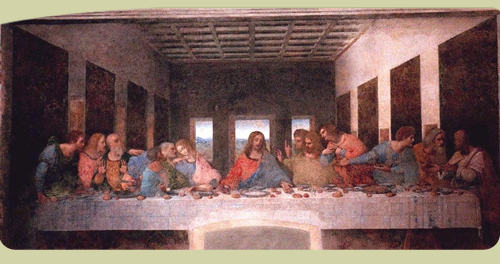
The story of the death of Christ is highlighted by the Last
Supper in Matthew 26:26-28 , which is the breaking of the
proverbial body and drinking of the blood of Christ. The twist
in the vampire mythology is a complete retrospect of this
story, with vampires basically doing the same as the Last
Supper, but as a way of life, not a movement into death. The
essence of life as blood is the root of the vampire mythos
and the story of Christ. Both shed blood for the lives that
it will impact, and surprising each has an outcome of death.
Is it this sense of death and loss of blood (life) that further
establishes the vampire as an effective agent of fear?
The effect of vampires and evil in relation to the Bible and
Christ can be further examined by looking at the Last Supper
more in depth. At the Last Supper, Jesus surrounds himself
with his followers, while Dracula has traditionally remained
a solitary figure. The Last Supper was a celebration of life
and friendship, neither of which is reflected (excuse the
pun) in the mythos of vampires. The solitary lifestyle leads
to a disturbing thought of a creature roaming the night, looking
for victims, which no need for companionship or love.
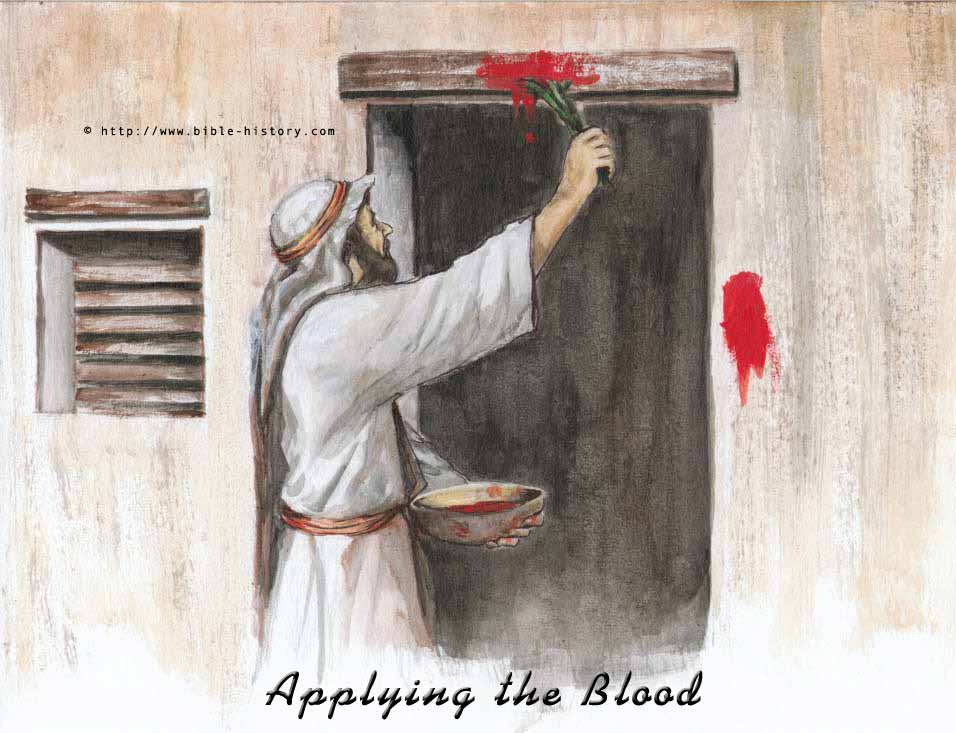
| The Last Supper took place during Passover. When you
look at Passover, it is a celebration of the freeing of
the Jews from the Egyptians. More importantly, it is called
Passover in part because they place blood on their door
so the angel of death would "pass over" there
house it was a pure lambs blood. The last supper celebrates
the escape from death by using an innocent's blood. |
 |
Two ways to look at the Passover and how it is related to
vampires are;
Christian: Innocents blood saves lives
Vampire: Brings them life
Or
Christian: Innocent blood defeats death
Vampire: Innocents blood draws vamp
(For a quick side note, in the 2000 Patrick Lussier film
Dracula 2000 the last supper is featured, and it is revealed
that, in this film origin, Dracula is actually Judas, tying
in a lot of the Christian symbolism that has been seen throughout
many vampire works.)
|
Catholic Cross. http://www.twoheartsdesign.com/images/clipart/catholic/cross/images/cross1.jpg.
TwoHeartsDesign.com. Accessed 11-27-2006
Glover, David. Vampires, Mummies, and Liberals: Bram Stoker
and the Politics of Popular Fiction. Durham. Duke University
Press. 1996
Hughes, William. Beyond Dracula. New York. St. Martin's Press
Inc. 2000
New International Version of The Holy Bible. Michigan. Zondervan
Publishing House. 1973.
Passover. http://www.bible-history.com/art/images/passover.jpg.
Rusty Russell. Accessed 11-27-2006.
Stevenson, Gregory. Televised Morality: The Case of Buffy
the Vampire Slayer. Hamilton Books. 2003.
Stevenson, John Allen A Vampire in the Mirror: The Sexuality
of Dracula
PMLA. Modern Language Association. 1988
The Last Supper. http://www.danbrown.com/secrets/davinci_code/last_supper.html.
Accessed 11-27-2006.
Waller, Gregory. The Living and the Undead. Urbana. University
of Illinois Press. 1986
Wolf, Leonard. Ed. Blood Thirst, 100 Years of Vampire Fiction.
New York. Oxford University Press. 1997
|