Contact me at [email protected] for any questions � Copyright 2014 |
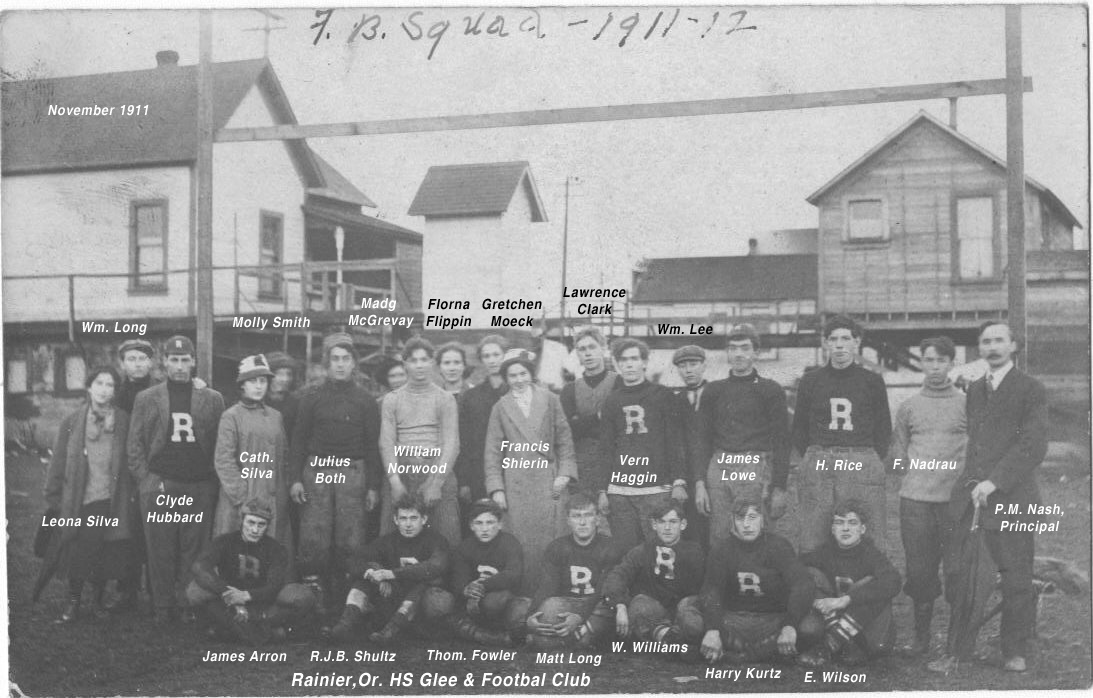
Harry E. Rice grew up in Rainier and graduated in 1912 in Rainier high school's first senior graduation along with May Nadeau and Esther Dawson. In the 1920 Rainier High School yearbook, the "Emeraude" (the first year it was published), it noted that he lived in Chicago, Ill where he was a Chemist. Though he lived far away he still held a deep fondness for his former home. In 1969 a collection of his childhood memories "Episodes in the life of a Columbia River kid" was published. One of the chapters from the book "Rainier, Oregon: A Day to Remember" is shown below. It recounts a July 4th celebration in Rainier in about 1904 or 1905. It is interesting to see the similarities between then and today's "Rainier Days in the Park."
A little lumbering and fishing town on the south bank of the Columbia River, right at the big bend in the heart of the Coast Range, about 50 miles from the Pacific Ocean. Population about 2,500, mostly engaged in salmon fishing or the lumbering industry. Some farms scattered around where they could find a level space, five sawmills and three logging camps. The main street, Water Street of course, was wide and ran parallel with the river. The SP&S railroad ran down the middle with its inevitable siding alongside. There were the usual assortment of stores, dry goods, grocery, meatmarket, drugstore, barber shops (two), blacksmith, bank and post office, and only seven saloons. These were strung out for about four blocks, the ones on the north side projecting out over the river supported by piling and back of that, warehouses and wharves. The ones on the other side were dug into the foot of the hill which went up for a few blocks and possibly about 500 feet high. I must not forget the Rainier Hotel, a three-story frame building backed into the hill with the lobby and small stores on the first floor and about 30 rooms above. Such was the town.
The prominent men decided that we were to have a rousing old- fashioned Fourth of July celebration that year - it was about 1904 or 1905. They put out collection boxes all around in the stores and offices and asked everyone to contribute and have a part in the affair. One of the committee told my Dad that the best collections came in from the boxes placed in saloons. This general collection was supplemented by donations from business and prominent men of the town. Quite a sizable war chest was accumulated.
Preparations were begun weeks in advance. We had our public square - a platform a couple of hundred feet square on the river side of the street and extending out over the river. The planking was heavy enough to accommodate the heaviest drays and teams. The men got busy and put up a framework over the whole area. Then they hauled in fir branches from the logging camps and made a roof over the whole works. It furnished shade, and with the river breeze blowing freely it was nice and cool. Then they brought in fir trees 12 or 15 feet tall and lined them up along the edge of the sidewalks from one end of the business district to the other. When the branches were trimmed off the inside a little over head-high it formed a delightfully shaded arcade the full length of town. In addition a pit was dug and logs burned to form a huge bed of live coals. Then a beef and a couple of hogs were spitted over them to barbecue. A man was kept on duty to turn the spit.
Finally the Great Day arrived. I lived on a farm adjoining the town on the downriver side. I was up long before daybreak as I had my chores to do and was certainly not going to miss the start of things. I had some trouble with the milking. The cows did not realize what day it was and put up a protest at being milked at that early hour. At last I was done and went to the house to gulp a hasty breakfast, wash behind my ears and don a clean shirt and jeans.
It was just sunrise and there was the darnedest explosion. (I think this was on the Fourth - it seems to have been around that time.) We knew the blacksmith was going to shoot his anvils on the Big Day. (This consisted of placing a handful of black powder between two anvils and touching it off with a redhot iron rod.) Another man was going to set off some dynamite. But nothing like this ! We all rushed outside to see what was happening, and the whole episode fell into focus. U. S. Navy ships often entered the Columbia and visited Portland during June and July celebrations - battleships, cruisers and torpedo boats. (The Wisconsin was in around this time; the Wyoming in 1904; Marblehead, Chicago and Boston in 1905; others in 1906 and 1907; in 1912 it was the Oregon.) On this occasion, because of the tricky currents and vagaries of the channel, the Navy captain had decided to anchor overnight. The ship was right out in the river in front of my home and had fired a sunrise salute. The reverberations caught between the mountains on both shores sounded like the granddaddy of all thunderclaps. You can rest assured that everyone in town was wide awake.
I know for sure it was the morning of the Fourth when I saddled my pony and set off for town, for I was to ride in the parade. Dusty was feeling his oats, so he proceeded to give a very good demonstration of how a cow bronco ought to buck. I managed to stay with him and we were on our way.
I had a whole silver dollar in my pocket so I was a millionaire. You would be surprised at the firecrackers you could get for a dollar back in those days. I picketed Dusty in a vacant lot with plenty of grass and went to join my friends. We wandered up and down the street until eight o'clock when we had to report for the parade. Then we got the thrill of our lives! The captain of the Navy ship had sent its band, a contingent of Blue Jackets and a group of his officers in full dress to join our parade.
The Governor of the state was to be the speaker of the day. His special car which was attached to the morning passenger train was due at 9:30. So we marched to the station and lined up right where the car would be spotted. The liveryman, Joe Lowe, all dolled up in his Sunday best was there with his new "surrey with the fringe on top" to provide transportation for the Honored Guest. I think that Governor Chamberlain (I think that was who it was) when he stepped out on the platform in his formal frock coat and top hat, must have just about collapsed when he saw the military line up standing at "Present Arms." With the band to lead us we made a circuit of the town and ended up at the square. The band and the military returned to their ship and with a three-whistle salute answered by the mills and every whistle in town, the Navy was on its way to Portland.
Our program proceeded in its planned form, Opening Prayer, Welcome by the Mayor, Dean Blanchard, Reading of the Declaration and the oration by the Governor. Then everyone cleared out to allow the men to rearrange the benches and set up long plank tables. The call rang out, "Come and get it before we dump it in the river." And everybody came. Such a feed! Barbecue sandwiches, cheese, baked potatoes with lots of home-made butter, pickles, smoked smelt, home-made ice cream - with real cream, coffee or milk. Seconds were available.
In the afternoon there were games and races, climbing the greased pole, and of course the tussle for the greased pig. There was a baseball game with a team from St. Helens.
Then it was time for everyone to go home and take care of the evening chores. We had some friends, including several of mine, and Mother set us up a good picnic supper. We all collected in the front yard, right on the bank of the river, to watch the fireworks. They had been purchased with the contributed fund and were to be set off from the deck of a lumber barge anchored in midstream. We sure had ringside seats, but I believe they could have been seen from every house in town, built on a hillside as it was.
As the sun sneaked down behind the western mountains, the snowcapped peaks of Mount St. Helens and Mount Adams took on a posy pink of the afterglow to furnish a beautiful backdrop for the fireworks - supplemented by the reflections in the mirror-like river. And so a tired boy hit the hay to dream ... I should say not. He was too dead to the world to dream.
I think that everyone who could walk, hobble or crawl had attended the celebration. Dad said that it was estimated that over 3,000 had been fed at lunch.
Just an aftermath. A few days later the men collected all the trees and fir branches and piled them on a float made of drifting saw logs. This was towed out to midstream and set on fire. So with this mighty bonfire slowly drifting downstream behind Walker's Island with the outgoing tide came the last part of a Day to Remember.
Contact me at [email protected] for any questions � Copyright 2014 |