Table of Contents:
Disclaimer
Physical Aspects of the Clarinet
Tuning Your Clarinet
Long Tones: What's The Big Idea? (Tone Quality & Air Support)
Warming Up The Right Way
Working Smart, Not Hard
Repertoire
Clarionet. An instrument of torture operated by a person with cotton in his ears. There are two instruments worse than the clarionet - two clarionets.
- Ambrose Bierce: Devil's Dictionary 1911
Disclaimer: I don't know, nor do I pretend to know, everything about the clarinet or playing the clarinet. Quite to the contrary, I'm rather new at this (I've only been playing six years), and still have a lot to learn. However, for those who know even less than me (don't feel bad, two years ago I would've drawn a total blank on almost everything here), I provide this page, which I hope will be helpful.
Also note that a lot of this information comes from various places. Some of it I have learned on my own, other pieces from master classes, and still others I just absorbed from random conversations in band and comments from the director. I try to give credit where credit is due, but sometimes I just don't remember where I learned it.
Physical Aspects of the Clarinet
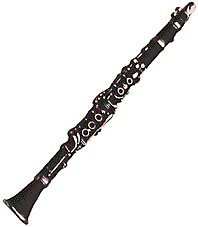 |
The clarinet is comprised of five basic parts (top to bottom): the mouthpiece, the barrel, the top joint, the bottom joint, and the bell. If the top joint & bottom joint have other names, I don't know them, and I've never heard them refered to as anything else. On the mouthpiece you have two other things: The reed, which is what vibrates to produce sound, and the ligature, which holds the reed in place. There are many different kinds of reeds, mouthpieces, and ligatures, so each has its own section. There are also different sorts of barrels, but I am afraid I don't know much about them, though I encourage you to do your own research on the matter. I have also heard that different bells can largely effect the way your clarinet plays, though I know even less about this than barrels. |
Ah, reeds. They can be your best friend, or your worst enemy--and usually the latter. There is only one general concensus on reeds, and that is that there is none... well, maybe that they are the most wretchedly annoying things ever set upon the face of the planet, but that's a separate issue.
The best way to find out what reeds work best for you, is to try them out.
Personal Preference: I went through five brands of reeds before finding something I really liked. While I found that Rico's Grand Concert Reeds are great for a snitch (they play beautiful for the first forty minutes, then generally go caput on me), Vandoren V-12s last longer and play better after you give them a couple of days to break in.
Myth: A common myth among beginning or young clarinetists is that the harder the reed you play on, the better you are.
Fact: Reed strength actually has little to do with how well you play. Although with stronger air support you will need a stronger reed, reed strength is more dependent upon the kind of mouthpiece you play on.
For more information on reeds, I would check out Salli Chmura's article at the Online Clarinet Resource.
Mouthpieces
If you're anything like me, the last time someone asked you what sort of mouthpiece you play on (or if someone asked you what sort of mouthpiece you play on), your answer was something like, "Um... I don't know?"
"But honey, you're a good clarinetist, you should know." That's what I was told, and they were right. You should know.
Myth: Equipment doesn't matter. An excellent clarinetist will sound good no matter what.
Fact: All right, so maybe that is true. An excellent clarinetist will sound good no matter what, but if they want to sound excellent, they'll invest in some excellent equipment. And do you know what the #1 way to improve your sound is? (aside from lots of hard work and/or buying a new clarinet) Buying a new mouthpiece.
Right now I play on a K-5L model mouthpiece by the Woodwind Company (a branch of Leblanc). It's a student model moutpiece, and very good for its price. Like the mouthpieces most professionals play on (or so I was told by Frank Renk of the San Diego Symphony), it has a medium-open long facing.
However, everyone has their own preference, so the only way to find the right mouthpiece is to try out different mouthpieces. For example, although my mouthpiece it really great, I actually prefer a slightly more closed mouthpiece--at music camp I had the opportunity to play on a Clark Fobes San Francisco Model Mouthpiece (that's his profession model) and simply fell in love with it.
Bay Woodwinds is also well known for their excellent mouthpieces. If you're looking for something slightly more affordable though (and aren't we all), David Hite and Vandoren make good mouthpieces too.
Always remember though, the mouthpiece does not make the player. The player makes the mouthpiece. (Well, actually the mouthpiece maker makes the mouthpiece, but you know what I mean...)
Ligatures
Like mouthpieces, ligatures will vary greatly from player to player. I just got a Vandoren Optimum Ligature, which did wonders for the girl I used to sit by in my school band, but have discovered that I really like my Fabric "Revelation" ligature much better. Other people prefer string ligatures, and then there are those who think they're double reed players and actually wrap string around their mouthpiece :) Seriously though, there are many many types of ligatures out there, and you should shop around.
Before I get into how to tune your clarinet, lets go over the basics of how you should tune:
First, you should tune your low E. If it's flat, heaven help you, but if it's sharp, go ahead and pull out at the bell. This is the only note that will be effected by pulling at the bell, which is why it's smart to tune it first. Second, tune your open G. If it's flat too, get yourself a shorter barrel, but if it's sharp, pull out the barrel until it's in tune. Although pulling the barrel will effect all the notes on your clarinet (with the exception of the low E), it is the only thing that will effect your open G. Finally, play your tuning note (clarion) C. If it is sharp, pull out between the top and bottom joints. This will not effect the open G or the low E, but will effect every other note on your clarinet.
I learned that nifty way of tuning the summer after my freshmen year of high school from Patricia Shands, the clarinet instructor at Pacific Music Camp. I have only the deepest respect for her (heaven knows she's better than me), but I'm going to tell you this now, in regards to what Frank Renk said at a master class at SMAS in June 2002 (whom I not only respect, but also idolize :)
Tuning your clarinet isn't about adjusting it so everything's perfect--that's what you do while you're playing. Just adjust the barrel to where you know it should be, then play. He claims that when the tuning note is given on stage he never tunes, but checks that his reed plays--noting that if he has to check that he's playing in tune, he doesn't really know his instrument.
So how do you get to know your instrument? Well, what Ms. Shands taught me definitely came in handy, but here's another method I use, which I learned from my personal instructor/band director, Bob Smith (don't laugh, that is his name):
Turn your tuner on and tune just your tuning note (clarion) C. Leave the tuner on, but don't look at it anymore. (This, I should know, only works w/ a chromatic tuner which will automatically figure out what note you're playing) Get a piece of music out. Play it, then choose a random note in the piece to stop on and just hold that note out--now look at the tuner. Is it sharp? Flat? In tune? Don't adjust. Now stop playing the note. Make a mental note. Say it was sharp. Now think to yourself about playing it in tune (which, if it was sharp, would mean thinking about playing flatter). Play the note again without looking at the tuner, but try to adjust it by ear from where you know it was. Look at the tuner--are you in tune?
If it's the first time you've done this exercise, the answer is probably still no. It's frustrating, I know, but it not only helps you play in tune (it brought my pitch way down from having to pull a quarter inch to only pulling a quarter centimenter), it also helps your ear develop a much better sense of pitch.
Don't worry though, we'll save the ear training lessons for another time :) If you're really interested in ear training, check out Good-Ear.com.
Long Tones: What's The Big Idea?
Another appropriate title for this section would also be "How I Learned To Love The Slow Movements," and I'll explain why. I first started taking lessons my freshman year of high school. (Wow, only two years ago!) In February 2001 (seems so long ago, huh?) we were preparing for the CMEA Solo & Ensemble Festival, and my teacher told me, "I want you to pick a slow piece." Groan. But slow pieces were so boring.
But he saw my argument coming and shot it down before I could even spit it out: "They're only boring because you make them that way," he explained, "You hate playing them because they don't sound nice, don't you?" What could I say? he had me nailed. The solution: long tones. Long tones to get rid of the fuzz and to build overtones. And it worked. After countless hours of turning blue in the face, I managed to fall in love with the piece I hated.
And this year it was his turn to groan when I selected yet another slow piece for Solo & Ensemble -- "What's up with you and the second movements?" (the 2nd movement is generally the slow one) and I had to remind him it was his fault :)
So I thought I had the idea of long tones down. Then I got to music camp this summer and took a lesson from Frank Renk. (Uh-oh, here we go again; I'm telling you, this guy is ingenious...) And I learned a whole new use for long tones: air support!
He said that all non-professional clarinetists are guilty of changing their emboucher from note to note. He proved it to me by turning my mouthpiece around on my clarinet and having me blow while he fingered through the notes. He started with low notes, and then when he hit the register key nothing came out--until I changed my emboucher! It's really a fun experiment, and it's very eye opening.
Anyway, by changing your emboucher for each note, you prevent a steady and even sound from coming through, so you use long tones to help you: Start with a low C--play it for four beats, then imagine you're still playing it, and just just lift your ring finger (you'll be playing a D, but keep thinking C). The transition should be very smooth, you shouldn't even hear a transition, the note should just change, like a singer.
Trust Me, I Know: It doesn't happen the first time. Or the second. Or the third or fourth or four hundredth. I've been working on it like crazy, and though I have the concept down perfectly (or at least well enough to relate it to you), I still can only do it when I'm playing long tones--and that's only sometimes. But hey, that's how good tone quality started out too, so I have faith.
It's all about practice. But that's another topic.
Why is how you warm up so important? Why do you even need to warm up? **Coming Soon**
It's something my band director keeps repeating, but what does it really mean? It means practicing, not just playing.
What's The Difference?
If you go home and just play through your music--even five times in a row, you're not practicing. It will help you get better if you already know the music pretty well, but it isn't going to get you the 2nd Weber Concerto down in time for the audition.
Why Practice?
There are a million and one reasons people practice, but the main one is to get better. If you're only practicing because it's fun, that's great, but at some point you're going to stop and hate it, and you'll have to ask yourself, is it worth it? To some people, the answer is yes. To others, it's no. And both answers are completely legitimate, and sometimes the answer is both.
My experience:
At county honor band my sophomore year, I sat first chair. It was one of the most horrible things that ever happened to me. You see, the boy who sat second chair, Stephen Amundson (I'll never forget that name), was definitely better than me, and he had been first chair the past three years, so the pressure was really on.
The way my county honor band works is we get the music the last week of November, then we take it home and learn it, then the first week of January we come back, but it together, and perform a concert. So I had one month. And I still remember it--the hardest piece I'd ever played (I would've taken either Weber Concerto over it any day)--Dance of the Jesters. There were only two days I didn't practice over break--New Years Eve and New Years Day--and only because I was at my grandparents and they live in a condo, so I couldn't practice.
So I got back to school the week of the concert, and I still couldn't play the piece. I was freaking out, and I was totally burnt out. The Tuesday before the concert I broke down in tears and admited to my band director that I couldn't do it. I was so frustrated, and every time I looked at my clarinet I wanted to cry. I wanted to play and I wanted to practice, but it just made me sick.
What do you do when that happens? Stop practicing. He made me promise not to practice for the rest of the week except for at the rehearsals. It was horrible--I wanted to practice so bad--but I abstained, and I felt so relieved that I didn't have to practice.
The concert when great. I like to think I did just as well as Stephen. Well, maybe not, but close enough that no one cared? I was just happy to have survived.
So in my situation, I decided that practicing was and wasn't worth it. Whoever said "Find a job you love and you'll never have to work a day of your life," was wrong in my opinion, but the work is worth more than the money, and it has its own pay off in the end.
Ok, I'm definitely not the person to be writing about repertoire, because I have none. I have this annoying habit of learning a piece, performing it, then putting it down and never looking at it again.
However, I've compiled a list of basic repertoire pieces & places you can go for information/help/purchasing them. Let me tell you first that my favorite place to go when there's something I don't understand is the Bulletin Board at sneezy.org.
Um, there will be more come. I promise. But this is all for now.
Concerto for Clarinet in A Maj (W.A. Mozart)
I was told by several sources that no matter what audition you go to where, this is always the first piece they'll ask you to play (More specficly, the beginning of the first movement), so I thought it'd be a good place to begin.
To Bb or not to Bb? That is the question.
And there are several answers. You want to know what I would do? If I could afford an A clarinet, I would play it on an A clarinet, because that's how it was originally composed and it makes it a lot easier on your accompanist.
However, when I took it to CMEA Solo & Ensemble in March 2002, I played it on a Bb clarinet, and the judge had nothing to say--well, except that it was absolutely beautiful.
Will they know the difference? Probably not. Some people say an A clarinet definitely sounds different than a Bb; I haven't noticed. They might be able to look at the clarinet and know it's a Bb, but unless they have perfect pitch, if they can't tell the difference between the clarinets, chances are they won't be able to tell the difference between the pitches either.
Personal Experience:
I first learned this piece my sophomore year of high school ('01-'02). I performed the first movement at our winter concert (though I can't say I can still get up and perform it if need be) & was told it went very well. The second movement (my personal favorite) I played for Solo & Ensemble -- I got a superior, and the judge said I did just amazing for a sophomore. I also played the 2nd movement at a Chamber Recital at my high school, and for seating auditions at Stanislaus music camp where I sat first chair. The third movement just sort of scares me. We'll leave it at that. I never did get it up to tempo, but it was a lot of fun.
I have learned that the opening themes are the most important part. The first eight measures (that you play) of the first movement are really the most difficult part; to zero in even more: I spent two weeks on the first measure trying to get it just right. It's all about air support :)
The second movement I was told that it wasn't good enough unless I could make the audience cry in the first fifteen measures. I was so thrilled when my middle school band director (she listened to me at Solo & Ensemble) came up after my performance and said she almost started crying.
The third movement is so incredibly hard because it has to sound easy. I wish I could tell you more, but that's all I learned--that's really all I learned, because I certainly didn't learn how to play it.