
�
Every second of February, Canadians dig up an old superstition to determine whether the winter is near its end . This is the traditional date on which the groundhog, or wood-chuck is supposed to come forth from its burrow in order to gaze upon or note the absence of his shadow.
Considering the snow and ice in many sections of Canada on that date, one may logically wonder if he can possibly be awake enough to dig his way up through it all. But let�s assume he does make his scheduled appearance. If the sun is shining, and he sees his shadow, we are supposedly in for another six weeks of winter.
When the saying was first made up it was less definite. Groundhog Day was also known as Candlemas Day. During the medieval period in European history the proverb took this form:
�If Candlemas Day be fair and Bright,
Winter will have another fight;
But if Candlemas Day brings clouds and rain,
Winter is gone and won�t come again�
and the present
�If Candlemas Day is bright and clear,
there will be two winters in the year�
�
There are many other popular beliefs about animals and weather. For example, it is popularly supposed that animals can foretell the severity of weather for a whole season by growing their coats of fur accordingly, or the number of nuts squirrels store away in the fall.
LITERATURE�� ������������������������������������������������������������������������������ ������������������������ back
In The Blackwoods of Canada Catherine Parr Traill writes:
"Though the Canadian winter has its disadvantages, it also has its charms. After a day or two of heavy snow the sky brightens, and the air becomes exquisitely clear and free from vapour; ... see against the saffron tinted sky of an evening, or early of clear morning, when the hoar-frost sparkles on the trees, the effect is particularly beautiful.
I enjoy a walk in the woods of a bright winter-day, when not a cloud, or the faint shadow of a cloud, obscures the soft azure of the heavens above; ... The evergreens, as the pines, cedars, hemlock, and balsam firs, are bending their pendant branches, loaded with snow, which the least motion scatters in a mimic shower around,..." (An Anthology of Canadian Literature in English, 1990)
I think this quotation from Parr Trail�s work portrays very well how the visitor feels in Canada. I think one of the most striking things I found during the winter is the clearness of the sky, which looks as if it were summer, blue sky and very bright days. The colours nature and the weather produce are also very special. During Autumn, the saffron and yellow in the woods, the blue, white, and clarity of the days in winter,... are really striking.
Most of the books I have read by Canadian authors are full of descriptions of the landscape and the weather in winter. John Moss, Margaret Atwood, Jane Urquhart. In Invisible Among the Ruins, J. Moss writes: "The red maple leaf is a flame, the brief colour of Autumn; the white of our flag is the winter" (Moss, 2000: p 13).
I was also surprised by the number of poems Canadian writers have devoted to Canadian winters. Of course, they use Canadian landscape, such as maples, maize,... but winter receives special attention as compared to other seasons or themes.
Sir Charles G. D. Roberts has a poem entitled "The Winter fields"
Winds here, and sleet, and frost that bites like steel.
The low bleak hill rouns under the low sky.
Naked of flock and fold the fallows lie,
Thin streaked with meagre drift. The gusts reveal
By feats the dim grey snakes of fence, that steal
through the white dusk. The hill-foot poplars sigh,
While storm and death with winter trample by,
And the iron fields ring sharp, and blind lights reel.
Yet the in the ridges, wrenched with pain,
Harsh solitary hillocks, bound and dumb,
Grave glebes close-lipped beneath the scourge and chain,
Lurks hid the germ of ecstasy � the sum
Of life that waits on summer, till the rain
Wishper in April and the crocus come.
(An Anthology of Canadian Literature in English, 1990)
And there are many other authors and poems, like Pauline Johnson "His Majesty the West Wind", Archibald Lampman "Winter Evening", P. K. Page "Stories of Snow", Margaret Avison "Snow", Phyllis Webb "Eschatology of Spring", Alden Nowland "Canadian January Night",...
PAINTING�� ���������������������������������������������������������������������������������������������������� back
This influence can also be seen in the works of Canadian painters. The Group of Seven has many paintings of Winter landscapes. "Winter, Don River", by A. J. Casson, "House in Winter", by L. L. Fitzgerald, "Winter, Algonquin Park", by Lawren Stewart Harris, "Quebec Farm in Winter" by A. Y. Jackson, "Spring Snow" by Francis Hans Johnston, "October Woods" by J. E. H. MacDonald,"Snowberries" by Franklin Carmichael.
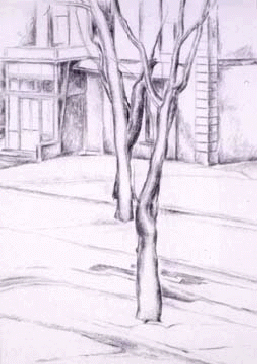
House in Winter, 1944.L. L. Fitzgerald. Pencil drawing
�
MEDIA�� ���������������������������������������������������������������������������������������������������������������� back
It is surprising the number of Canadian weather websites you can find, local radio stations give weather broadcasts every 30 minutes, news papers on line offer current weather conditions. The following are some Spanish and Canadian weather websites:
El Canal del Tiempo: http://www.tiempo.weather.com
CNN en espa�ol:� http://www.cnnenespanol.com/tiempo/datos/ciudades/ValladolidEspantildea.html
Environment Canada: http://www.cmc.ec.gc.ca.html
Instituto Nacional de mateorolog�a: http://www.inm.es/
The weather Channel: http://www.weather.com
The Weather Network: http://www.theweathernetwork.com/
El Pa�s: http://www.elpais.es
Ottawa Citizen: http://www.ottawacitizen.ca
I will first point out that although the websites named "El Canal del Tiempo" and "CNNenEspa�ol.com" are in Spanish, they are translations, or the Spanish version, of English sites. Both of them offer temperatures in both Celsius and Fahrenheit degrees, when in Spain the Fahrenheit scale is never used for weather temperatures.
As for the newspapers, in the Spanish papers the weather section usually contains a map and text, the information is provided in full text, whereas in the Canadian ones, it is more common to find graphics and only data, such as wind: 19 km/h, or dewpoint: 0 C,..., instead of complete sentences or paragraphs.
These would be things to bear in mind if any of the companies were to create a site for Spain. Avoid the use of the Fahrenheit scale, do not include information such as the wind chill factor, which the Spanish audience is not used to find,...
�
home�� ������������������������������������������������������������������������������������������������������������������������ back