9 April 1747
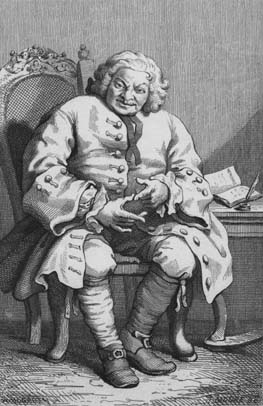
Beheaded for High Treason, at the age of Eighty, 9th of April, 1747
Beheaded for High Treason, at the age of Eighty, 9th of April, 1747
LORD LOVAT, who in 1715 had been a supporter of the House of Hanover, in 1745 changed sides, and became a friend of the party which he had before opposed.
His career in life began in the year 1692, when he was appointed a captain in Lord Tullibardine's regiment, but he resigned his commission in order to prosecute his claim to be the Chief of the Frasers; in order to effect which he laid a scheme to get possession of the heiress of Lovat, who was about to be married to a son of Lord Salton. He raised a clan, who violently seized the young lord, and, erecting a gibbet, showed it to him and his father, threatening their instant deaths unless they relinquished the contract made for the heiress of Lovat. To this, fearing for their lives, they consented; but, still unable to get possession of the young lady, he seized the Dowager Lady Lovat in her own house, caused a priest to marry them against her consent, cut her stays open with his dirk, and, assisted by his ruffians, tore off her clothes, forced her into bed, to which he followed her, and then called his companions to witness the consummation of the outrageous marriage. For this breach of the peace he was indicted, but fled from justice; but he was nevertheless tried for rape, and for treason, in opposing the laws with an armed force; and sentence of outlawry was pronounced against him. Having fled to France, he turned Papist, ingratiated himself with the Pretender, and was rewarded by him with a commission; but he was apprehended on the remonstrance of the English ambassador in Paris, and lodged in the Bastille, where, having remained some years, he procured his liberty by taking priests' orders, under colour of which he became a Jesuit in the College of St Omer,
In the first rebellion of 1715 he
returned
to Scotland, and, joining the King's troops, assisted them in
seizing
Inverness from the rebels; for which service he got the title of Lovat,
was appointed to command, and had other
favours conferred upon him. In the
rebellion
of which we are now treating he turned sides and joined the Pretender,
a step treacherous in the extreme. When taken, he was old, unwieldy and
almost helpless; although in that condition he had been possessed of
infinite
resources to assist the rebellion. He petitioned the Duke of Cumberland
for mercy; and, hoping to work upon his feelings, recapitulated his
former
services, the favours that he had received from the Duke's grandfather,
King George I., and dwelt much upon his access to Court, saying he had
carried him to whom he now sued for life in his arms and, when a baby,
held him up while his grandsire fondled him.
On the 9th of March, 1747, however, he was taken from the Tower to Westminster Hall for trial, and, the evidence adduced clearly proving his guilt to be of no ordinary character, he was convicted. He was next day brought up for judgment, and sentence of death was pronounced.
That this sentence was not ill deserved
appears from a speech of Lord Belhaven, delivered in the last
Parliament
held in Edinburgh, in 1706, in which his lordship, speaking of this
nobleman,
then Captain Fraser, on occasion of the Scots plot, commonly called
Fraser's
plot, says that " he deserved, if practicable, to have been hanged five
several times, in five different places, and upon five different
accounts
at least : as having been notoriously a traitor to the Court of St
James's,
a traitor to the Court of St Germain's, a traitor to the Court of
Versailles and a traitor to his own country of Scotland; in being not
only
an avowed and restless enemy
to the peace and quiet of its established
government and constitution, both in Church and State, but likewise, a
vile Proteus-like apostate and a seducer of others in point of
religion,
as the tide or wind changed; and, moreover, that (abstracted from all
those,
his multiplied acts of treason, abroad and at home) he deserved to be
hanged
as a condemned criminal, outlaw and fugitive, for the barbarous, cruel
and most flagitious rape he had, with the assistance of some of his
vile
and abominable band of ruffians, violently committed on the body of a
right
honourable and virtuous lady, the widow of the late Lord Lovat, and
sister
of his Grace the late Duke of Atholl. Nay, so hardened was Captain
Fraser,
that he audaciously erected a gallows, and threatened to hang thereon
one
of the said lady's brothers and some other gentlemen of quality who
accompanied
him in going to rescue him out of that criminal's cruel hand."
On the morning fixed for his execution,
9th of April, 1747, Lord Lovat, who was now in his eightieth year, and
very large and unwieldy in his person,
awoke at about three o'clock, and was heard to pray with great
devotion.
At five o'clock he arose, and asked for a glass of wine-and-water, and
at eight o'clock he desired that his wig might be sent, that the barbe
r might have time to comb it out genteelly, and he then provided
himself
with a purse to hold the money which he intended for the executioner.
At
about half-past nine o'clock he ate heartily of minced veal, and
ordered
that his friends might be provided with coffee and chocolate, and at
eleven
o'clock the sheriffs came to demand his body. He then requested his
friends
to retire while he said a short prayer; but he soon called them back,
and
said that he was ready.
When his lordship was going up the steps to the scaffold, assisted by two warders, he looked round, and, seeing so great a concourse of people, " God save us," says he, " why should there be such a bustle about taking off an old grey head, that cannot get up three steps without three bodies to support it ? "
Turning about, and observing one of his
friends much dejected, he clapped him on the shoulder, saying: "Cheer
up thy heart, man! I am not afraid; why
should you be so? " As soon as he came upon the scaffold he asked for
the executioner, and presented him with
ten guineas in a purse, and then, desiring to see the axe, he felt the
edge and said he " believed it would do." Soon after, he rose from the
chair which was placed for him and looked at the inscription on his
coffin,
and on sitting down again he repeated from Horace:
" Dulce et decorum est pro patria mori "
and afterwards from Ovid:
"Nam genus et proavos, et qux non fecimus ipsi, Vix ea nostra voco."
He then desired all the people to stand
off, except his two warders, who supported his lordship while he said a
prayer; after which he called his solicitor and agent in Scotland, Mr
W.
Fraser, and, presenting his gold-headed cane, said, " I deliver
you
this cane in token of my sense of your faithful services, and of my
committing
to you all the power I have upon earth," and then embraced him. He also
called for Mr James Fraser, and said: " My dear James, I am going
to heaven ; but you must continue to crawl a little longer in this evil
world." And, taking leave of both, he delivered his hat, wig and
clothes
to Mr William Fraser, desiring him to see that the executioner did not
touch them. He ordered his cap to be put on, and, unloosing his
neckcloth
and the collar of his shirt, knelt down at the block, and pulled the
cloth
which was to receive his head close to him. But, being placed too near
the block, the executioner desired him to remove a little farther back,
which with the warders' assistance was immediately done; and, his neck
being properly placed, he told the executioner he would say a short
prayer
and then give the signal by dropping his handkerchief. In this posture
he remained about half-a-
minute, and then, on throwing his
handkerchief
on the floor, the executioner at one blow cut off his head, which was
received
in the cloth, and, with his body was put into the coffin and carried in
a hearse back to the Tower, where it was interred near the bodies of
the
other lords.
-excerpted from The
Tarlton
Law Library, University of Texas, Austin
Viva Jim Hightower!