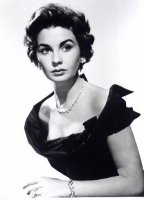
Biography of Jean Simmons
By Tim Wallace ©2000
Beginnings
Jean Simmons, the beautiful, gifted, demure British film legend, was born January 31, 1929 in a corner of London known as Crouch End,
on a street which had a pub at one end, a prison on the other, and was raised in a dreary part of London known as Cricklewood.
"No Cricklewood girl would ever admit being from there," remembers Jean. "Usually she'd lay claim to someplace else, like Golders Green,
which was the suburb next to us and at least boasted a fine crematorium if nothing else." (Pollock)
Jean's father Charles Simmons, a schoolteacher, helped Jean to start in a dancing school run by Mrs. Aida Foster. Two weeks later the
school was visited by an English producer named Val Guest, who was combing London's dancing schools looking for a "fresh face" to appear in an upcoming
1943 film called Give Us the Moon. The freshest face Mrs. Foster knew was that of young Jean Simmons, then only fourteen years of age.
"It can't last, all this, you know", advised her father following Jean's acceptance for the role, "You'll be back here soon, just a plain
Cricklewood girl again; so keep your head screwed on tight" (Pollock). And she did, through a career that has spanned six decades, garnered
two Academy Award nominations, and established her as one of Hollywood's greatest actresses.
Re-making 'Great Expectations'
"For me it was like traveling in a time machine because I played the role of Estella in the film and now,
after more than 40 years, I play the role of the old woman - that gives you quite an inexplicable feeling."
--Jean Simmons
|
In 1946, Jean played the role of "Estella" in David Lean's epic Great Expectations along with several burgeoning film icons, including
John Mills as Pip and Alec Guinness as Herbert Pocket. But it was the eccentric Martita Hunt as the twisted Miss Havisham, that made a special
impression on young Jean, a role she would herself play forty-two years later when she was offered the role of Miss Havisham in the 1988
version of Great Expectations, directed for television by Kevin Connor. "When they offered me the part (of Miss Havisham), I thought 'They
must be out of their minds'. Then I started to read it again and I thought, 'Yes, let's have a go!' And I had the guts to play Miss Havisham."
So now it was her turn to whisper in Estella's ear: "You can break his heart!" "I had to put Martita Hunt out of my head completely.
She was a very stylized, unique actress" (Lennon).
David Lean, who went on to direct Lawrence of Arabia, Dr. Zhivago, Bridge on the River Kwai, Ryan's Daughter, and Passage to India,
told young Jean that she had a future in film if she learned her job - and not until then had she ever really been
serious about acting (Pollock). First, Jean played the role of "Kanchi", a native girl, in Black Narcissus, the story of a group of nuns who
establish a convent in a former brothel in the Himalayas. "I was only 16", remembers Jean, "I was browned up and had to do a temptress,
crawling up Sabu's leg. I didn't quite know what the hell I was doing. He [Director Michael Powell] just said: 'Do it on instinct.' But they had stuck a ring in my
nose and it was driving me crazy. Every time I smiled it fell off. I was giggling half of the time" (Lennon). Giggling or not, Jean was
convincing as the native girl who is taken into the convent run by Sister Clodagh (Deborah Kerr). Under the direction of Michael Powell (The
Thief of Baghdad), Black Narcissus won Academy Awards for Cinematography and Art Direction and featured standout performances from Deborah
Kerr as Sister Clodagh, David Farrar as Mr. Dean, and particularly Kathleen Byron as the mad Sister Ruth.
Hamlet and Olivier
In 1948, eighteen year-old Jean Simmons was selected for the role of a lifetime, playing Ophelia to Laurence Olivier's Hamlet, a film which
Olivier also produced and directed. Olivier had gone to see David Lean's making of Great Expectations and thought to himself,
"That's my Ophelia." However, Jean's busy schedule at the time forced Sir Laurence to look elsewhere. Ninety-four Ophelias were interviewed
and thirty-three tested without success. Determined to have his Ophelia, Olivier negotiated with the Rank organization
(to whom Jean was contracted at the time) for thirty shooting days, and the die was cast (Holden 218).
Jean had never seen a performance of Hamlet, had never read the play, and had no preconceptions about the part of Ophelia. Jean's staggering
natural talent, though, made up for her almost total lack of training (Lasky 182). Under Olivier's wing and the tutelage of acting coach Molly
Terraine, she portrayed Ophelia as "a secluded, protected, well-brought up young girl, whose sudden exposure to the backwash of jealousy,
intrigue, vendetta and murder is simply too much for her" (Birch). When the film was released, she was catapulted into international stardom.
Jean appeared on the cover of Time magazine on June 28, 1948, received the first of her two Oscar nominations, and won the Best Actress award
in the Venice Film Festival. "I didn't even know what an Oscar was at the time!" recalls Jean (Rubio). Olivier himself won the Oscar for Best
Actor and the film won a total of four Oscars, including one for Best Picture, from seven nominations. He is the only director in the history
of film to have directed himself to an Oscar winning performance.
"And the luminous performance of Jean Simmons as the truly fair Ophelia brings honest tears for a shattered
romance which is usually a so-what affair."
--Bosley Crowther, Review in The New York Times, September 30, 1948
|
Jean remembers Hamlet with great affection. "I was only 18 years old when I was chosen for the role of Ophelia and the fact that it was
directed by Laurence Olivier was incredible. Women had been in love with him since Wuthering Heights and I was totally in awe of him.
They arranged for me to study with an extraordinary acting teacher, as I had never done any Shakespeare before. Larry was a perfectionist
but he had a lot of patience with me and that gave me confidence. To work with Laurence Olivier was certainly one of the greatest joys of
my life" (Rubio). On Friday October 20, 1989 in Westminster Abbey a service was held for Olivier following his death, "The Service of
Thanksgiving for the Life and Work of Laurence Olivier". A procession of actors and actresses carried items symbolic of his life and work
and laid them on the altar. Jean Simmons carried the script used in the film of Hamlet (Lewis 68).
Another facet to the story of Hamlet is the rift it began between Olivier and his wife Vivian Leigh, who had believed she would play the role
of Ophelia, as she had done a decade before at Elsinore. Olivier believed that Leigh, then thirty-three, was too old for the part. Instead,
it was Jean in the role, looking strikingly like Vivien Leigh in the Elsinore days (Lasky 177), much to Leigh's chagrin. Leigh soon became
obsessed with the notion that Simmons and Olivier were having an affair - an utterly groundless supposition about which she could not be swayed.
"I'm losing him to a bloody child!" she exclaimed to a friend (Kiernan 232).
Leigh's obsession and accompanying mental imbalance soon brought her to the film set where she contributed heavily to the tension that already
existed due to a demanding schedule, Olivier's passion for perfection, and the tragic scenes which were being filmed, most particularly Jean's
portrayal of Ophelia going mad (Spoto 206). Vivian Leigh continued the obsession even after the film was completed, released, and all the awards
handed out. In May of the following year, Leigh (who was known for her earthy language) was at the theatre with the Sir Laurence and Jean
Simmons when she suddenly held up her white-gloved hands and said calmly, "Oh, Larry, f*** it! I've dirtied my gloves!" (Spoto 209) She began
a string of affairs and one-night stands. Most of her friends today agree that a major contributing factor was that she had been harboring a
deep resentment and desire for revenge stemming from her suspicions about Olivier and Jean Simmons during the making of Hamlet (Kiernan 240).
Memories of " The Blue Lagoon"
"I first saw this film on the late, late, late show in 1978 when I was seventeen. I actually videotaped it
on our new '78 RCA VCR and showed it to everyone. Everybody enjoyed it. I, myself, thought it was a very good
movie and when I heard of it's remake a couple of years later I thought, 'Oh, no! They're going to ruin it!'
which they did. The original with Jean Simmons was so innocent and left to the imagination. In the Brooke Shields/
Christopher Akins version, I didn't exactly want to see them 'do it.' That took away the innocence of the story of two kids
shipwrecked on an island."
--"KCFAN", Comments on 'The Internet Movie Database'
|
Following the success of Hamlet, Jean was off to Fiji to make The Blue Lagoon, based on Henry DeVere Stacpoole's 1903 novel, a splendorous film
that is now out of print. Photographs of Jean taken from the film are radiant and breathtakingly beautiful.
A 1980 remake featuring Brooke Shields failed to achieve the sense of innocence and wonderment captured in the 1949 version.
Stewart Granger
Seemingly on top of the world, Jean soon had her own flat in London and the luxuries that stardom brings. She owned an eggshell blue
convertible, a Cooper-Bristol racer, that frequently got her in trouble with the local constabulary (Pollock). Her twenty-first birthday party
in 1950 was an extravagant bash that was covered by Picture Post magazine and the guests included Richard Attenborough, Dirk Bogarde, and Guy
Rolfe.
But the man that had already swung Jean's head was Stewart Granger, a tall, handsome actor some fifteen years her senior who was best known for
his swashbuckling roles. Both Simmons and Granger were under contract to J.Arthur Rank, who opposed Granger's advances towards her, even calling
a meeting to confront Granger at one point, believing Granger was still married to Elspeth March. At the meeting, Granger dropped a bombshell
on Mr.Rank himself, revealing that he had been divorced for six months and regarded that information as nobody else's business. Nonetheless, the
relationship between Granger and Simmons remained a secret. In Granger's autobiography "Sparks Fly Upward", he states " …we still couldn't go out
together openly as I didn't want the press to get hold of our affair and make it sordid with their snide remarks. She was their darling and I
could imagine their reaction to her first love being old Swashbuckling Granger" (Granger 131).
In September of 1950, Jean went to the annual film festival in Venice, accompanied by flamboyant Hungarian director Gabriel Pascal, where they
met Ingrid Bergman and her husband Roberto Rosellini. Pascal, "a stocky, fiery, utterly un-English character with a dazzling, gap-toothed
smile" (Brownlow 117) was part owner of Jean's contract with Rank and also the director of Caesar and Cleopatra, a film that had nearly
bankrupted Rank. Pascal, or "Gabby" as his friends knew him, was the man who persuaded (some say conned) George Bernard Shaw into giving him
the film rights to all of his plays and achieved critical acclaim and financial success with the film version of Shaw's "Pygmalion" (Granger 81).
The Excitement of Indecision
"It wasn't love at first sight when I met Jimmy (Stewart Granger), but long before we were married my head certainly got to be
filled with lovely nonsense about him. But all he kept saying was either that he was too old for me or that I was too young to know
my own mind. When I was alone I would think that maybe he was right, but when I was with him I knew he was wrong. I never new
indecision could be so exciting." (Pollock)
|
The magazine Picture Post took several photographs of Simmons and Pascal together, referring to him as her "new escort", but Jean's mind was
elsewhere (Picture Post). Colin Clark, former assistant to Sir Laurence Olivier, was a young man of seventeen vacationing in Venice with his
family who met Jean and remembered her struggling with whether or not to marry Granger. "I met Jean on that Venice holiday in 1950 when my
twin sister and I were 17", remembers Clark, "My father, Sir Kenneth Clark, was a friend of Pascal, who had brought Jean to Venice for the
film festival, together with her sister, and her sister's baby. We became friends with Jean, and also with Ingrid Bergman who was staying in
the same hotel (The Excelsior on the Lido) with her husband, Roberto Rosselini. We later met Jean at her flat in London on a couple of
occasions. At that time Jean was debating whether to marry Jimmy Stewart (Stewart Granger) and was wearing an expensive gold bracelet from
him. I advised against it (too vain, too old, married before, etc.) but needless to say she ignored my advice! Jean was dazzlingly pretty and
very natural and friendly. Not at all spoilt. We all had a lovely holiday exploring Venice - except when Pascal was around, and Jean was on
duty."
In December of 1950, Jean Simmons married Stewart Granger in Tucson, Arizona at the home a lawyer friend of Howard Hughes in perhaps one of the
most bizarre weddings in Hollywood history. Howard Strickland, head of MGM publicity, had made the engagement announcement and then pressured
the couple to arrange a "secret" marriage, ala Gable and Lombard. Cary Grant suggested that Howard Hughes arrange the wedding and the couple
agreed. It was the beginning of a long and frightful series of episodes between Simmons, Granger, and Hughes which ultimately ended in a
courtroom. After the wedding, while in a stall in the men's room, Granger secretly overheard a conversation between Cary Grant and Howard
Hughes in which Grant asked Hughes what he thought of Simmons. " I'd sure like to sink my teeth into that" remarked Hughes (Granger 239).
The Hughes Nightmare
|
J. Arthur Rank (1888 - 1972) was one of the most significant figures in the history of British cinema. He was a millionaire flour
manufacturer with strong Methodist convictions who started out in the cinema making religious movies to show in chapels and village
halls. Within 10 years he had a near monopoly in British film production and ran one of the country's main cinema circuits (Odeon).
|
Hughes wasted no time in pursuit of his fantasy. He soon bought Jean's nearly expired contract from J. Arthur Rank, who made a handsome profit
on the deal (Higham 160). Hughes immediately began pressuring Jean's agent, Bert Allenberg of the William Morris Agency, to discuss a new
"deal" that would obligate her to a seven year contract in return for making her the "biggest star in the world" or destroy her career if she
refused (Granger 248). Everyone involved knew that Hughes had something quite different in mind for Jean. But she refused to buckle despite
the threats, despite heavy lobbying by Hughes representative Walter Kane, and despite the crushing loss of a role in Roman Holiday that ultimately won an Oscar
for Audrey Hepburn. The renowned director of Roman Holiday, William Wyler, had been set on Simmons, but Howard Hughes refused to release her
or even discuss a loan-out. Wyler almost cancelled the film before settling on Hepburn (Walker 70-1) However, Jean still owed Hughes two films
and Bert Allenberg informed Hughes that was all he was going to get. Exasperated and angry, Hughes called Jean directly. " When are you going
to get away from that goddamn husband of yours?" Hughes thundered. " I always have to see you either with him or Bert Allenberg. I want to
talk to you alone, honey. We can go away somewhere and thrash this whole thing out. You won't be sorry, I promise you." An angry Granger took
the phone away and told Hughes to lay off or he would be the one who would be sorry (Granger 261).
One of the commitments was fulfilled in 1952 when Jean made the film-noir classic Angel Face, co-starring Robert Mitchum and directed by Otto
Preminger. Preminger was instructed by Hughes to treat her badly and so he indulged himself, bullying Jean for the entire length of the
production (Higham 168). During one particular take, Preminger instructed Mitchum to slap Jean again and again. Mitchum, noticing Jean's
swelling and reddened face, became angered, turned suddenly, and slapped Preminger. Mitchum asked the abusive director if he'd like to have
another. Preminger quickly agreed to make the last take the final take (Granger 262). Angel Face was supposed to be a flop, but nearly fifty
years later Turner Classic Movies (TCM) plays the film every other month. A haunting minor-key score by Dmitri Tiomkin adds to the suspense
throughout the film, but it was Jean's edgy performance as the psychopathic Diane Tremayne that shook audiences and revealed yet another
dimension of her enormous talent.
Following a final meeting with Simmons and Bert Allenberg in which Simmons informed Hughes that she would never sign his contract, Hughes let
it be known to all other studios that if they employed Jean, they would find themselves in litigation with him (Granger 266). It was the
equivalent of a career death sentence, as no studio boss would take on Hughes and his vast fortune. Simmons and Granger, despite admonitions
from friends and Louis B. Mayer himself, courageously took to the offensive and sued Hughes first. Ultimately, with no case, Hughes' lawyers
offered an out of court settlement including court costs and damages, which Simmons accepted for her legal expenses only. From that day
forward, Jean Simmons worked independent of any studio. Recalling the memory of Hughes in a 1999 interview, Jean bore him no malice: "I guess
he had his idiosyncrasies, but I found him very nice - he would almost come into a room backwards, he was so shy" (Lennon).
Costume Dramas, Guys and Dolls
In 1953, Jean starred in the big-budget blockbuster ,The Robe, the first film ever shot in Cinemascope (wide screen process), alongside Richard
Burton and a cavalcade of stars including Victor Mature, Richard Boone, Michael Rennie, Dean Jagger, and Jay Robinson (who was brilliant as the
evil emperor Caligula). The film was an adaptation of a Lloyd C. Douglas novel about a Roman centurion who presides over Christ's crucifixion.
Richard Burton was nominated for an Academy Award for the film, despite what most critics today regard as a stiff and uninspired performance,
and his own misgivings, as Burton's contempt for dramatic work other than the stage was well known. As Simmons remembers, he later changed his
tune: " He didn't think movie-making was very interesting or very good. He said, 'I can have hysterics like this or I can do that' and indeed
he could. But he kind of looked down on it. It is very demanding, when you do things arse over backwards and out of context. He soon changed
his mind" (Lennon).
In addition to The Robe, Jean made two other highly successful films in 1953, including The Actress, in which she portrayed actress Ruth Gordon
(Harold and Maude, Rosemary's Baby, Inside Daisy Clover) and Young Bess, where she starred as Queen Elizabeth alongside her husband Stewart
Granger. M-G-M had originally wanted Greer Garson for the role and then replaced her with Deborah Kerr (who co-starred as Catherine) before
deciding on Jean. She gave a sizzling performance as the courageous and headstrong young princess who becomes Queen. Ignored by the Academy,
Jean received a Best Actress award from the National Board of Review for Young Bess as well as nominations for The Actress and The Robe.
Brando remembers Jean
"I had a chance to work with Jean Simmons, who was cast in the role of [Désirée]. She was winning, charming, beautiful and
experienced and we had fun together. Unfortunately, she was married to Stewart Granger, the Great White Hunter."
--Marlon Brando, from 'Songs My Mother Taught Me'
According to Granger
"Jean was preparing for another film at Twentieth Century, this time with Marlon Brando. It was to be called Désirée and she played
one of Napoleon's mistresses. Marlon made it obvious that he was bored with the whole thing and was merely getting rid of one of
his commitments. He muttered and mumbled his way through the part and I didn't see how Jean could have heard him, let alone acted
with him, but Marlon can never be bad all the way through a picture and some of his scenes were brilliant. Jean liked him a lot
but I found him fairly insufferable."
-- Stewart Granger, from 'Sparks Fly Upward'
|
Over the next two years, Marlon Brando became a central figure in Jean's career. First, despite threats and lawsuits from powerful studio
executive Daryl F. Zunuck, he refused to act in the costume epic The Egyptian, which Jean appeared in. As a compromise with Zanuck, Brando
accepted the role of Napolean in Désirée, which featured Jean in the title role. Brando remembers, "The film was directed by Henry Koster.
I did all my homework and did the best I could. A kind and pleasant man, Koster was a lightweight who was much more interested in uniforms
than the impact of Napoleon on European history. By my lights, Désirée was superficial and dismal, and I was astonished when told it had
been a success" (Brando 192). But the story of silk merchant's daughter who was Napoleon's first love and later the wife of his adversary,
Jean-Bapiste Bernadotte (who became King of Sweden), captured the public's imagination, even if the film took poetic license with the actual
historical details. In contrast to Brando's somewhat spiritless acting, Jean gave an inspired performance.
Following Désirée, Simmons and Brando teamed up in 1955's musical comedy classic Guys and Dolls, a radical departure for both from dramatic roles
and costume epics. Brando, who had never sung before in his life, played professional gambler "Sky" Masterson, a nickname earned by the
enormity of his wagers, who is lured into a sucker bet for one thousand dollars by Nathan Detroit (played by Frank Sinatra) that he can't take
Jean Simmons as "mission doll" Sister Sarah Brown of the local Salvation Army as his date to Havana. Detroit(Sinatra) desperately needs the
money in order to raise the money to pay for a place to stage his "oldest established, permanent floating, crap game in New York". Directed
by talented Joe Manciewicz (The Philadelphia Story and All About Eve) and scored wonderfully by Frank Loesser, Guys and Dolls featured many of
the performers who were in the original Broadway play, including Vivian Blaine as Adelaide, Nathan Detroit's long-suffering girlfriend of
fourteen years and scene-stealing Stubby Kaye (Cat Ballou) as Nicely-Nicely Johnson, who shines on songs like "I've Got the Horse Right Here"
and "Sit Down You're Rockin' the Boat" . While Simmons and Brando struggle with the singing on " I'll Know" , Jean shines on the now classic
"If I Were a Bell" and both are respectable on "A Woman in Love".
The Real Slugger in the Family
"By the time I got home Jean had finished 'Guys and Dolls' and had loved every minute of it. She told me proudly that the fight
sequence had been a great success and that I wasn't the only one in the family who could throw a punch."
"One day Walter Kane of the Hughes era, knowing how interested I was in boxing, brought the great Jack Dempsey along to meet
us… I told him the real slugger in the family was Jean. I'll never forget the surprised look on Dempsey's face when, having told
her to let one go, the tiny Jean knocked him back about two yards with the force of her punch to point of his shoulder. He signed
a glove 'For Jean, from one slugger to another. Dempsey.'"
--Stewart Granger, from 'Sparks Fly Upward'
|
Against the surreal sound-stage Times Square scenery, Jean is radiant as the naïve Sister Sarah, leader of the failing Broadway Save-a-Soul
Mission. Finally accompanying Brando to Havana in return for the promise of him delivering "one-dozen genuine sinners" to the Mission for her
Thursday night prayer meeting, she knocks back a few too many Bacardi-spiked milkshakes, gets into a bar brawl, and falls in love all in the
same evening. Forty-five years after its release, Guys and Dolls remains one of the most fun " feel good" musicals ever made.
The Birth of Tracy, Until They Sail, and The Big Country
In 1955, Jean gave birth to daughter Tracy Granger. Insisting on a normal birth, Jean was in labor for eighteen hours before succumbing to
both the doctor and husband Stewart Granger's insistence on a Caesarean. Granger proclaimed daughter Tracy as the most beautiful baby he had
ever seen. The following day, Granger asked the head nurse where he could find his baby and the nurse led him to a glass screen with a view
into a room of about 20 newborns. " I didn't have to be told which one was mine" , recalled Granger, "I'd have picked her out anywhere and I
hadn't lied to Jean. She was the most beautiful baby I'd ever seen. Even the nurses agreed with me." (Granger 352)
After completing her final contractual obligation to Howard Hughes with the 1956 film Hilda Crane, Jean starred alongside Paul Newman in
Robert Wise's beautiful film of love and tragedy during wartime, Until They Sail, adapted from a story by James A. Michener. Also starring
in the film were Joan Fontaine, Piper Laurie, and fourteen year-old Sandra Dee in her film debut. Wise researched heavily before making the
film, traveling to New Zealand where he interviewed several women who had gone through experiences similar to those of the women portrayed in
the film.
"I didn't have to bend on sentimentality. I hoped to make those stories, particularly the one with Paul Newman and Jean Simmons,
as honest as I could without overdoing it."
--Robert Wise on 'Until They Sail'
|
The widowed Barbara (Jean Simmons) meets cynical Captain Jack Harding (Paul Newman) whose job it is to investigate New Zealand women who want
to marry American soldiers, when he investigates Barbara's older sister Anne, who wants to marry Capt. Bates (Charles Drake). Bates is
subsequently killed in action, leaving now pregnant Anne in a terrible predicament. Barbara and Harding pursue a platonic relationship,
although it is clear they are in love. Barbara's sister Delia, who moved to Wellington and was involved in a number of trysts with American
soldiers, is murdered by her husband Shiner when he returns from the war and discovers her infidelities and her desire to divorce him in order
to marry an American soldier. Barbara and Jack's relationship is put to the test when Harding is called to testify in a trial about the
character of Barbara's sister Delia and tells the court Delia was intimate with seven men. Hurt and angered, Barbara storms from the courtroom.
In the film's moving climax, Barbara and Jack are reconciled and she follows him to America.
Until They Sail was the only film that Newman and Simmons made together, despite their obvious on-screen chemistry. With beautiful
cinematography, outstanding music, and a poignant story, Until They Sail is not to be missed.
Following Until They Sail, Simmons again paired up with Director Robert Wise to star in a light comedy called This Could Be The Night.
Jean played a naïve secretary who works for a gangster running a nightclub, played by Paul Douglas, while being romanced by Anthony Franciosa
as Douglas' young associate.
In 1958, Jean made one of her finest films when she appeared in William Wyler's The Big Country, alongside an all-star cast featuring Gregory
Peck, Burl Ives, Charlton Heston, Carroll Baker, Chuck Connors, and Charles Bickford. Over forty years later, The Big Country remains an
under-appreciated masterpiece, one of the finest Westerns ever made. With stunning cinematography, a marvelous, now classic score by Jerome
Moross, and an Academy Award winning performance by Burl Ives, The Big Country tells of two rival ranching clans, the Terrills and the
Hannasseys locked in a spiraling cycle of resentment and retribution. Into the middle of the fray comes Jim McKay, played by Gregory Peck, a
wealthy, retired ship's captain from Baltimore with the intention of marrying Pat Terrill, the only child of the Terrill's patriarch, Major
Henry Terrill, played by Charles Bickford.
Praise from a 'Big Country' co-star
"Among the ladies of my profession I highly respect is Jean Simmons. Not only is she extremely gifted, but what I find even
more praiseworthy is the fact that she's managed to remain unaffected by the corrosive influences and the pitfalls of fame that
have destroyed so many of her sister-actresses."
--Charlton Heston
|
Jean Simmons played the pivotal role of Julie Maragon, the local schoolteacher and owner of an inherited ranch which houses the area's key
water supply, "The Big Muddy" , upon which both the Terrills and Hannasseys livestock depend. Jean is brilliant as the soft-spoken,
understated beauty that gradually takes center stage, both in the conflict between the clans and in the eyes of Jim McKay after he and Pat
Terrill part ways, as McKay fails to meet Pat's expectation of what a "real man" should be.
Wyler's direction is sheer genius. Filming a fight sequence between Heston as Terrill ranch foreman Steve Leech and Peck as Jim McKay, he
pulls the camera back so far from the protagonists that they look like ants compared to the surrounding beauty of the landscape. The entire
point of the film is to show the futility and self-defeating nature of violence, a point brilliantly underscored by this simple cinematic
device. Emphasizing the point, McKay asks his bloodied and tired rival, "So tell me, Leech, what did we prove?"
Jean's experience on The Big Country, however, was less than pleasant, as it was for other cast members, including Gregory Peck and Carroll
Baker. Jean's manager, Jeffrey Barr, said that Jean had told him Wyler was "very cruel and hurt her deeply." "She still bears the scars
thirty years later," Barr added. "I've worked for Jean fifteen years and never heard her say that about any other director." While declining
an interview with Wyler biographer Jan Herman, Simmons did tell a reporter about the shoot. She recalled the atmosphere on the set felt
"very dodgy - the sort of prevailing tension that invites paranoia, causes you to wonder, 'What have I done?'…I guess Willy was in a position
to know what it took to achieve great performances, but he also seemed bent on making things difficult…and there was all that constant
rewriting. We'd have our lines learned, then receive a rewrite, stay up all night learning the new version, then receive yet another rewrite
the following morning. It made the acting damned near impossible." (Herman 385)
Coming Apart
During 1958, Jean made two films, Home Before Dark and The Earth Is Mine. After the filming of Home Before Dark, Jean arrived home to tell
husband Stewart Granger about a young politician who had wooed her with flowers and practically broke down her bedroom door. "…He was so
attractive and had such a lovely smile I nearly let him in," a teasing Jean told him with a grin. Granger was not amused and ask her what
his name was. " Oh yes, he's a very important senator called John Kennedy." (Granger 380)
Falling Apart
"My nerves were beginning to go. The thought of the vast amount of money we owed, the constant problems of the ranch, the
running of the house and worry about my next film were beginning to make me moody and short-tempered. I'm never too placid at the
best of times but Jean and the kids were used to the sudden flare-ups that just as suddenly disappeared but now I became morose
with worry and started to lose my confidence in what I'd undertaken…"
--Stewart Granger, from 'Sparks Fly Upward'
|
With all joking aside, however, Jean's marriage to Stewart Granger began to fall apart following the making of Home Before Dark. Granger had
bought a ranch a few years before in New Mexico, with the idea of breeding and raising cattle. But the combination of Granger's lack of
experience, a series of mishaps on the ranch, and his faltering career put enormous financial pressure on the couple. At one point, Simmons
and Granger agreed to take any part offered to them just to alleviate some of the debt. Granger finished a film called The Whole Truth and
when he arrived back home after three months away, he was immediately called away to begin filming Harry Black in India. Having moved back to
L.A. with her baby because she couldn't stand the loneliness of the ranch without her husband, Jean cracked. "The day of the departure was
awful", recalls Granger. "Jean became hysterical and told me she couldn't stand a marriage that meant continual separations and seemed
entirely to forget our pledge that no matter what, we would accept any film we were offered." Jean informed Granger that she wouldn't be
there when he returned. Granger recalled the day with rue: "Miserably, I drove to the airport, thinking I'd probably blown my marriage
cursing myself for risking everything for that bloody ranch." (Granger 375)
The pressures resulted in a blunder that damaged both of their careers. William Wyler was casting the blockbuster Ben Hur and wanted Granger
for the role of 'Massala' and Simmons for the role of 'Esther'. However, Granger wasn't happy with the fact that Jean, a major star, was
being cast in a minor role and that he himself had not been offered the title role. Their agent, Bert Allenberg, was even more upset.
Allenberg was enraged that Granger would have to play second fiddle to Charlton Heston and that Jean had only been offered a "nothing" part.
Following Allenberg's advice, Granger called casting director Sam Zimbalist and turned down the roles. But when the financial pressures and
marital problems began to mount, Granger recanted and tried to get Wyler to accept himself and Jean for the roles but to no avail.
Spartacus
Remembrances of 'Spartacus'
"When I first saw this movie, I was young enough to fall in love with Jean Simmons. Her eyes were enough to drown in."
--John Bowes, Comments on Amazon.com movie reviews
"Jean Simmons has had an impressive acting career that has spanned more than 50 years. She is both a great beauty and an
enchanting actress. She gave Varinia dignity, strength of character and a quiet seductiveness that played well off the power
exuded from Douglas. Their screen chemistry was both passionate and touching."
--FlickJunkie-2, Atlanta, GA, Comments on 'The Internet Movie Database'
"A final word on the lovely Jean Simmons. She is one of the most beautiful women that has ever graced the silver screen."
--Vaseal, Dublin, Comments on 'The Internet Movie Database'
|
Soon after, Jean landed the role of 'Varinia' in Kirk Douglas's big production of Spartacus after Douglas was unsuccessful in casting the role
with other actresses. It was no secret that Douglas wanted someone other than Jean Simmons for the role of 'Varinia'. Douglas had come up
with a clever linguistic scheme in which English actors would play all of the Roman parts in the film. Jean's distinctive British accent
would therefore upset the idea, since Varinia was one of the slaves and the flashpoint of the rebellion revolves around Spartacus's love for
her. Douglas pursued many options to fill the role. Elsa Martinelli was not available, Ingrid Bergman turned it down, and Jeanne Moreau was
in the middle of an affair with the director of The Lovers. Douglas tried unknown German actress Sabina Bethmann, but it soon became obvious
she wouldn't work out either. Jean eagerly accepted the role when at last she was offered the part. As Douglas remembers
"Only my stubbornness about the linguistic scheme had prevented us from hiring her in the first place. I called her at her ranch
in Nogales, Arizona. As she tells it 'Kirk told me to get my ass on out to Los Angeles. I did. Pronto.'" (Douglas 318)
Spartacus was a troubled production even before it began shooting in January of 1959. Douglas had attracted a plethora of superstars and he
held out carrots to keep them interested. Each major player (including Simmons, Laurence Olivier, Charles Laughton, Peter Ustinov and Tony
Curtis) had been sent a script favoring their particular role, creating a situation that strained temperaments (Spoto 287). Spartacus shot
for 167 days, employed over 10,000 people and cost over $12 million, making it one of the most expensive films ever produced in Hollywood at
that time. However, the film was a great success, winning the Golden Globe Award for Best Picture, three Oscars, and grossing over $13 million
within the year.
The film's original director, Anthony Mann, was fired only a month into the production schedule and was replaced by then unknown thirty-two
year old Stanley Kubrick. Kubrick cut much of the dialog, particularly the early love scenes between Douglas and Simmons, preferring to use
the camera and music instead. As Douglas remembers his collaboration with Kubrick, "…we talked about silent films, how they used music to
set the scene for the actors. We tried it in several scenes of Spartacus that would have only music under them. It really helped."
(Douglas 319) However, Kubrick and Douglas clashed throughout the production and though Spartacus propelled Kubrick into his now legendary
career, he disavowed it fervently afterward, complaining that he was not given sufficient freedom over script and content (Thomas 169).
Blacklisted screenwriter Dalton Trumbo, a victim of the 1950's Communist witch-hunts orchestrated by Senator Joseph McCarthy and his henchman,
had secretly written the script for Spartacus. Trumbo, in turn, had been at odds with the book's original author, Howard Fast, who had bitterly
criticized the script (Holden 336). Before the film was released there was considerable debate regarding the writing credits. Trumbo had been
operating under the pseudonym "Eddie Lewis". An apparently shameless Stanley Kubrick surprised everyone by suggesting that Kubrick himself
be given the writing credits. In the end, Douglas courageously took on the Hollywood establishment and gave Trumbo the credit. There was
surprisingly little resistance and it effectively ended the blacklist in Hollywood.
In the role of Varinia, Jean found a match her own quiet strength and beauty. Varinia is a slave in a gladiator school run by her master
Batiatus (Peter Ustinov), "a venal, conniving slave dealer." The gladiators are treated as "special animals", tutored in the art of killing
and occasionally rewarded with a woman in their cells. In this degrading way, Varinia meets Spartacus (Thomas 171). At first, Spartacus is
excited with the prospect of sex with Varinia, but repulsed when he realizes that Batiatus and others will observe them. "I am not an animal!"
Spartacus screams at his overlords. "Neither am I!" Varinia retorts, reminding Spartacus that only a moment before he was perfectly willing
to treat her as property. Shamed, Spartacus hands Varinia back her robe. It is a powerful, unforgettable scene, one that foreshadows women's
rights long before it was fashionable.
Spartacus and Varinia fall in love in scenes without dialog, underscored by the beautiful music of composer Alex North. When Varinia is sold
to Crassus following his visit to the gladiator school for an afternoon of entertainment, Spartacus cannot bear the loss of her and begins the
rebellion that will eventually threaten the security of Rome herself.
Spartacus is one of Jean's finest performances and yet it is only one of many in the film - Olivier is remarkable as the diabolical
Crassus, Laughton is wonderful as the hedonist politician Gracchus, and Ustinov as the rogue Batiatus won an Oscar for best supporting actor.
But Jean's special gift, used brilliantly by Kubrick throughout the film, is that she needn't utter a single word - her mere presence on the
screen is enough; her burning eyes, the tilt of her head, or a mere glance say more than a thousand lines of dialog ever could.
Elmer Gantry
Following the filming of Spartacus, Jean accepted the role of Sister Sharon Falconer in writer/director and Philadelphia tough-guy Richard
Brooks' upcoming production of Elmer Gantry, for which Brooks had spent three years writing the screenplay from a novel by Sinclair Lewis.
Facing financial difficulties as a result of the obligations husband Stewart Granger had incurred in his ranching endeavors, dealing with the
death of two close friends (Sam Zimbalist and manager Bert Allenberg), and worried over Granger's eroding career (he had been out of work for more than a
year), Jean went off to work in Hollywood with a director with a reputation for terrorizing everyone near him.
In the title role, Brooks more than had his match in real-life tough-guy Burt Lancaster, the outspoken, wild, and gifted actor who emerged from
a poverty-stricken childhood in East Harlem. Their collaboration began in 1955, when Brooks asked Lancaster if he had ever read Elmer Gantry.
"Oh, yes, Sinclair Lewis was one of my heroes," Burt replied. Three years later, Brooks presented Lancaster with the first draft of the script.
For the next seven months, holed up in a $45-a-month rented office on the Columbia lot on Gower Street (Buford 200), they worked together
tearing apart every scene, piece by piece. They built the script, as Brooks later said, "brick by brick, like a wall. " (Buford 200) They
transformed Lewis' Gantry, an unsympathetic caricature, into "a recognizable, full-blooded human being with common weaknesses and vanities."
(Fishgall 187) They also gave him a dose of heroism and courage as well. Following suit, the character of Sister Sharon Falconer was also
transformed from merely ambitious and manipulative to ambitious, manipulative and a true believer, basing the character on controversial
real-life evangelist Aimee Semple MacPherson. The Gantry character became an amalgam of Billy Sunday and Billy Graham, the latter carefully
denied by the director and star (Buford 201).
The cast was rounded out with staggering talent: Arthur Kennedy as hard-bitten, cynical reporter Jim Lefferts, Dean Jagger as calculating
revival manager Bill Morgan, Patti "The Singing Rage" Page (singer of 'The Tennessee Waltz') as gullible musical director Sister Rachel,
Edward Andrews as fatuous George Babbit, and Shirley Jones as the vengeful Lulu Bains, whose scintillating performance re-ignited her stumbling
career when she took home an Academy award for Best Supporting Actress (Buford 201). Andre Previn wrote a daring, discordant score for the
film that dramatically highlighted the tension throughout.
Lancaster was Gantry
"…supremely bankable, [Lancaster] wanted to play the role to which he could bring all he was: Irish shaman, Church of
the Son of Man choirboy, settlement house do-gooder, who opposed evangelism as a sapping of the will to work for change, backroads
circus hustler, and progeny of the 1920's Manhattan which had embraced the novels of Lewis. Above all, 'Elmer Gantry' played into
his enduring fascination with the duality of good and evil within one person, within himself. Lancaster was the venal preacherman."
--Kate Buford, 'Burt Lancaster, An American Life'
|
Lancaster pulled out all the stops and gave the best performance of his career. Unfortunately for Jean, it overshadowed perhaps the greatest
performance of her career in a perfect interpretation of Sister Sharon as equal parts selfless saint and shameless grifter, but always driven
by her secret ambition. At times, Jean plays Sister Sharon with subdued softness - as when she listens to Elmer rehearse his first testimony
or when she faces down the tough crowd in Zenith with a simple prayer; at other times, she is cold and ruthless "Katy Jones from Shantytown",
when she backs off Gantry's advances ("Oh, this time I mean it!") or when she must pay the blackmail money to Lulu Bains ("Get the money!"
she hisses to Bill Morgan while glaring through narrowed eyes). Lancaster was voted best actor of 1960 by the New York Film Critics and he
won the Oscar for Best Actor. Elmer Gantry received four nominations for Oscars; it won two, Shirley Jones picking up the other. Richard
Brooks was nominated for Best Director, but like Simmons, received nothing.
However, Simmons and Brooks won each other. Although intimidated by Brooks initially, Jean, then thirty years old, fell in love with him.
"The first three weeks I literally went home in tears because I didn't understand this lunatic. And one day he was carrying on about something
- very noisy - and I suddenly caught the ttwinkle in his eye, and from then on it was a piece of cake." (Fishgall 189) Simmons wasn't the
only one who thought Brooks' demeanor was an act. "He was a faker: His whole goal in life was to reach that pedestal where everybody would
say, 'Don't work with that son of a bitch.'" recalled Tom Shaw, Gantry's assistant director who went on to work twenty-five years with Brooks
and loved and admired him (Buford 202).
Richard Brooks
Remembrances of Richard Brooks
"Richard used to come to my house a lot in the last few years. He would bring a bottle of Aquavit and tell these great stories
about his marriages...the people he'd known."
"He was a marshmallow pretending to be a real tough guy. He could lose his temper. He liked to have this marine drill sergeant
thing going …the shirt was out, the pipe. But he was very kind and very generous. And smart. He was a wonderful guy."
--Paul Mazursky
"Richard Brooks was never kind and gentle with anybody. When you first heard him talk, you would think he hated everybody. He
would shout and scream."
"People said that I would never last with him...not a picture...not an hour with him. But I was with him until the day he died.
He was a wonderful, decent man and extremely bright."
"He was a great guy. God, he was a great human being."
-- Tom Shaw
|
In December of 1959, Jean asked Stewart Granger for a divorce. As Granger put it "…it had been a combination of things that had ruined our
marriage; the nerve-racking strange wedding, the Hughes battle, the continuous separations, the bad timing of my turning down those films
and the final blow, when we lost our two greatest friends." (Granger 399) In reality, the financial and personal pressures created by
Granger's ranching ventures probably had more to do with their divorce than his reasons. Jean left for England to begin work on a bedroom
farce called The Grass Is Always Greener, with old friends Cary Grant, Deborah Kerr, and Robert Mitchum. Granger accepted a role in North to
Alaska, alongside John Wayne. When the films were completed, Granger and Simmons announced their divorce.
In 1961, Jean married Richard Brooks. They would remain married seventeen years, ending with their 1977 divorce. Richard Brooks died in 1992 from congestive heart
failure after a lifetime of writing and directing a host of well-known films, including Key Largo, Blackboard Jungle, The Professionals,
Cat on a Hot Tin Roof, and Looking for Mr.Goodbar. With Brooks, Jean had a second daughter, Kate. Jean remembers Brooks with a mixture of
affection and respect: "Working on Elmer Gantry with Richard was wonderful. We fell in love, of course, and he is my favorite director. We
divorced after 17 years but we remained good chums and spoke to each other on the phone nearly every day until he died [in 1992]." (Lennon)
Brooks, though, never really endeared himself to those who worked on his movies. In a November 2000 interview with writer Geoffrey MacNab,
actor Scott Wilson who played killer Richard Hitchcock in Brooks' film adaptation of Truman Capote's masterpiece In Cold Blood, remembered
that only Jean's presence calmed him down. "[Brooks] could be charming when his wife, Jean Simmons, was on set, but more often he was an ogre.
I think he would have been happier if he could have hanged us [Wilson and co-actor Robert Blake] at the end of the film so we couldn't talk
about it." (MacNab)
The Happy Ending
Though seemingly at the peak of her career, Jean would not appear in another film until 1963's critically acclaimed All the Way Home, based on
the James Agee novel "A Death in the Family". Leonard Maltin, a film critic not known for being overly generous in his appraisals commented
that the film was "beautifully done, with Simmons offering an award-caliber performance as [Robert] Preston's wife." Two years would pass
before Jean appeared in two forgettable 1965 films, Mr. Buddwing and Life at the Top.
In 1967, Jean appeared with Jason Robards and Dick Van Dyke in Divorce American Style, then starred with George Peppard and Dean Martin as
tough stagecoach operator Molly Lang in Rough Night in Jericho, before making her television drama debut in Hallmark theatre's TV drama
Soldier in Love. The following year Jean appeared with Maxmillian Schell in another television dramatization, this time in the role of
Fraulein Rottenmeier in Blake Edwards' Heidi. She also appeared in an episode of Hawaii Five-O.
Eight years of Jean's career had passed with mostly forgettable films, despite her own fine performances. Jean was now closing in on forty
years of age, when leading roles for beautiful actresses usually begin to disappear. But Jean was about to launch the second half of her
career with another stunning performance, this time as alienated Denver housewife Mary Wilson in Richard Brooks' 1969 harbinger of feminism,
The Happy Ending, for which she received a Best Actress nomination.
The Happy Ending is something of a period piece by today's standards, but it beautifully captures the frustration of a woman lacking an
identity or purpose trapped in the meaningless hell of a stale marriage to a stuffed-shirt lawyer. Husband Fred (John Forsythe), wants nothing
more from Mary than for her to be a trophy, a walking testament to his success; a thing to show his clients when they arrive for his annual
tax-deductible wedding anniversary celebration. Like some empty advertising slogan, Mary's husband Fred throws out "Hey, I love you"
placations to her as if on cue. Mary's emptiness belies all of the happily-ever-after fairy tales so many of her generation bought into and
foreshadows the emergence of independent, career-oriented women.
Feeding her frustrations with barbiturates and booze, Mary Wilson is caught in the downward spiral of a dismal, dreary, and powerless life that
includes hiding out in dive bars, an arrest for drunk driving, and a failed suicide attempt. In the climactic scene of the film, Mary
confronts Fred after he belittles her for watching a re-run of Casablanca following another of their anniversary showcases. It is the single
most powerful scene of Jean's career. Like a volcanic eruption, she lets fly all of the venom, bile, and rage stored up in fifteen years worth
of repression:
Fred:  "You've seen that a hundred times - we'll miss the news."
Mary:  "The news? The news is here! Us!  You and me and that no-man's land you call a bed!"
Fred:  "I'm not complaining."
Mary:  "Then you ought to."
Fred:  "I'm satisfied."
Mary:  "You couldn't be - not after what it used to be."
Fred:  "What do you expect it to be after fifteen years?"
Mary:  "Not what it is."
Fred:  "Whatever it is, I love you."
Mary:  "We're not in love!  We MAKE love - and damn little of that.  And it's kiss, kiss, groan and twitch, wham, bam,
       thank you m'am!"
Fred:  "Why don't you scream it out the window?  Does Marge have to know?"
Mary:  "She knows."
Fred:  "She's a KID, for Christ sakes!"
Mary:  "Kids know."
Fred:  "Okay, okay.  Now cool it, will you?"
Mary:  "I'm against cool."
Fred:  "I can't talk to you."
Mary:  "'Cause we got nothing to say to each other!  Before we married, you never stopped talking.  Now you talk only
       to clients.  Marge talks only to the telephone.  The only people who talk to me are the television and Agnes."
Fred:  "That's drunk talk.  Ah, I've got a big day tomorrow."
Mary:  "Doing what?  Training for those two hour, six martini lunches? Goosing topless waitresses?"
Fred:  "And a Happy Anniversary to you, too!"
Mary:  "And that all-year-round electric tan!  Phony!  Smile, you're on Candid Camera to prove we're happy!  Phony!
        All those lousy plaques on the wall - 'Best Man of the Month', 'Best Christian of the Week in Denver'.  Phony!
        We don't even know a real Christian!   If we had to live twenty-four Christian hours, we'd go insane!
        Phony!  Phony! Phony!"
Fred:  "What about you?  And what are you?  Joan of Arc on a bender?  What about you?"
Mary:  "I'm nothing at all - zero!"
Fred:  "You're one thing - drunk!"
Mary:  "Not yet."
Fred:  "Where the hell are you going?"
Mary:  "Back to Casablanca - back to Humphrey Bogart, Peter Lorre, and Claude Rains."
Fred:  "Dead! Dead! Dead!"
Mary:  "Dead and buried, they're more alive than we are."
Jean Simmons should have won an Oscar for that scene alone. Instead, it went to Maggie Smith for The Prime of Miss Jean Brodie.
Mini-series Blockbusters and Recovery
David L. Wolper was impressed
In an interview with FashionFind.com, David L. Wolper, executive producer of 'The Thorn Birds', commented on Jean's extraordinary
acting talent.
FF to David L. Wolper, Executive Producer: "Do you have any specific memories that are poignant to you, that really struck you
and stay with you?"
David L. Wolper: "Yes, there are moments of Jean Simmons, when she heard her husband died; the way she did it. I thought there
was going to be an immediate scream, but there's a great delay in movement, then this -- you know, it's just the way she performed.
It was just magnificent."
--Pia Gina Cooper, 'The Making of The Thorn Birds'
|
Over the next twelve years, Jean appeared in a series of forgettable feature and made for television films: Say Hello To Yesterday,
Mr.Sycamore, The Dain Curse, Dominique is Dead, Beggarman/Thief, Golden Gate, Valley of the Dolls, and A Small Killing. Finally, in 1983,
Jean landed a role worthy of her talent when she appeared as Fiona "Fee" Cleary in one of television's most compelling mini-series,
The Thorn Birds. It was an unusual role for Jean. Fee is a sometimes unsympathetic character living down the shame of an illegitimate child
and a subsequent hastily arranged marriage to husband Paddy (Richard Kiley). Jean used all of her skills to bring Fee to life: the facial
expressions she so masterfully used in Spartacus two decades before, the long delay she learned in The Big Country, the poise, power, and
dignity she brought to Sister Sharon in Elmer Gantry - it was all there. For her outstanding work in The Thorn Birds, Jean Simmons was not
denied this time: she won an Emmy award for her performance. "It gave me great satisfaction", she remarked to interviewer Yolanda Rubio when
asked about the award.
Landing the role of Fee Cleary was no accident, either. "When I read the book", remembered Jean, "I was working in London. When I found out
they wanted to make a film of the story, I knew they would have to do a mini-series because they would not be able to tell the story in two
hours. Then I did something I had never done before: I called the producer, Stan Margulies, and told him that I had to play the role of Fee.
He listened to me without promising anything but a year later he called me in London and told me: 'The role is yours.' It was very exciting.
One of the most beautiful experiences I have ever had - all the actors were perfectly cast and it was a pleasure working with them." (Rubio)
In 1983, Jean took another bold step when she entered the Betty Ford Clinic seeking treatment for alcoholism. "I chose to make it public when
I got out of the clinic almost six years ago" Simmons remarked in a 1989 interview. "I think it's important for women to know that this
addiction is curable and that there are clinics where they have staff who are specialized in this type of problem. It is also essential to
clarify the misconceptions related to this problem, which affects people of both sexes, all ages, and from all social backgrounds. But the
important thing is to take on the responsibility yourself - not to take any alcohol ever and to succeed. This problem is curable and I am
here to prove it." (Rubio)
A Standout Performance
"The other really stand out performance is given by Jean Simmons as Miss Havisham, whom Pip meets soon after the graveyard
incident. It is interesting to note that Simmons played Estella as a 15 or 16-year-old girl in 1946. In this version she has a
much more complex role of the mysterious, eerie and somewhat demented Miss Havisham: a woman of ruined and decayed beauty who has
become so thin she is spectre-like in appearance. Disney has gone to considerable length to make Simmons look bad enough for the
part, and at times she is unrecognizable except for her voice. At other times even the fright-mare make-up can't make her look
quite bad enough. Still Jean Simmons gives the part a grace, dignity, and even a regal quality which is not there in previous
versions of the character. Simmons version of Miss Havisham is fascinating and she dominates/steals every scene she is in."
--camiela, USA, Comments on 'The Internet Movie Database'
|
Jean appeared in the 1985 mini-series blockbuster North and South, as well as the sequel in 1986. She also appeared in Midas Valley,
Perry Mason: The Case of the Lost Love, then reunited with Kirk Douglas in the television remake of the classic Inherit the Wind, and also
appeared in A Friendship in Vienna (narrator), Yellow Pages (aka Going Undercover), and The Dawning, before landing the role of Miss Haversham
in the1989 Disney remake of Great Expectations.
Simmons had played young Estella in David Lean's 1946 version of Great Expectations, a film voted the fifth all-time favorite by the British
Film Institute (BFI). "Quite right, too" remarked Jean Simmons to interviewer Peter Lennon when asked her about the BFI vote. But in the
1989 version, Simmons took on the pivotal role of Miss Havisham and turned in yet another award worthy performance, adding her own unique
twists to the character. In many ways, Jean reached the pinnacle of her career in the role of Miss Havisham, electrifying every scene she
appears in with danger and the bitterness derived from her ruined wedding decades before. Miss Havisham's entire existence revolves around
the construction of Estella, her instrument of revenge on all men for the unforgivable betrayal that defines her sorrowful plight. In the
hands of a master such as Jean Simmons, the fictional Miss Havisham became frighteningly real.
Simmons took on the role of another "bad guy" in 1991 when she starred in one of the best-ever episodes of Star Trek: The Next Generation
called 'The Drumhead', appearing as the McCarthyesque character Admiral Norah Satie. Satie is a federation investigator, the daughter of a
legendary Federation judge, and is brought in when an apparent act of sabotage is committed on the Enterprise. Using the incident as a
springboard for her own megalomania driven agenda, Satie uses simple racism as her tool to target a crewman who has hidden his Romulan
(alien race that has a long-standing history of suspicion and violence with the Federation) ancestry. When Picard (Patrick Stewart) resists
her investigation, Satie focuses her investigation on the captain of the Enterprise. In a dramatic showdown, Simmons and Stewart square off
in the climax of the episode, each contributing some of the finest acting in the long history of Star Trek. The irony of this episode dates
back to Jean's performance as 'Varinia' in Spartacus, which was the one film that defied and helped to break the Hollywood blacklist.
Return to The Big Screen
Outstanding acting
"Any flaws in 'How to Make an American Quilt' simply melt away under the powerful acting of a deeply intelligent cast. Maya
Angelou, Anne Bancroft, Ellen Burstyn, Kate Nelligan, Jean Simmons, and Lois Smith are something to behold as they recall the
pain that love has caused in their lives."
--Joan Ellis, A Nebbadoon Review
|
In the early 1990's Jean appeared in a bevy of television dramas including People Like Us, Laker Girls, Sensibility and Sense, the series
revival of Dark Shadows, They Do It with Mirrors, Angel Falls, One More Mountain, and narrated the A&E series Mysteries of the Bible.
1995 brought Jean back to the big screen in How to Make An American Quilt, with another star-studded cast featuring Winona Ryder, Anne Bancroft,
Ellen Burstyn, Kate Nelligan, Alfre Woodard, Kate Capshaw, Rip Torn, Lois Smith, and poet Maya Angelou. Jean played the role of Em, who has a
long-suffering marriage to philandering husband and artist, Dean (Derrick O'Connor), whose wanderings even include Em's fellow quilter
Constance (Kate Nelligan). How to Make an American Quilt is a series of mini-dramas detailing the tribulations of love as experienced by
each member of Finn's grandmother's quilting bee and related to Finn (Ryder), a graduate student wrestling with her own indecision about marrying
live-in boyfriend Sam (Dermot Mulroney). To arrive at a decision, Finn decides to move to her grandmother's house for a summer, where the
quilting bee is busy constructing a quilt entitled "Where Love Resides". Finn is ostensibly there to finish her thesis, but in reality she's
trying to settle the question.
In one of the film's more poignant vignettes, Em (Simmons) takes refuge from the windstorm in her artist husband's converted garage studio.
Inside, she finds a series of Dean's portraits with Em herself as the subject. The entire scene is constructed without one word of dialog as
Em runs her hands and eyes through her husband's creations and tools, at last falling to sleep on a sofa, only to be lovingly discovered later
by Dean who awakens her with a kiss.
Directed by Australian Jocelyn Moorhouse, How to Make an American Quilt had limited critical success, despite strong performances by the
talented cast. In many ways, the film was reminiscent of the more successful adaptation of Amy Tan's masterful novel The Joy Luck Club,
but the central story (Finn's indecision) lacked real power and the windstorm plot device that scatters Finn's thesis strained credibility.
'Her Own Rules'
"Melissa Gilbert does a good job here, but the best performance is turned in by Jean Simmons as Katherine Stanton
(the mother). Simmons goes through a whole range of emotions in her time on camera, and each one is done perfectly both in her
face and voice."
--camiela, USA, Comments on 'The Internet Movie Database'
|
Following How to Make an American Quilt, Jean made two television dramas, 1995's Daisies in December (British television) and
1998's Her Own Rules. Jean's latest project was narrating a television retrospective of director George Cukor, American Masters:
On Cukor in November of 2000. Cukor directed Jean in the Ruth Gordon biography film The Actress.
Jean Simmons, one of the most beautiful and gifted women ever to appear in film, continues to attract admirers new and old, astounding the
world with the talent discovered in the small Cricklewood dance studio more than fifty years ago.
Jean resides in Santa Monica, California.
Works Cited
American Film Institute. Films: Until They Sail.
http://www.afionline.org/wise/films/until_they_sail/until.html
Birch, Lionel. "Jean Simmons as Ophelia". Picture Post. October 11, 1947.
Brando, Marlon with Lindsey, Robert. Songs My Mother Taught Me. New York: Random House, 1994.
Brownlow, Kevin. David Lean. New York: St. Martin's Press, 1996.
Cooper, Pia Gina. The Making of the Thorn Birds. Fashionfinds.com, 1999.
http://www.fashionfinds.com
Douglas, Kirk. The Ragman's Son. New York: Simon and Schuster, 1988.
Fishgall, Gary. Against Type: The Biography of Burt Lancaster. New York: Scribner, 1995.
Granger, Stewart. Sparks Fly Upward. London: Granada, 1981.
Herman, Jan. A Talent For Trouble: The Life Of Hollywood's Most Acclaimed Director, William Wyler. New York: Putnam, 1995.
Higham, Charles. Howard Hughes: The Secret Life. New York: Putnam, 1993.
Holden, Anthony. Laurence Olivier. New York: Macmillan, 1988.
Kiernan, Thomas. Sir Larry: The Life of Laurence Olivier. NewYork: Times Books, 1981.
Lasky, Jesse L., Jr. with Pat Silver. Love Scene: The Story of Laurence Olivier and Vivien Leigh. New York: Thomas Y. Crowell, 1978.
Lennon, Peter. "Interview with Jean Simmons". The Guardian. November 12, 1999.
Lewis, Roger. The Real Life of Laurence Olivier. New York: Applause, 1997.
MacNab, Geoffrey. "He'd Have Been Happy to Hang Us". Independent Enjoyment. November 3, 2000.
http://www.independent.co.uk/enjoyment/Film/Interviews/2000-11/brooks031100.shtml
Munn, Michael. Burt Lancaster: The Terrible-Tempered Charmer. London: Robson Books, LTD., 1995.
Picture Post. "When Stars Fell on Venice". Picture Post. September 23, 1950.
Pollock, Louis. "I'm glad my husband's the boss". Redbook. January 1955, 28.
Rubio, Yolanda. "Hello! Visits the distinguished actress who was recently honored for her contribution to the arts." Hello!.
Spoto, Donald. Laurence Olivier: A Biography. New York: HarperCollins, 1992.
Thomas, Tony. The Films of Kirk Douglas. New York: Citadel, 1991.
Walker, Alexander. Audrey: Her Real Story. New York: St. Martin's Griffin, 1994.