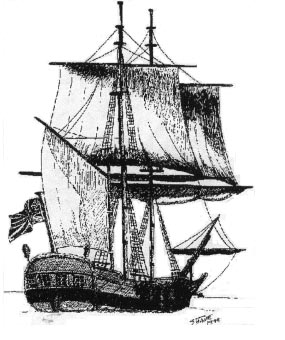
|
|
Tracing the
Vanguard Lic. Santiago
Boland 20th February 2003 Bahía Blanca, Argentina |
|
The Vanguard was a myth for me
since I was a child: the vessel my great grand parents had come from Ireland on
board. Foggy dew surrounded her as she sailed in sea of shadows, and it made
me more difficult to understand the family tragedy of exile. Not earlier than 1984 I found some
documental notice of the Vanguard and her travel to Argentina in 1849. Some
correspondence with Dr. Coghlan, a lawyer of Buenos Aires, a recognised
author of books on the subject, allowed me to access for the first time to a
document about the ship. Mr Coghlan in his book “Los Aportes de los
Irlandeses en la Argentina”, mentioned the Vanguard as the vessel arrived to
Buenos Aries on 23rd July 1849 with sixth passengers of Boland |
|
|
surname on board. Spite we saw later the data
didn’t exactly matched, the track to find out an image of the Vanguard was
definitively open.
Neither familiar tales nor Mr. Coghlan’s books were right. Not six but
only four Boland adult passengers were recorded as landing at Buenos Aires
from the Vanguard on July 23rd 1849. John Boland, my great grand
father, his brothers, Williams and Edward Boland, Elizabeth Boland and her
son, Edward’s family. The records mentioned Dublin, in Ireland, as the port
of departure. And Magaret Moran, my great grand mother, grand mom Margaret,
had not arrived on board the Vanguard on 1849, but landed on 17th
February 1850 from a brig, her name Lisboa. I’ve arrived too late to life to
start the Vanguard’s query. The elders had passed away; the whole second
generation was dead when the phantasmal ship fascinated me. However I tried
to gather the tales, the stories, the familiar legends, the clan’s myth my
father and his sisters and brothers used to refer. My eldest sister was a
helpful adviser in this preliminary effort. Some years later, we found a lost branch of the Boland and
received from a cousin of mine, professor Juan Augusto Vilgré La Madrid, a
dossier with a synthesis of his research on the family. The Vanguard
reappeared once and again in Augusto’s papers. In 1997, while preparing a
get-together to celebrate the century and a half of the arrival of grandfather
John and his brothers, one of my nieces proposed me to write a booklet on the
history of the family. I accepted the challenge and tried to trace the way
our ancestors came to Argentina. I wrote to the Foras Muiri na hEreann, the
National. Maritime Institute of Ireland, in Dublin, and Mr John Wolahan, the
Dpy. President in those years, assisted me in my task, but as the Buenos
Aires arrivals' records pointed out Dublin as the port of departure, we
misaddressed the research. Nevertheless, from this first
approach and after the opinion of Wolahan, we assumed that our Vanguard was
the only one undertaking a voyage to South America. Mr Wolahan Mr Benn, an
enthusiastic of ships, for advice. According to Mr Benn, this
Vanguard was built by M. Thompson at Sunderland and launched on October 1840.
She was surveyed Sunderland on November 1840 and, soon after, sold to Clarke
and Co and registered London where was surveyed on March 1841 for voyage to
Berbice in Guayana, the British Guiana in South America. She was classed 8
A1, a not particularly high classification. A really well built vessel- in
the authorized statement of Mr Benn, would be given 12 years A1. In 1848 she
was granted 3 year A1 extension at the end of which she dropped to AE and in
March 1855 her classification was withdrawn. By this time she was Whitby
owned. Since 1851 was in the Baltic trade, and in the United Kingdom coastal
trade, which normally meant coal from NE Coast and timber, tallow, grain,
hemp homeward. Probably hauled coal down to London in winter months when the
much of the Baltic would have been ice- bound. In spite we had not her plans her dimensions as estimated by Mr Benn comparing the dimensions of a dozen other snows built Sunderland about the same period may be believable. She would have been about 85'x23'x16', and would displace 247 tons, according to the Lloyds’ Register. The crew for Mr Benn, would probably be the master, mate, bosum, cook, steward, perhaps 6 ableseamen plus 1 or 2 ordinary seamen, under 21 years of age or boys under 19 years. Regarding the crew the Lloyd's
Register of Shipping 1852 shows that “our” Vanguard’s Master was Mr.
Bedlington, who was also her owner. This fact has just been confirmed
by Mrs Margaret Evans, Assistant Curator, Maritime Archives & Library,
Merseyside Maritime Museum, Liverpool, UK, who at my request consulted the
Lloyd's Register 1849, a piece of evidence I haven’t yet, and found the
Vanguard had Mr. Bedlington as master and owner also in 1849. The same
source, the Lloyd's Register 1848, pointed out that the Vanguard, registered
at London, belonged to Clark & Co, and under her master, Mr Longrdge made
the passage London – Bahia. There are not documents about the former masters yet. It seems so a crowded ship carrying a crew of twelve seamen plus nearly a hundred passengers, taking into account her dimensions. Spite Mr Bedlington’s interests may be assumed the Vanguard might carried only passengers to Buenos Aires and not cargo at all. The
voyage itself –estimated Mr Benn in his letter – would probably have been a
"fair weather" trip sailing off about April or early May. Food
would have been pretty basic: salt beef and salt pork on alternate days,
flour, possibly dried peas, perhaps potatoes plus some fresh vegetables at he
beginning of the passage. Rice, tea, and sugar available daily in very small
quantities. Mr Benn was right. A month ago, I've been informed about the existence of the memories of Mr Robbins. Mr. Edward Robbins and family, his wife and eleven children, were also on board of the Vanguard in her travel Liverpool- Buenos Aires. The 1849's page from such memories gives crucial information on the journey, as the date of departure: 8th May 1849 that ratifies Mr. Benn’s opinions. Mr. Robbins makes uas known the port of the departure, Liverpool. There, Mr. Robbins and family boarded the Vanguard, after waiting for a month. Mr Robbins informs us about a characteristic of the journey: sickness that took two victims at sea, a man and a child. Such a clue as the existence of Mr. Mc. Donnald, who arranged the trip before hand, opens a perspective for a peculiar research. The memories has allowed some precisions on the arrival and landing. The Vanguard, states Mr Robbins, arrived Buenos Aires on July 13th 1849, but she was in quarantine until the 22nd July on which day the passenger landed. . The book of entries of passengers to Buenos Aires, however, records 23rd July as the date of landing, perhaps because the 22nd was Sunday, or more probably because, by the time, passenger lists were generally taken on board the ship prior to arrival. We have got a copy of this list, and with this document the sources in Argentina are almost exhausted. The next step, in Argentina is to trace the Vanguard passengers' descendants, what we have just begun will follow up, meanwhile our research address to British Islands. The aims of the further investigations will be: 1) to find out Vanguards description, even her plans if it were possible; or get a picture of her, at least; 2) to verify the name of her master Bedlington, and look for the roll of her crew; 3) rebuild the whole roll of passengers in the journey to Buenos Aires; there are three omissions, at least, in the list we have: the two passengers dead at sea, and Ann Mary Coffy, mentioned by Mr Robbins. And as a last question: why Vanguard? Would be chosen by hazard? Perhaps, was named after Nelson’s vessel? But that would be a new problem to be solved If your ancestor, friendly reader, have come on board the Vanguard or you know somebody whose ancestor had, make me aware of that. I’ll be grateful, and what is more important: you had to recreate the journey, the Odyssey of our ancestors. Perhaps, in their company we returned to the plain heroism, that of common man’s heroism, and we should rescue the values, those we have lost. |
|