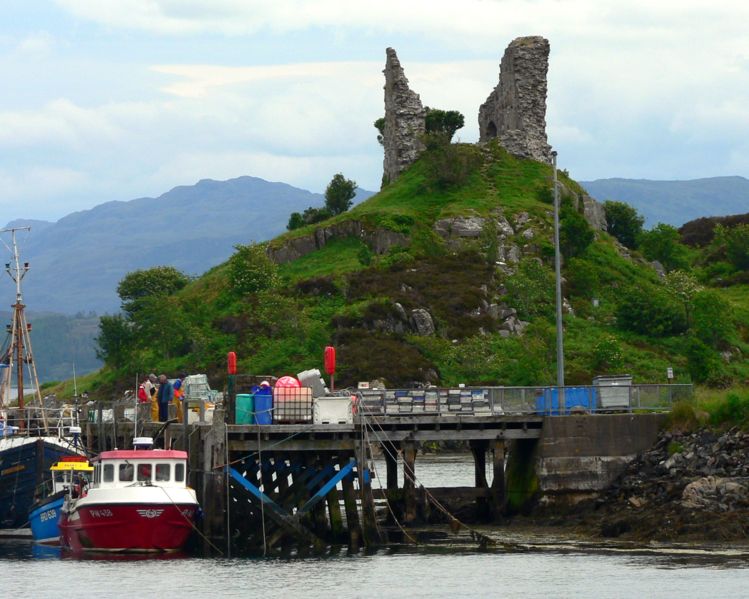
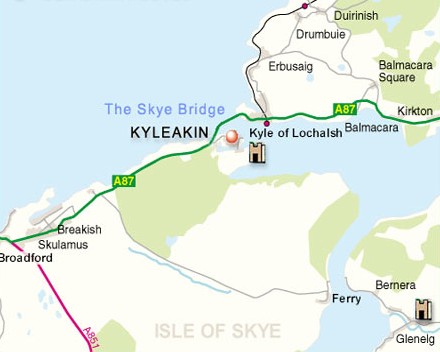
Both Dun Akin Castle and Kyle Akin take their name from King Hakon, Akin being the Scots spelling of Acain, the old Gaelic rendering of Norse name Hakon. It is from this region on the Isle of Skye that the Clan Akins takes its name. It is said that Findanus and his bride stretched a heavy chain across the narrow sound of Kyle Akin and levied a toll on all the ships that passed through the strait. Because of her bold personality, Findanus' wife was nicknamed "Saucy Mary."
The Vikings continued to occupy the Western Isles of Scotland for several centuries until they were finally driven out in the year 1263 A.D. by Alexander III, King of Scots, who defeated King Hakon IV at the battle of Largs, bringing an end to the Nordic domination of the Hebrides.
Among these early records is found mention of William Ackin, who was a witness in the parish of Brechin in the year 1476. John Eckin was a tenant under the Bishop of Aberdeen in 1511. John Ackyne served as ballie of Stirling in 1520. Robert Aykkyne was admitted to the burgess of Aberdeen in 1529. Bessie Aiken of Leith was found guilty of Witchcraft in 1597, narrowly escaping execution. David Akin of Aberdeen was an early passenger to America, settling in the colony of Rhode Island with his wife and family before 1664. A John Aiken was among those who fought under the banner of the Covenant at the Battle of Bothwell Bridge in 1679. Alexander Aiken of Bo'ness, West Lothian, was among those who took part in the ill-fated Darien expedition in 1699.
In 1609 Ireland's northern province of Ulster was opened up for colonization, as an enterprising scheme by two opportunistic businessmen from Ayrshire, Scotland, by the names of Montgomery and Hamilton. The successfully petitioned King James VI & I for the release of an imprisoned Ulster chieftain, Con O'Neill, in exchange for thousands of acres of land in northern Ireland. These were cleared of the former landlord's native Irish tenants in order to make way for settlement by Protestant colonists from Scotland. Members of the Clan Akins were among the thousands of Scots who settled in that troubled region during that period.
With the revolt against the Stuart King, Charles I, during the English civil war, much of the historical information of the Clan Akins was lost when Oliver Cromwell's ships carrying records of all the clans, as spoils of war, sank off the coast of Berwick-upon-Tweed. After Charles II was restored to the throne, he instituted a public register of all the clans between 1672 and 1676. However, the then chief of the Clan Akins having emigrated to Ulster as an exiled supported of King Charles I, and later having settled on the American colony of Maryland where he died in 1669, his son failed to establish his right to the Name and Arms of the Clan Akins and as a result the chiefship fell into a period of dormancy lasting for more than three hundred years.
In Ireland the surname is common only in Ulster where the Scottish immigrants settled in the 17th century, but there new variations in spelling began to be seen. Aikens in County Armagh, Akins in County Monaghan, Eaken in County Tyrone, Eakin in Counties Derry and Down, Eakins in County Cavan, Ekin in County Donegal, and Ekins in County Sligo. In County Antrim, where the name was most common, it was found to be most concentrated in the area northwest of Ballymena in the mid 19th century. Dr. Joseph Aiken published a poetic work in 1699 entitled "Londonderias - Or a Narrative of the Seige of Londonderry,"
The clan name, under its various spellings, continued to be prevalent in Scotland, being among the 100 most frequently encountered surnames in 19th century records, ranking 90th in order of occurance with a per capita ratio of 20 individuals per every 10.000 bearing the surname, mostly in Lanarkshire and the surrounding counties, totaling an estimated 5,592 Scots bearing the surname in one of its many forms. Variations of the name are said to be common in the parish of Ballantrae, as well as in the counties of Aberdeen, Fife, Lanark, Perth, Angus, Renfrew, Ayr, Dumbarton, Stirling, and the Lothians.
Among the many friends of Scotland's national poet, Robert Burns, was an Ayrshire gentleman by the name of Robert Aiken, who Burns mentions in a number of his works including the prelude to "The Cottar's Saturday Night," and "Holy Willie's Prayer," as well as his "Epitaph for Robert Aiken, Esq." and "The Farewell."
When the British government began to oppress the Scots colonists who had settled in northern Ireland with heavy taxes and religious persecution, many of them left, fleeing to North America as a safe haven where they might start new lives for themselves. It was in this way that many members of the Clan Akins came to America. Between 1717 and 1776 more than 250,000 Ulster Scots left northern Ireland mainly for the United States. In the year 1729 more than 6,000 arrived at the port of Philadelphia alone. 100,000 more came to the America in the two decades following the Revolutionary War.
Thus with 11 million citizens of Scottish and Ulster Scots descent, the United States can claim to have the largest portion of the28 million Scots worldwide, over twice as many as in Scotland itself, which has a total population of only five and a half million, and it is in the United States that the Clan Akins is its strongest.
According to recently gathered statistics from the Social Security Administration, the total number of individuals bearing the clan name in its three most common forms accounts for some 53, 650 persons. The spelling of Akins being the most usual, with a count of 23,586 individuals; followed by Aiken, with 17, 924 persons; and Akin, with 12.140 people bearing that form of the name.