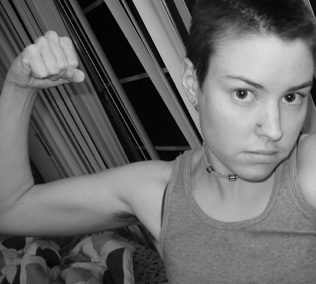
| i view identity as extremely personal and fluid. I do not claim to know anyone better than they know themselves, and therefore i respect everyone's self identity (even if i "get the vibe" and they identify as straight) I expect the same respect from others toward me and my identity. To say i am physically female and a lesbian does not sufficiently cover my identity. I don't look like most "women" and am not attracted to those who conform to feminine gender stereotypes. Words i most comfortably use to self identify are dyke, queer, androgynous, and genderneutral. Since gender is so fluid, i would never box myself in and exclude dating anyone based on gender identity, if the attracted and connection was there. Many of the terms i use to self identify are fluid in their definitions and therefore, i use this page to expound on their meaning, and more specifically, what they mean to me and how they shape and define who i am. |
| identity: |
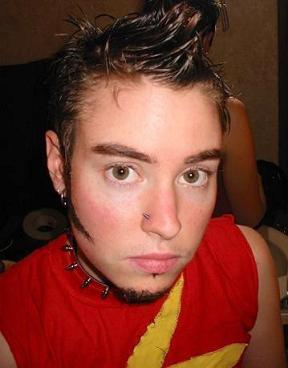
| I've always thought Drag Kings were wicked sexy, so i recently developed my own King persona: Max Voltage. Last year I organized and participated in Santa Clara University's First Annual Drag Show. I put together a boy band: N'TYSE, and was Justin Timberlake. We performed to N'SYNC's "Pop." Max Voltage and his Flaming Blue Balls performed at a local queer club in portland, and Max is starring and organizing, with his brother Eva, his own uber-show in portland. Fall quarter, SCU will host it's 2nd annual drag show. Why i do Drag: I get frustrated with society's obsession with grouping us in these two inflexible categories of man and woman, and then placing so many extreme stereotypes and roles along with both categories. If we don't follow these stereotypes, there must be something wrong with us, we're a gender deviant. Society has trained us to be frustrated by people who's gender we can't sum up immediately. I get a kick out of anyone who plays around and fucks with gender because people need to realize the fluidity, and need to be confused by their inability to categorize. It's fascinating to observe the subtlties of gender. When i'm in drag, i walk, talk, stand, dance, interact differently. So many subconsious aspects of ourselves are influenced by our gender identity, and when i dress in drag, i can play with these gender stereotypes and explore aspects of myself i didn't know existed. Read more about Max Voltage and Drag Kinging here. |

| Spoken from the lips of hateful individuals, the word dyke can take on painful conotations. However, when re-claimed, the word can be an empowering identity. This is what the word dyke means to me: I consider dyke to describe more where one is on the gender spectrum then one's sexual identity. Granted, most dykes date other dykes, and might therefore be considered lesbians, but a dyke is definately more masculine than a lesbian. on one level, dyke is a look: urban punky clothing with extremely short hair, commonly pierced and tattooed. Dykes are occasionally mistaked for boys and more closely approach the transgendered line than do lesbians. But, on another level, dyke is an attitude. Words like hard, smart, sharp, intense, confident, radical butch and extreme come to mind. A dyke is a lesbian who is totally honest about who she is and not afraid to wear her sexual identity on her sleave. A dyke is never in the closet. Recently i've moved away from the dyke identity because it implies i date women exclusively, which is not the case at at all. |
| I am fascinated by the conflict of Queer Studies vs Identity Politics. The two are so completely at odds with each other, how can we possibly find a compromise? Queer Theory seeks to destroy the very identity with which Identity Politics base their power. The more i read about Queer vs Gay/Lesbian, the stronger i identify with the Queer movement and the Queer identity or lack there of. I agree that the male/female, gay/straight either/or system is not only innacurate and socially constructed, but oppressive as well. But, can Queer theory make any gains in the reality of society, or is it too thoroughly idealistic? Is it human nature to attempt to fit humans into distinct categories, and can society function without these categories? How might we get there? Queer theory seems to lack realistic, tangible short term goals, a strength of the Gay and Lesbian movement. So we're left to choose between realism and idealism, essentialist v constructionist, assimilation vs revolution. Somehow both Queer Theory and Identity Politics must co-exist to fight in their different manors against a shared evil, oppression. On a personal level, i identify as Queer simply because i do not fit into any nicely defined categories. Whenever i used terms to identify, i feel like i am compromising a part of myself, contorting myself to fit into a socially constructed box. |
| Queer |
 |
| Dyke: |
| Genderfucking & Max Voltage |
| Transgendered? |
| I suppose this too depends on your definition. Perhaps in the sense that i do not fit into an either/or gender category, some might consider me trans. I however, do not identify as Trans because i feel much more confortable with the labels genderneutral or genderfree. I do not identify as essentially masculine OR feminine. I feel gender is constructed and therefore would never change myself physically (like taking T) to fit into an either/or gender group. Though it has taken me a while to get here, through aukward teenage years struggling with the fact that i don't look like the girls on the cover of Teen Magazine, i am now completely comfortable in my body. Being born female has shaped, through good and bad, who i am, and will always be a part of myself. I can't imagine ever changing my body permanently (aside from tattoos and piercings, of course) I have extreme respect for those who have the courage and strength to face the oppression that comes with transgendered identity, and those who can endure the extreme changes when they decide to take T-shots. But that is something I could not ever do. |
 |