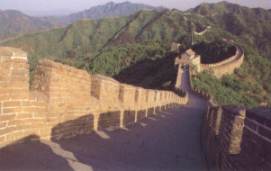
The Great Wall of China

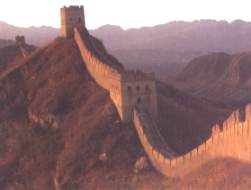
As far back as the 4th century BC large walls separated kingdoms within the
region that now makes up China. Many cities were surrounded by large walls
which acted as the primary defense against all to common invasions. Southeast
Asia was comprised of over a dozen different independent States which were
constantly at war with each other and which caused there borders to change
quite frequently. By early 3rd century BC the number of States had been
reduced and the few remaining had become quite powerful.
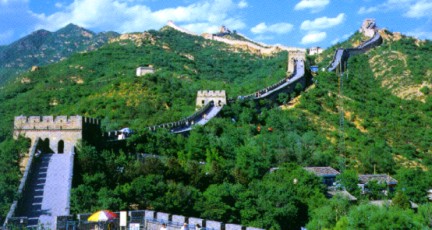
In 221 BC after conquering most of its neighboring states, Ying Zheng, the
ruler of the Qin State declared himself Qin Shihuangdi, the first Emperor of
The Qin Dynasty. The word Qin in pronounced "chin" and is the source
of the name China. Thus began the reign of the First Emperor of China, and the
beginning of the Great Wall. Qin Shihuangdi began the construction of the
Great Wall by connecting many of the existing border walls to protect the
northern border of his kingdom from invasion. The construction continued for
centuries and employed the work of millions. Every type of material available
at the time was used. From mud and reeds, to the finest mortar bricks ever
made. ( still intact centuries later ) The second major section of the Great
Wall ( the section still standing today ) was started during the Ming Dynasty.
The final section of the wall was completed around 1600.
Gallery
Back
Home
Visible from Space, The Great Wall of China is the largest man-made feature on
the planet. It is actually several different walls which were constructed
throughout a period of 1,875 years. The total length of all of the sections
measures over 2,950 kilometers. A great wall indeed. It is listed as one of
the Man-made wonders of the World.