The Deadly Art of Southern Praying Mantis
Inside Kung-Fu, June 1992
Jeff Larson
T
he moment had come as a silenced crowd peered anxiously toward the man at center stage. This was the
Masters Demonstration at the U.S. National Chinese Martial Arts
Championships in Houston, and the man everyone was stretching
to see was sifu Henry "Poo" Yee, fifth-generation practitioner
of southern praying mantis kung-fu. He is a direct disciple of
fourth-generation master Lum Sang See and "the keeper of
the flame." In the 300-plus year history of the system, no
international audience had ever witnessed so open a display of
this highly secret and most deadly art. So guarded was this kung-fu
style that this is the first full generation which has allowed
non-Asian students. Master Lum Sang See brought the system to
the United States in 1941. Of all the "enter the gate"
disciples who trained under master Lum Sang in New York Chinatown's
Hip Sing Tong, none has done more to carry on, develop and promote
the system than Henry "Poo" Yee.
The Beginning
Sifu Henry "Poo" Yee began his kung-fu training at the
age of six in China. With family in New York and relatives in
China, sifu Yee spent portions of his early youth traveling between
both Continents. After taking permanent residence in New York
Chinatown, a young "Poo" Yee began to study southern
praying mantis under the guidance of master Lum Sang See. "Poo"
Yee's dedication to the system became apparent early on as he
arrived day after day without fail and spent endless hours training
in this high art. Impressed by Yee's dedication, master Lum Sang
choose him to be one of his "enter the gate" disciples.
As is tradition, enter the gate disciples undergo training more
difficult and infinitely more advanced than those students who
train in the school's general classes. Master Lum Sang's disciples
often trained full-contact in a room whose windows had been taped
to keep any light from getting in. They trained without the use
of pads, full-contact, in the dark.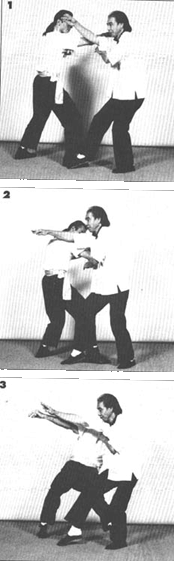
To these young men, this room was not something they worried about
or feared -- it was an honor. They were, after all, training in
the art of southern praying mantis, known to many of kung-fu's
higher order as the kung-fu of kung-fu. Sifu Yee's daily instruction
under master Lum Sang would last for a period of ten years, from
the time Yee began in 1955 until master Lum Sang closed his hands
(retired from teaching) and moved to Taiwan in 1965. The relationship
between these two men, both as teacher and student and as friends,
never wavered. Sifu Yee and master Lum Sang remained in close
contact through the years, but rarely met face-to-face until one
day in 1980 when a head-on car accident would change "Poo"
Yee's life forever.
Tragic Accident
Sifu Yee was hospitalized for nearly two months and the diagnosis
was not good. Yee's right hand was locked in a half-closed position
and weeks of therapy yielded no result; he was told it would likely
never improve. Worse news, however, was yet to come. Doctors had
determined that the condition of his left leg (which required
him to use a cane to walk) would not improve and amputation below
the left knee was suggested. Henry "Poo" Yee began soul
searching as the doctors awaited his approval to amputate. The
decision "Poo" Yee made not only changed his own life,
but also affected the history of southern praying mantis kung-fu.
Determined not to accept such a fate, Henry "Poo" Yee
decided to go to Taiwan to see his teacher in the hopes that the
medicine this true master possessed would help him regain the
use of his body. As history dictates, those hopes were realized.
Master Lum Sang's medicine, along with a series of exercises,
allowed sifu Yee to quickly regain the complete use of his hand.
Master Lum Sang then assigned "Poo" Yee to a close friend
to assist in rehabilitating his leg. After many months of daily
work his leg was back to normal. Where Western medicine had failed,
Eastern medicine "at the hand of master Lum Sang See,"
had given him back his body and his life.
Dedicating His Life
As a matter of honor and to show respect, sifu Henry "Poo"
Yee began to show the world the "true kung-fu" of master
Lum Sang See. He trained students in Paris, Hong Kong, England
and Germany. During his time with master Lum Sang following his
accident, sifu Yee received a lifetime gift from his master as
Lum Sang trained him in the complete techniques of his secret
"jook lum temple," "tin sing chi kung" and
the high technique form of "siem kuen". Sifu Yee also
received the encouragement and blessing of Lum Sang to teach and
promote the "true art" of southern praying mantis.
Master Lum Sang also gave sifu Yee his recipe for dit da jow and
instructed him in the healing arts. After teaching and promoting
the art of master Lum Sang See throughout the world, sifu Yee
settled for some years in Fort Pierce, FL. He also trained the
Fort Pierce Police Department. Sifu Yee then moved to Atlanta,
Ga., to continue promoting Lum Sang's art. In Atlanta, sifu Yee
quickly built a dedicated following. As in any martial arts school,
there were those who began and quit within weeks or months, but
those who stayed and trained diligently received instruction and
insight into a truly incredible system of kung-fu from a most
qualified instructor. In late October, 1991 sifu Yee gave his
last annual seminar and test prior to leaving for Houston, Texas,
where he has opened a new school.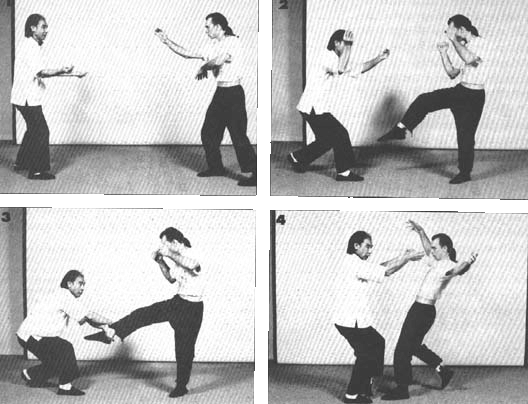
Lum Sang See
Master Lum Sang See is kung-fu. Lum Sang began training in kung-fu
at a very young age and soon received acclaim as a most effective
fighter. In the China of the early 1900s that was no small feat,
since your level of kung-fu often determined life or death. At
around 13 years of age, Lum Sang began training in the southern
praying mantis system of kung-fu from then master Chung Yel Jung.
"In the southern praying mantis system, circles are everything and everywhere."
(Lum Sang had already trained for many years in other systems
by this time.) Lum Sang trained diligently for a number of years
under master Chung Yel Jung until grandmaster Lee Sum See arrived
at Chung Yel Jung's door. Grandmaster Lee Sum See informed (his
student) Chung Yel Jung that he was enroute to build a temple
and asked that Lum Sang accompany him. A boy of 15 or 16 years
of age would prove to be great help in building a temple and also
supply him with a traveling companion, Lee Sum See suggested.
Chung Yel Jung respectfully complied to his master's request and
Lum Sang found himself enroute to build a temple with the grandmaster
of the southern praying mantis system.
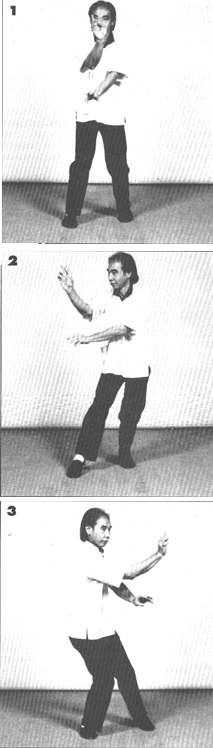 Golden Opportunity
For Lum Sang, training directly under the grandmaster would prove
to be a golden opportunity. The time Lum Sang spent with Lee Sum
See (the "Old Monk" as Lum Sang called him) both building
the temple and training would run six years. During this period
Lum Sang would achieve an extremely high level of kung-fu, including
training in the southern praying mantis chi kungs (of which there
are many whose purposes vary).
But the training and friendship between these truly remarkable
kung-fu men would come to an abrupt halt during the Japanese invasion
of Hong Kong, when upon his teacher's insistence, he found himself
enroute to England. While in Liverpool, England, Lum Sang trained
the (hakka) dock workers in his most treasured art. Lum Sang's
next stop would be New York's Chinatown in 1941. After a brief
but convincing display of his talents, Lum Sang was given high
position in the Hip Sing Tong, where he would teach until his
departure for Taiwan in 1965. Since that time Lum Sang has traveled
extensively, returning often to the United States. But since he
has "closed his hands," his whereabouts have been kept
secret.
The Beginning
The history of kwong sai jook lum gee tong long pai, also known
as mui fa tong long, is extremely well-documented, with the masters
and sifu within the system careful to ensure that this information
remains intact. Mention the name of any accomplished practitioner
to sifu Yee and within seconds he'll have told you where he lived,
his teacher, how long he studied, whom he trained (if anyone),
and when he died.
The system was founded 300 years ago by a monk named "Sam
Dart." Lee Sum See inherited the mastership from "Sam
Dart," making him the second-generation master. Chung Yel
Jung became the third-generation master, followed by Lum Sang
See, fourth-generation master. Lum Sang See remains alive and
well and although he no longer teaches openly, he does (as is
traditional) work with his enter the gate disciples from time
to time.
Tin Sing Chi Kung
Tin Sing chi kung is the heart of the southern praying mantis
system. This chi kung provides the practitioner with knowledge
of the three gates -- center, left and right, as well as the high,
middle and low. It also provides knowledge of how to move from
heel to toe and from instep to the blade of the foot. Internal
training begins and is developed here as you learn about the tan
tien, the development of chi and the movement of chi throughout
the body. Patience in chi kung training is not merely helpful,
it is absolutely necessary.
Bow-fat (The foundation)
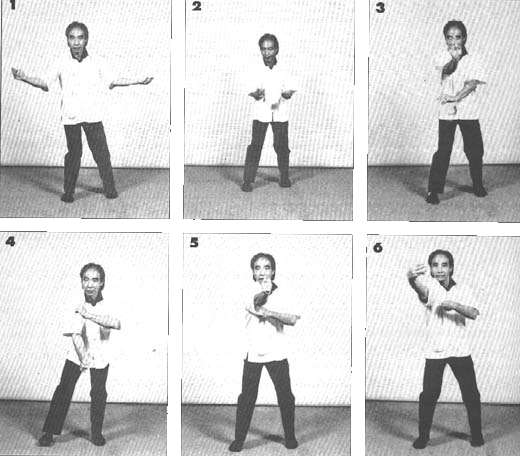
The horse stance of southern praying mantis kung-fu, or tong long
pai, is called bot ding bot bot. This means that a "T"
is not a "T" and a "V" is not a "V,"
common terms when describing horse-stance positions. The foot
position of bot ding bot bot has the front or lead foot one-half
step in front of the rear foot. Both feet are turned in, but the
angle is greater in the lead foot. When walking the horse (boom
bow ma), the right knee raises waist high and crosses the body's
centerline, while the right foot circles in front of the body.
As the right foot is placed down it is now one full step in front
of the rear foot. The rear foot then slides one-half step forward,
bringing you back to a one-half step foot position or "bat
ding bat bat".
Kuen-fat (Hand techniques)
The hand techniques of southern praying mantis are called kuen-fat.
Please note that although these are called hand techniques the
entire body, from the heel to the fingertip, is being utilized.
They are called hand techniques because that is where contact
is taking place. Yum yan yel gong (discussed later) contains all
hand techniques used within the system's kuen-fat. As tin sing
chi kung and yel sun yen train the student in internal power,
the movements found within yum yan yel gong train the student
in external power. Within the framework of the yum yan yel gong
lies two distinctive parts -- yel sao (soft) and gon sao (hard).
Each part contains a number of distinctive movements, including:
•Yel sao (Soft hand techniques)
-- Tun sao, fun sao, sog sao, mor sao (fforward and backward),
bow sao and chum no/jaw jook/sog sao.
•Gon sao (Hard or power techniques) -- Jet choi, yel choi,
dan choi, ka choi, shung jung ha, laun choi and gao choi.
Yum yan yel gon
Yum yan yel gong means the internal and external of soft and hard.
Most martial artists are familiar with the term yin/yang, which
is a Mandarin term. Since this is a southern style, we use the
Cantonese term yum/yan. The yun yan yel gon contains both hard
and soft techniques. Although external power is trained here,
it does not necessarily imply the absence of chi kung or internal
power. In fact what the southern praying mantis practitioner is
working to achieve is a connection between internal and external
so that when external power is used it is also "filled"
with internal power.
Yel sun yen
The yel sun yen is a soft moving excercise which trains the student
to connect the bom bow man (walking horse) with the kuen-fat (hand
techniques). It is an extension of the tin sing chi kung and also
develops an understanding of the centerline, while training the
student to block (hook or grab) and counter (strike) in both the
right and left gates.
 Forms and Levels
Tong long pai does not use belts merely as a system of rank. It
does, however, use colored sashes. A green sash, designating yellow
wood, is used by new students. A yellow sash, signifying development
or refinement, is worn by more advanced students. The color of
sashes, however, plays a very small role, since it is understood
that the real reason for wearing a sash is to manipulate "blood
flow" within the body. The sash is "relaxed" when
training soft techniques, such as chi kung. The sash is tightened
when doing power or hard techniques. This serves a two-fold purpose:
it gives support to the base of the spine and small of the back,
preventing back injury and it concentrates the blood flow between
the two halves (yum/yan) of the body.
In the southern praying mantis system there are three main forms. Leading up to the first form, and between the second and third forms, there is a vast amount of technique which must be trained and well-understood if you wish to correctly do the form.
•Som bow foon nan choi is the first form of tong long pai. Leading up to som bow foon nan choi is the training of tin sing chi kung, bow-fat, yel sun yen (soft) and gon sun yen (hard). At this stage the student also begins to learn the chin som/how som of tong long pai. Chin som trains the beginning 1-2-3 body postures/soft positions. How som trains the back-up of the hard power training (the striking techniques of the system's phoenix eye fist).
•Som bow gin is the second form of tong long pai and is known
to many in its translated form as three-step arrow. The yun yang
gel gon contains both the "seeds" of the system and
the technique needed to achieve an accomplished level in som bow
gin. This form also is called the second traditional long form
of kuen-fat. Simply put, there is a lifetime of kung-fu within
this form if yo wish to achieve a highly developed level. If you
understand its practicing philosophies it could prove to be a
most powerful and deadly system of kung-fu.
•Siem kuen is the third form and offers an advanced level
of training. Also called the mui fa system, this training places
its concentration on the tong long claw (finger) system where
claw can develop the feet and elbows as well as the palm strikes.
The philosophy of this training is to mix and combine the systems yum yan yel gon with control of its short powers. The "seeds" of the technique used to achieve the mui fa system include: mui fa sao fat; gao gin sao; bow sao; kem sao; and yam yam mor sao. The techniques include dai sao, yun sao, biu sao, and huh sao.
Training in this highly effective technique requires the system's
chi kung power and body control. It also requires the system's
iron claw training. In training the siem kuen or mui fa system,
great personal discipline is required.
Inch power
Of all of the weapons within the vast arsenal of southern praying
mantis, there is probably none more feared than its deadly inch
power. Just when you think you've blocked, trapped, or contained
him, the trained practitioner explodes with exacting inch power
(almost always into nerves or a vital area). Within a fraction
of a second the game has drastically changed. Tin sing chi kung
plays a large role in inch power training, especially when using
finger strikes. Many elements must come together to deliver successful
high-technique finger strikes. First the body must be positioned
correctly to create and contain chi. Second, the strike must be
delivered at the precise second the hand "fills" with
chi.
 A System of Circles
Whole circles, half-circles, quarter circles, circling in and
circling out, circling high and circling low. In the southern
praying mantis system circles are everything and everywhere. Circles
are used to walk the horse, position the body, generate power,
'block,' strike, perform the chi kung, and move from gate to gate.
Working alongside the system of circles is the yat yee som (1-2-3).
As higher levels are achieved, the numbers increase, much based
on the number three. The foundation, however, rests in the chin
som, or the first three soft positions, and the how som, the second
or power positions.
Conclusion
It is important to understand that despite the vast information
contained in this article, it still constitutes the tip of the
proverbial iceberg. Southern praying mantis kung-fu is the horse
stance, chi kung, circles and inch power, body position and hand
techniques. However, if each step is not learned, trained and
performed correctly, it ceases to be tong long pai. In the end,
qualified instruction, proper attitude and diligent training are
always your best allies.
About the Author: Jeff Larson is
an "enter the gate" student of sifu Henry "Poo"
Yee.
home