













Cavalier:
A Natural Healer
What does it take to be an Animal Assisted Therapy Pet Partner? The two key elements are: 1) A dog that has the temperament
of warmth, love and companionship to humans The requirements are: 1) Passing the Canine Good Citizen Test and the
Temperament Test. [Testing is done by a certified evaluator.] To learn the specifics of becoming a Pet Partner team here is Duke's Story... |
||
| Hi There! I am an
ANIMAL ASSISTED THERAPY DOG. I live and work with my owner and handler Lois Abrams. We help make people of all ages feel better. We visit homes for abused kids, shelters for adults, youth and children, Ronald MacDonald House, nursing homes, assisted living homes for seniors and rehabilitation hospitals. Pet Partners such as dogs, cats, rabbits, and hamsters belong to Delta Society and work with their human pet partners. We are members of Create-A-Smile in Orange County, CA. I have been working with Lois; I call her "Mom", since I turned one year of age. I love seeing all those people we visit, smile and laugh playing with me and my animal friends and their human partners. |
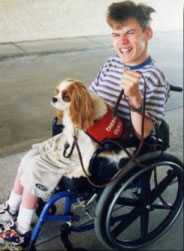 |
|
| I thought you might
like to know how I became a pet partner. Lois began training me when
I was just a puppy. Some of my friends that I work with were trained
as adult animals. Mom helped me by taking me with her to places that
were inside and outside like offices, stores and shopping malls. I
learned not to be afraid of loud noises, wheelchairs, crutches and
walkers, and all types of human beings from babies to old people and
even teenagers—those skateboards and roller-blades can really
startle you. I learned to greet people and let them pet me and even
look at my teeth. One of the hard parts was having food put in front
of me and I couldn't eat it---even my favorite snack hot dog---until
Lois said it was all right. We went to "dog school" for
obedience training when I was so little I thought the other dogs would
eat me. I got used to being with big dogs, little, noisy dogs, and
middle size dogs. I learned to play with them and not be afraid or
aggressive. I stayed in obedience training until I was ready to pass
my CANINE GOOD CITIZEN TEST. We "working dogs" must pass
this test 100%. I heel when I walk and come when I am called. I learned
to sit and go down when I am told. I stay in a down or sit until I
am called. This really helps when I am with my pet partner buddies
and pictures are being taken of us with one of the people we visit.
I will stay with a stranger when told to do so and let them pet me
and touch me---even if they are rough or awkward with their touch.
The second part of my testing was for my "Skills" as a therapy dog. All those things Lois desensitized me to as a puppy. I only had to pass this test 80% and I made it! We get re-evaluated every two years and have to make a visit at least once a month. I really love being a therapy dog and creating all those smiles. |
||
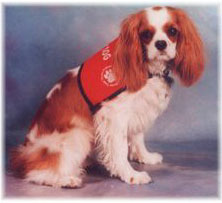 |
Sheeba Anakin, "Duke" began his work as an Animal Assisted Therapy Dog when he was a year old. Duke and owner-trainer Lois Abrams, Ph.D. were certified by Therapy Dogs International and The Delta Society. They are active members of Delta Society's Create-A-Smile, Orange County, CA. (www.deltasociety.org) | |
| Duke and I were recently trained by HOPE Animal Assisted Crisis Response and are now certified at the National Level to respond to disasters, crisis and traumas. This was a 40 hour training January 10-13, 2002 in Portland OR. Cindy Ehlers President and Executive Director of Hope Crisis AACR conducted the workshop along with Joshia Whitaker. Duke and I were only one of two teams out of 21 that began the course to be certified at the National Level. I must say that Duke was very calm and remained focused on his "job" of comforting others during our intense and challenging training. Our training included flying in the plane cabin lying on the bulkhead seat floor. Going twice through security checks at the airport, experiencing an ambulance center with sirens blaring while Duke make himself very comfortable on the pillow of the gurney. We went to the Portland Fire Department | 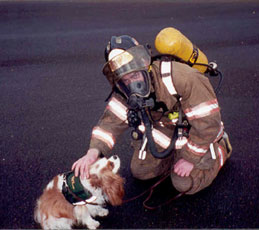 |
|
Training Center where the big hose was sprayed -- of course Duke thought it was water fun time. They built a fire and again had the firefighters dressed in full fire fighting uniform gas mask running. Our training was also held at a gang center police sub station. We rode on the MAX a light rail system, and did simulated role play disaster situations. The training was featured on KOIN 6 PM News on January 13th. Duke and I were on the news clip [I believe it is because the Cavalier is so photogenic as there were 18 K-9 Teams to chose from.] I am aware that there was at least one Cavalier Pet Partner team that responded to 9-11 at the Family Center. On September 11, 2001 only four K-9 teams in the country were trained for work as crisis response and all four were through Hope AACR. After January 14, 2002 there were 14 teams trained and only 6 K-9 teams certified at the National Level. Duke and I are one of the 6 K-9 teams. I know that Cavaliers make outstanding therapy dogs and now I know that the Cavalier with its willing human partner may also be of service to our country doing work in crisis response. Published with the permission of Dr. Lois Abrams Ph.D. *Source: Cavalier
King Charles Spaniel Club (USA) with written permission. |
||
|
ARTICLES 
|
 |
No material may be reproduced in any manner whatsoever without written permission from the CKCSsg.